Friday’s October 9, 2026 Conference Is The Court’s First Regular Friday Conference Of The Term
Thirteen firearms petitions have been reported for that conference: eight challenges to the federal felon-in-possession ban, 18 U.S.C. § 922(g)(1), three challenges to the unlawful-user ban, § 922(g)(3), and two other Second Amendment questions.
Orders from this conference are set for Tuesday, October 13 at 9:30 a.m. ET. Monday, October 12, is a Court holiday.
§ 922(g)(1) — Lifetime Felon Disarmament (8)
• Jefferson v. United States, No. 26-5617 (4th Cir.). Whether the lifetime ban is unconstitutional on its face or as applied.
• Tardieff v. United States, No. 26-5565 (5th Cir.). Whether a permanent ban on all felons is facially unconstitutional under Bruen.
• Higgins v. United States, No. 26-5487 (8th Cir.). Whether § 922(g)(1) allows as-applied challenges, and if not, whether it is facially overbroad.
• Cook v. United States, No. 26-5474 (4th Cir.). Facial and as-applied challenge to the lifetime ban.
• Johnson v. United States, No. 26-270 (10th Cir.). Whether someone whose only felony is nonviolent may bring an as-applied challenge.
• Mabrey v. United States, No. 26-5445 (4th Cir.). Facial and as-applied challenge to the lifetime ban.
• Jones v. United States, No. 26-5452 (9th Cir.). Whether the Ninth Circuit’s refusal to hear as-applied challenges conflicts with the Court’s precedent.
• Nuño-Lopez v. United States, No. 26-5520 (10th Cir.). Facial and as-applied challenge to § 922(g)(1).
§ 922(g)(3) — Unlawful Users Of Controlled Substances (3)
These follow United States v. Hemani (June 2026), which held that the ban could not be applied to a habitual marijuana user.
• Zapata v. United States, No. 26-5488 (8th Cir.). Facial Second Amendment challenge.
• Torgerson v. United States, No. 26-5473 (8th Cir.). Same facial question.
• Ledvina v. United States, No. 26-5025 (8th Cir.). As-applied challenge, plus vagueness of “unlawful user” and a related false-statement conviction under § 924(a)(1)(A).
Other Second Amendment Questions (2)
• Quadell-Lee Gaines v. United States, No. 26-303 (8th Cir.). Whether Bruen’s “relevantly similar” test requires a federal historical tradition to justify a federal ban, rather than colonial or state practice.
• Williams v. Illinois, No. 26-5616 (Ill. App.). Whether Bruen’s historical test applies to criminal penalties tied to a shall-issue concealed-carry licensing regime.
Another Possible Case
A fourteenth case, Novotny v. Moore, No. 25-1324, FPC’s challenge to Maryland’s public-carry location bans, was distributed for October 9. FPC reported on October 6 that the conference was being rescheduled again, so it may not actually be discussed Friday.
What’s Not On Friday’s List
The magazine cases held over from the September 28 long conference (Duncan v. Bonta, Gator’s Custom Guns v. Washington, and NAGR v. Lamont), and Beckwith v. Frey, the Maine 72-hour waiting-period petition, which is listed for the October 16 conference. Monday’s order list already denied cert in 48 firearms cases from the long conference, including United States v. Hembree on the felon ban, and left nine petitions pending without redistributing them for October 9.
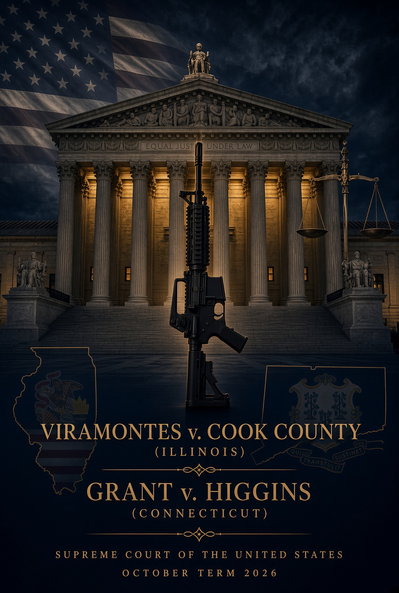
The AR-15 cases already granted — Viramontes v. Cook County and Grant v. Higgins — are not part of this conference. They are set for argument on December 2.
On October 5, 2026, the Supreme Court declined to hear Johnson v. Jacobson, No. 26-255, a challenge to Minnesota’s refusal to recognize certain out-of-state carry permits. The order leaves the Eighth Circuit’s ruling in place and leaves unresolved whether a law-abiding citizen must obtain a separate firearm license in every state he crosses.
The denial is not a decision on the merits. It is a decision not to decide. Four justices must vote to grant certiorari, and this petition did not get them. No justice wrote to explain the denial or to dissent from it. The questions the case presented remain open for a later vehicle, a different circuit, or a clearer factual record.
Those questions go to the practical reach of the right to bear arms in public. Jeffrey M. Johnson, Sr., a Georgia resident and long-haul truck driver, holds a Florida Concealed Weapons License and a Georgia Weapons Carry License. Minnesota does not recognize either. When he drives through the state, the law requires him to unload his handgun and secure it rather than carry it for self-defense. The Liberty Justice Center sued on his behalf, arguing that the Second Amendment does not stop at a state line. The lower courts disagreed. The Supreme Court, for now, has let that disagreement stand.
The Driver and the Statute
Johnson is not a Minnesota resident and does not seek a Minnesota permit as his preferred path. He already completed the licensing process in two states that issue permits to qualified applicants. He makes regular trips into or through Minnesota as part of his work. The dangers of long-haul trucking are part of the record in the case: he carries a handgun for self-defense and wants to keep doing so lawfully when his route enters Minnesota.
Minnesota Statute section 624.714 generally requires a permit to carry a pistol in public, including in a vehicle. The requirement applies to residents and nonresidents. County sheriffs issue permits to applicants who meet the statutory criteria. The state also maintains a reciprocity list under section 624.714, subdivision 16(a). Holders of permits from recognized states may carry in Minnesota as if they held a Minnesota permit. Georgia and Florida are not on that list. According to counsel for Johnson, Minnesota declines to recognize permits from fifteen other states.
The practical result is a patchwork. A permit that is good enough for Florida or Georgia is not good enough, in Minnesota’s judgment, to let the same person carry while passing through. A driver who has already been screened, trained, and licensed must either go without the means of self-defense, lock the firearm away, or stop and complete Minnesota’s own process, including any in-person and fee requirements that process imposes on a nonresident.
David A. McCoy II was a co-plaintiff in the district court. The appeal that reached the Eighth Circuit, and the petition that reached the Supreme Court, were prosecuted in Johnson’s name against Bob Jacobson in his official capacity as Commissioner of the Minnesota Department of Public Safety.
How the Case Reached the Court
The Liberty Justice Center filed the lawsuit on January 7, 2025, in the United States District Court for the District of Minnesota, No. 25-cv-54. The complaint sought declaratory and injunctive relief under 42 U.S.C. section 1983. The claim was that Minnesota’s reciprocity statute violates the Second Amendment by forcing a licensed nonresident to obtain yet another license before he may bear arms in public for self-defense.
The district court dismissed the claim. Judgment was entered on September 11, 2025. Johnson appealed to the United States Court of Appeals for the Eighth Circuit, No. 25-3036. A panel of Judges Bobby E. Shepherd, Ralph R. Erickson, and L. Steven Grasz heard the case. Judge Grasz wrote the opinion, filed May 26, 2026. There was no dissent. The court affirmed.
Johnson then petitioned for a writ of certiorari. The petition was filed on August 24, 2026, and docketed on August 27 as No. 26-255. Minnesota waived its right to respond on August 31. The petition was distributed for the Court’s long conference of September 28, 2026, the conference at which the justices dispose of the large stack of petitions that accumulated over the summer. On October 5, the order list recorded a single line: petition denied.
Two sets of amici supported the petition. On September 15, the Second Amendment Foundation, the National Rifle Association, the California Rifle & Pistol Association, the Second Amendment Law Center, the Minnesota Gun Owners Caucus, and the Citizens Committee for the Right to Keep and Bear Arms filed a joint brief. On September 22, Huang Tiange and others, through counsel including Corey J. Biazzo, filed a second brief. Both asked the Court to grant review. Neither was enough to move four justices.
What the Eighth Circuit Held
The Eighth Circuit applied the framework of New York State Rifle & Pistol Association v. Bruen, 597 U.S. 1 (2022). Bruen asks first whether the Second Amendment’s plain text covers the conduct at issue. If it does, the government must justify its regulation by showing consistency with the Nation’s historical tradition of firearm regulation.
The panel accepted that publicly carrying a firearm in Minnesota is conduct covered by the text. It then separated that conduct from the statute Johnson had chosen to attack. In the court’s view, public carry is regulated by the permitting requirement in section 624.714, subdivision 1a, not by the reciprocity provision standing alone. Johnson, the opinion stressed, repeatedly conceded that Minnesota’s shall-issue permitting regime does not itself violate the Second Amendment. The panel expressly declined to decide whether that concession was correct. It treated the concession as binding for this case.
From that premise, the reciprocity statute looked to the court like an exemption rather than a restriction. If Minnesota may require every nonresident to obtain a Minnesota permit, then a statute that lets some nonresidents skip that process removes a hurdle for them. It does not, on this reading, add a hurdle for everyone else. Johnson’s inability to use his Florida and Georgia permits was therefore described as the absence of a convenience, not the imposition of a new burden on arms-bearing conduct. The convenience of reciprocal recognition, Judge Grasz wrote, depends on interstate comity, not the Second Amendment.
The panel leaned on an analogy to professional licensing. States, it noted, are under no general obligation to recognize another state’s license to practice a profession, because such licenses are not extraterritorial. The opinion cited Hawkins v. Moss, 503 F.2d 1171 (4th Cir. 1974), for that proposition. Johnson also raised a void-for-vagueness argument for the first time on appeal. The court treated it as waived and, in the alternative, as meritless, because the reciprocity provision imposes no penal sanction of its own.
The holding is narrow in form and broad in effect. Formally, the Eighth Circuit did not uphold a may-issue scheme, did not reject Bruen, and did not decide the constitutionality of shall-issue permitting. Practically, it approved a system in which a state may ignore a stack of valid permits and insist on its own, so long as the plaintiff has conceded that the home-state process is constitutional and so long as the court is willing to treat non-recognition as legally distinct from the carry ban that non-recognition enforces.
The Questions the Petition Asked
The petition framed two questions. First, whether Americans must obtain a firearm license from each state to exercise their Second Amendment rights across the Nation. Second, whether state reciprocity statutes that do not recognize firearm licenses issued by all other states are valid under Bruen.
The petition’s core charge was that the Eighth Circuit had confined the right to the borders of the state that issued the permit. An ordinary citizen, it argued, can prove his eligibility through one state’s licensing process and still be told by the next state to prove it again before he may exercise what Bruen called the constitutional right to bear arms in public for self-defense. No other enumerated right, the petition said, works that way.
That framing matters. Heller recognized an individual right. McDonald held that the right is fundamental and applies to the states through the Fourteenth Amendment. Bruen held that the right extends outside the home and rejected interest-balancing tests that let judges decide how much of the right is convenient to honor. A rule that the right is real in Georgia, real in Florida, and suspended in Minnesota unless a third license is obtained is in tension with the idea of a national constitutional guarantee. It is also in tension with ordinary life. Truckers, travelers, people who live near state lines, and anyone whose work crosses jurisdictions cannot treat the right as something they exercise only inside the state that printed their card.
The amici pressed the same point in practical numbers. The Second Amendment Foundation brief noted that one couple documented more than $12,800 in fees to assemble permits covering forty-six states and the District of Columbia. It also noted that licensed carriers are, as a class, overwhelmingly law-abiding: Florida has revoked only about 0.36 percent of more than 6.6 million permits issued since 1987. The argument was not that every state must adopt constitutional carry. It was that a shall-issue regime, even if a state may impose one on its own residents, does not authorize that state to ignore every other state’s determination that a person is eligible to carry.
What a Cert Denial Does and Does Not Do
A denial of certiorari affirms nothing. It does not adopt the Eighth Circuit’s reasoning. It does not create national precedent. Lower courts outside the Eighth Circuit remain free to reject the comity theory. Courts inside the Eighth Circuit remain bound by the panel’s opinion unless the circuit rehears the issue en banc or the Supreme Court later takes a related case.
Ryan Morrison of the Liberty Justice Center put the point directly after the order. A denial of certiorari is not a decision on the merits, he said, and the question at the heart of the case remains open: whether a law-abiding American forfeits his Second Amendment right to self-defense simply by crossing a state line. Johnson came forward because he cannot lawfully protect himself while driving through Minnesota. Morrison noted that he is far from alone, given the fifteen states whose permits Minnesota declines to recognize, and said the question will reach the Court in time.
That is the correct legal reading of an unexplained denial. It is also cold comfort to the person who has to plan a route this month. Inside Minnesota, and inside the Eighth Circuit, the panel’s rule is the law until something displaces it. A trucker with Florida and Georgia permits still has to unload and lock the firearm, or obtain a Minnesota permit, or risk prosecution. The denial settles the status of this judgment. It does not settle the Constitution.
Several features of the case help explain why four justices may have passed. Johnson’s concession that Minnesota’s shall-issue process is constitutional gave the Eighth Circuit a clean way to stop at Bruen step one. A future plaintiff who challenges the nonresident permitting burden itself, rather than reciprocity “standing alone,” would present a different record. Minnesota’s waiver of a response meant the Court did not have a fully adversarial briefing on the petition. The case was also set for the long conference, where the volume of petitions is highest and the rate of grants is not. None of those features makes the underlying problem small. They do make this petition a harder grant.
The Patchwork the Denial Leaves in Place
Reciprocity in the United States is an accident of state statutes, not a constitutional rule. Some states recognize every other state’s permit. Some recognize permits only from states they deem substantially similar. Some recognize almost none. A few have moved to permitless carry for eligible adults, which reduces the problem for residents and for visitors who qualify under the same rules. The traveler’s right still depends on the map.
The cost is not abstract. A nonresident permit can require an in-person appearance at a sheriff’s office, a separate training course, fingerprints, and fees, even when the applicant already holds a permit from a shall-issue state. For a long-haul driver, multiplying that process by every non-recognizing state on a national route is not a minor administrative preference. The SAF figures on multi-state fee stacks describe a right that is, in practice, rationed by time and money. Bruen warned against licensing regimes that operate as abusive denials by delay or burden. A system that demands a new license at each border raises the same concern in geographic form.
The professional-license analogy the Eighth Circuit used is the weakest part of the opinion, and it is the part a later case will have to confront. A license to practice medicine or law is a state-created privilege to engage in a regulated occupation. The Second Amendment is not a state-created privilege. It is a pre-existing right that the Constitution forbids government to infringe. States may, within historical limits, condition the manner of carrying on objective criteria. They do not, by that power, convert the right into a license whose recognition is a matter of grace between sovereigns. Comity is how states treat one another’s policy choices. It is not how the Fourteenth Amendment treats a fundamental right.
The Rest of the October 5 Order List
Johnson was not the only firearms case turned away. The Duke Center for Firearms Law counted dozens of firearms-related denials on the same order list, most of them challenges to the federal felon-in-possession ban, 18 U.S.C. section 922(g)(1), or to the unlawful-user ban in section 922(g)(3). Those denials, coming after United States v. Rahimi and United States v. Hemani, suggest the Court is not eager to reopen the federal prohibited-person statutes on the records currently arriving. Johnson sits in a different category. It is a civil challenge to a state’s treatment of out-of-state permits, not a criminal appeal by a prohibited person.
Other Second Amendment disputes remain on the docket. Duncan v. Bonta, the long-running challenge to California’s ban on magazines holding more than ten rounds, has been conferenced repeatedly without a recorded disposition, a delay that itself has become part of the story. Waiting-period cases have produced a split between circuits. Interstate-carry litigation is not exhausted by this one denial. A case that challenges the nonresident process directly, that refuses to concede the constitutionality of serial permitting, and that comes out of a circuit willing to apply Bruen’s historical test to the burden would look different from Johnson.
What the Denial Means for the Right to Travel Armed
The Constitution does not contain a firearm-reciprocity clause. It contains a right to keep and bear arms, made applicable to the states, and a right to travel. Johnson asked the Court to say that the first of those rights does not have to be repurchased at every border. The Court declined to say that, and it declined to say the opposite.
For advocates, the useful distinction is between this judgment and the next case. The Eighth Circuit’s theory, that non-recognition regulates nothing because the real regulation is the permit requirement the plaintiff conceded, is a theory other courts can reject. It treats the right as fully honored once a person may apply for a local license, no matter how many local licenses the person’s ordinary life would require. That is a thin account of a right Bruen described as belonging to ordinary, law-abiding citizens in public. It is also an account the Supreme Court has not adopted.
For Johnson, the order is simpler. His Florida permit and his Georgia permit still do not authorize him to carry in Minnesota. The injunction he sought will not issue. The statute he challenged remains in force. The Commissioner he sued remains free to keep Georgia and Florida off the reciprocity list. A denial without comment is the Court’s way of saying not this case, not this term. It is not the country’s way of saying the question has been answered.
Solicitor General D. John Sauer has formally notified Senate Judiciary Chairman Chuck Grassley that the Department of Justice will not appeal the Northern District of Texas ruling in Silencer Shop Foundation v. ATF. The September 24, 2026 letter, filed in court on October 1, closes the government’s ordinary path to reverse a judgment that stripped National Firearms Act registration and advance-approval requirements from suppressors, short-barreled rifles, short-barreled shotguns, and certain other weapons for the parties the court protected.
The notice does not repeal the NFA. It does not create a nationwide injunction. It does lock in, for this administration, a permanent order that the registration scheme cannot be enforced against covered plaintiffs, their members, and their customers once Congress reduced the making and transfer taxes on those items to zero. For a statute that has governed suppressors and short barrels since 1934, that is the largest practical change in ninety years.
The Letter and the Duty to Tell Congress
Sauer’s letter is dated September 24, 2026, and is addressed to Chairman Charles Grassley of the Senate Committee on the Judiciary. It opens with the sentence the statute requires: consistent with 28 U.S.C. § 530D, the Solicitor General writes to advise that the Department of Justice has determined not to file an appeal in Silencer Shop Foundation v. ATF, No. 6:25-cv-00056 (N.D. Tex.).
Section 530D is not optional courtesy. When the Justice Department decides not to defend or appeal a ruling that a federal statute is unconstitutional, the Attorney General, through the Solicitor General, must notify Congress. The letter encloses the district court’s decision and summarizes why the department is standing down. It was docketed on October 1, 2026, the same day Gun Owners of America and the NRA circulated it. President Trump had already directed the department not to appeal, according to reporting in mid-September. Sauer’s notice is the formal commitment.
The letter is careful about scope. It states that Judge James Wesley Hendrix entered summary judgment for the plaintiffs, held that specified NFA provisions are unconstitutional as applied to short-barreled shotguns, short-barreled rifles, silencers, and “any other weapons,” and issued a permanent injunction against enforcement of those provisions as to “the plaintiffs and, where applicable, the plaintiffs’ agencies, political subdivisions, members, and customers.” It also records what the court did not do. The injunction does not reach machine guns or destructive devices, where the transfer and making taxes still apply, and it does not reach the special occupational tax on NFA importers, manufacturers, and dealers.
How the Case Reached This Point
The National Firearms Act of 1934 imposed a $200 tax on the making or transfer of certain firearms, paired with registration, fingerprinting, photographs, and advance approval by what is now the Bureau of Alcohol, Tobacco, Firearms and Explosives. The Supreme Court upheld that structure in Sonzinsky v. United States in 1937 as an exercise of the taxing power, not as a freestanding gun regulation. For decades the tax and the registry traveled together. The $200 figure never kept pace with inflation in a way that restored its original bite, but the paperwork, the wait, and the federal registry remained.
In 2025, Congress changed the premise. Section 70436 of the One Big Beautiful Bill Act, Public Law 119-21, eliminated the making and transfer taxes on suppressors, short-barreled rifles, short-barreled shotguns, and AOWs, effective January 1, 2026. The registration and approval machinery stayed on the books. Senators Cynthia Lummis and Mike Crapo had pressed for the tax repeal. Gun-rights groups immediately argued that a tax statute with no tax left to collect could not keep its regulatory appendages.
Silencer Shop Foundation filed in the Northern District of Texas in October 2025. A related case, Jensen v. ATF, was consolidated with it. The plaintiffs included individuals, Silencer Shop Foundation, Gun Owners of America and the Gun Owners Foundation, the Firearms Regulatory Accountability Coalition, manufacturers and dealers such as Palmetto State Armory, SilencerCo Weapons Research, and B&T USA, the Texas State Rifle Association, the Citizens Committee for the Right to Keep and Bear Arms, the FPC Action Foundation, and fifteen states: Alaska, Georgia, Idaho, Indiana, Kansas, Louisiana, Montana, North Dakota, Oklahoma, South Carolina, South Dakota, Texas, Utah, West Virginia, and Wyoming.
On August 5, 2026, Judge Hendrix granted summary judgment on the enumerated-powers claims and entered a permanent injunction. He stayed the judgment for seven days so the government could seek appellate relief. That stay expired, and the injunction took effect on August 13. Covered suppressor transfers on a standard Form 4473, without a Form 4, began the same day. The United States had until about October 5, 2026, to notice an appeal. It will not.
What Judge Hendrix Actually Held
The opinion is an enumerated-powers decision, not a Second Amendment decision. The court did not need to reach the Bruen claim because the taxing-power and commerce-power arguments were enough.
Hendrix held that the challenged provisions — including 26 U.S.C. §§ 5812, 5822, 5841, and related rules in 27 C.F.R. part 479 — were enacted as aids to a tax. Once Congress set the making and transfer taxes to zero, those provisions no longer produced revenue and no longer functioned as a tax. They therefore could not be sustained under Article I, Section 8, Clause 1. The government then tried to rescue them under the Commerce Clause. The court rejected that move. Congress had never invoked the commerce power for this scheme, and the registration rules were not a regulation of interstate commerce in the sense Article I requires. The opinion’s blunt line, quoted in the Solicitor General’s summary of the judgment, is that Congress’s choice to eliminate the taxes matters, and the defendants cannot save the regulatory scheme by pointing to a power Congress never invoked.
The injunction bars enforcement of the registration, application, and related possession provisions against the protected parties. It does not wipe the NFA off the statute books. It does not excuse the Gun Control Act. A covered buyer still completes Form 4473 and still clears the National Instant Criminal Background Check System. What disappears, for those buyers, is the NFA application, the fingerprint cards, the photograph package, the advance ATF approval, the entry in the NFA registry, and the wait that those steps imposed.
Who the Injunction Covers, and Who It Does Not
This is the point Sauer’s letter is explicit about, and the point most commentary flattens. The injunction is party-specific. It is not a nationwide vacatur of the NFA.
Protected persons include the named individual plaintiffs; current and future members of the associational plaintiffs, including Gun Owners of America, the Gun Owners Foundation, FRAC, the Texas State Rifle Association, the Citizens Committee for the Right to Keep and Bear Arms, the FPC Action Foundation, and Hot Shots Custom on the Jensen side; and current and future customers of the commercial plaintiffs, including Silencer Shop, Palmetto State Armory, SilencerCo Weapons Research, and B&T USA. The order also reaches the plaintiff states and, where applicable, their agencies and political subdivisions. Judge Hendrix wrote that coverage extends to current and future members and customers, so joining a covered organization or buying through a covered dealer is not limited to people who were members on August 5.
The items covered are suppressors, short-barreled rifles, and short-barreled shotguns. Any-other-weapon relief attaches to the Silencer Shop Foundation side of the case, not the Jensen side. Machine guns and destructive devices remain fully under the NFA, because Congress did not zero the tax on those categories. The special occupational tax and the dealer licensing structure for NFA businesses are outside the injunction.
For everyone else, the NFA registration scheme remains enforceable. A buyer who is not a member of a covered group, not a customer of a covered seller, and not otherwise tied to a plaintiff still faces Form 1 or Form 4 processing, even though the tax itself is already zero. That split is the live question ATF has not answered in writing.
What the Decision Not to Appeal Means in Practice
Declining to appeal does three things at once.
First, it makes the injunction permanent for this administration. A later administration could try to relitigate related questions, or Congress could amend the statute, but the United States will not ask the Fifth Circuit to reverse Hendrix’s judgment. The appeal window closes without a government notice of appeal. Groups that called the outcome permanent are describing that procedural fact, not a constitutional amendment.
Second, it confirms the direction President Trump gave the department after the August ruling. CBS News reported in September that the President had ordered the Justice Department not to contest the decision and had told Republican members of Congress he would keep the department from appealing. Senator Lummis publicly credited that choice, and the tax repeal she and Senator Crapo secured, as the reason the case could be won. Sauer’s letter is the institutional record of the same decision.
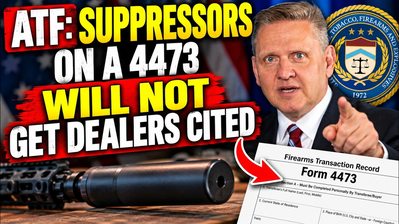
Third, it shifts the fight from the courthouse to implementation. ATF Director Robert Cekada has said, in substance, that the bureau is not enforcing the registration rules against covered parties. Dealers have received verbal guidance that 4473 suppressor transfers for covered buyers are not being cited. Written guidance was still pending in the first days of October 2026. On October 1 the department asked Judge Hendrix for more time to respond to plaintiff states seeking clarification of how the injunction applies inside their borders. The court extended that deadline to October 12, with the department citing the no-appeal decision and forthcoming ATF instructions.
For a covered buyer of a suppressor, the working path since mid-August has been a standard 4473 and a NICS check, without a Form 4 and without an NFA registry entry. Short-barreled rifles and shotguns are messier. Separate Gun Control Act language still speaks of Attorney General authorization for certain short-barreled transfers, and dealers have been cautious about treating a pure 4473 as enough until ATF says so in writing. Interstate transport raises a related problem under 26 U.S.C. § 5861, which penalizes transporting an unregistered NFA firearm. A suppressor or short barrel acquired under the injunction is unregistered by design. Covered owners should confirm coverage in writing with the organization or dealer they rely on, and should get specific advice before carrying the item across state lines.
The Limits That Remain
Several limits are easy to miss in the victory statements.
State law is untouched. A state that bans suppressors, restricts short-barreled rifles, or imposes its own registration still applies that law to its residents and to conduct inside its borders. The injunction restrains federal defendants. It does not bind state police or state prosecutors.
The Gun Control Act still applies in full. Prohibited persons remain prohibited. Dealers remain licensed. Background checks remain mandatory for commercial transfers. Nothing in Hendrix’s order, or in Sauer’s letter, creates an unregulated market.
The injunction does not bind non-parties in the way a universal remedy would. A future Justice Department that wanted to enforce the NFA against uncovered buyers would not be in contempt of this order. That is why industry groups and members of Congress have pressed ATF to apply the ruling more broadly by guidance or rulemaking, and why some dealers have warned customers that a 4473-only transfer can complicate warranties, travel, and resale if coverage is later disputed.
Machine guns, destructive devices, and the NFA special occupational tax sit outside the judgment. Anyone describing this as the end of the National Firearms Act is describing a political goal, not the order that was entered.
Why the Taxing-Power Theory Mattered
The case turned on a feature of the NFA that gun-control advocates have spent years trying to forget. Congress did not pass the 1934 Act as a commerce regulation of dangerous weapons. It passed it as a tax, because that was the enumerated power available, and the Supreme Court upheld it on that ground. Registration existed to make the tax enforceable. When Congress zeroed the tax and left the registry, it separated the accessory from the power that justified it.
Hendrix refused to let the government re-label the leftover paperwork as a commerce regulation after the fact. That holding is narrower than a Second Amendment ruling, and in some ways sturdier for the parties who won it. A later court does not have to relitigate whether a suppressor is an arm, or whether a short-barreled rifle is in common use, to understand why a zero-dollar tax cannot support a federal registry. The government, by declining to appeal, has accepted that framing for this case.
The same theory explains why the opinion stops where it stops. Categories that still carry a tax were not in front of the court on this claim. A future Congress that restored a real tax could argue that Sonzinsky is back in force. A future Congress that repealed the remaining registration rules outright would not need this injunction at all.
What Comes Next
ATF’s written guidance is the immediate practical gap. Buyers, dealers, and the plaintiff states need a document that says who may transfer on a 4473, how a dealer confirms coverage, how short-barreled rifles are supposed to move, and whether an item acquired under the injunction can travel. Until that paper exists, verbal assurances and organization membership cards are doing work the statute used to do.
The plaintiff states’ clarification motion will force a clearer map of the injunction inside the fifteen states that sued, Indiana among them. A ruling or a stipulated reading on whether state agencies and in-state transfers are fully covered would reduce the patchwork dealers are navigating now.
Outside the injunction, the political question is whether Congress finishes the job. The tax is already zero. The registry survives for anyone the order does not reach. Bills to delete the remaining NFA entries for suppressors and short barrels, or to codify Hendrix’s line, would matter more than another round of litigation against a department that has already refused to appeal. Parallel cases in other circuits could still produce conflicting judgments about uncovered parties. Those conflicts would return the issue to the appellate courts even though this particular judgment will not.
For covered owners the near-term meaning is simpler. The Solicitor General has told the Senate, under a statute written for exactly this moment, that the United States will not ask a higher court to put the registry back in place against them. The August 5 judgment stands. The Form 4, for those buyers and those items, is not coming back through this case.
Until further notice we do not advise, or support, Indiana resident GOA members attempting this until ATF and DOJ clarification and guidance has been issued and settled!
As written in our original article, “We are not lawyers and do not offer legal advice. This article does not constitute or establish a lawyer/client relationship. One should consult with qualified legal representation for advice!”
ATF Director Says Form 4473 Suppressor Transfers Will Not Be Cited Against FFLs
Federal firearms dealers who have been transferring suppressors on ATF Form 4473 instead of waiting for Form 4 approval received the clearest public answer yet from the Bureau of Alcohol, Tobacco, Firearms and Explosives. At a late-September 2026 industry briefing in Dallas, ATF Director Robert Cekada said an FFL found transferring suppressors on a Form 4473 will not be cited for a violation. Former NFA Division Chief Steve Albro went further, saying the Bureau’s working policy is to presume those transfers were lawful. The remarks do not repeal the National Firearms Act, do not apply to every buyer in every state, and are not a substitute for the written guidance still moving through ATF, the Department of Justice, and the White House. They do, however, address the license-risk question that has kept many shops from opening the safe since mid-August.
The Dallas Statement and Who Said It
Cekada made the comments at “The Briefing,” a FastBound FFL compliance event in Dallas attended by senior ATF officials. AmmoLand News reporter John Crump asked, on the record, how Industry Operations Investigators should treat a dealer transferring suppressors on a Form 4473. Cekada did not hedge: those dealers will not be cited for that practice. Albro, speaking in the same industry setting, said ATF’s posture is to presume every suppressor transferred on a 4473 was legally transferred. Those two sentences are the heart of the story for licensees.
Cekada also said written guidance on suppressor and short-barreled firearm transfers under the Texas NFA injunction is close—weeks, not months. He described ATF as only one of three offices that must sign off. The others are DOJ and the White House. Industry reporting after the event said sources believe the White House has been the slowest of the three. Cekada has previously said the agency will not take enforcement action against protected parties inconsistent with the court order, and that “getting it RIGHT matters more than getting it out fast.”
Cekada is not a political outsider dropped into the Bureau. The Senate confirmed him as ATF director on April 29, 2026, by a 59–39 vote. He was sworn in privately on April 30, 2026, and marked a ceremonial swearing-in at ATF headquarters on May 4. He is a career law-enforcement official who joined ATF as a special agent in 2005 after earlier work with the New York City Police Department and the Plantation, Florida, police department. The Dallas remarks therefore come from the Senate-confirmed head of the agency that inspects FFLs, not from an anonymous field memo.
How a Texas Judgment Created Same-Day Can Transfers
The Dallas comments only make sense against the court order that created the problem. On August 5, 2026, U.S. District Judge James Wesley Hendrix of the Northern District of Texas, San Angelo Division, entered final judgment in Silencer Shop Foundation v. ATF, No. 6:25-CV-056, consolidated with Jensen v. ATF. Hendrix held that the NFA’s registration and advance-approval requirements exceed Congress’s enumerated powers as applied to certain untaxed firearms: suppressors, short-barreled rifles, and short-barreled shotguns. The opinion treats the leftover paperwork regime as a tax-collection system with nothing left to collect.
That tax change is the other half of the legal hook. The One Big Beautiful Bill Act reduced the federal making and transfer tax on suppressors, SBRs, SBSs, and certain other covered items to $0, effective January 1, 2026. Congress left fingerprints, photographs, CLEO notification, Form 4 approval, and the NFA registry in place. Plaintiffs argued that once the tax disappeared, the constitutional basis for the remaining registration scheme disappeared with it. Hendrix agreed as to the covered items and the covered parties. Machine guns and destructive devices were not pulled out of the NFA.
The government received a seven-day stay. It let the stay expire. The injunction took effect August 13, 2026. That night, Gun Owners of America members Brandon Herrera and Wes Virdell took possession of suppressors at Silencer Shop in Leander, Texas, without a Form 4. GOA described it as the first lawful unregistered commercial suppressor transfer since June 26, 1934. Bauer Precision later reported completing a Form 4473 suppressor transfer on August 14. The Gun Control Act still applied: Form 4473, a NICS check, acquisition-and-disposition records, and the prohibited-person rules did not vanish. What vanished, for covered transactions, was the Form 4 wait.
Why Form 4473 Became the Practical Path
For a covered suppressor sale, the substitute process is the same form used for a rifle or a pistol. The buyer completes ATF Form 4473. The dealer runs NICS. If the check comes back proceed, the buyer can take the suppressor the same day. There is no Form 4, no fingerprints, no passport photograph, no CLEO notification, and no months-long ATF approval queue. A NICS delay remains possible, just as it does with any other firearm. Dealers filling out the form for a suppressor have been advised to mark it as “Other Firearm.”
That is not a deregulation of firearms in general. It is a court-limited substitute for NFA transfer approval on items Congress already untaxed. The GCA still requires a licensed dealer to use Form 4473 when transferring a firearm to a non-licensee. Suppressors remain “firearms” under the GCA even when NFA registration is enjoined for a particular buyer. That is why shops that moved early treated the 4473 as mandatory, not optional. Some marked the items “disposed” in NFA bound books and moved them onto GCA books before the transfer. Inspectors later accepted that approach in at least some of the audited shops.
Who Can Buy a Suppressor on a Form 4473 Now
The short answer is not “anyone.” Coverage tracks the parties to the Texas cases, plus state law and ordinary federal eligibility. A buyer who is not covered still faces the traditional Form 4 process unless a dealer independently decides otherwise—and most cautious shops will not.
Covered buyers generally include named individual plaintiffs; current and future members of the organizational plaintiffs; and current and future customers of the commercial plaintiffs, for qualifying transactions. Organizational plaintiffs identified across the consolidated cases include Gun Owners of America, Gun Owners Foundation, the Firearms Regulatory Accountability Coalition, the Texas State Rifle Association, FPC Action Foundation, and the Citizens Committee for the Right to Keep and Bear Arms. Commercial plaintiffs and commercial members tied to the relief include Silencer Shop Foundation / Silencer Shop, SilencerCo, B&T USA, Palmetto State Armory, and Hot Shots Custom, LLC. Coverage attaches to membership or to the transaction, not to a ZIP code. Donating to a group, following it online, or agreeing with its lawsuit is not membership.
Fifteen states joined as plaintiffs: Alaska, Georgia, Idaho, Indiana, Kansas, Louisiana, Montana, North Dakota, Oklahoma, South Carolina, South Dakota, Texas, Utah, West Virginia, and Wyoming. Their coverage runs to the states as governments—agencies and political subdivisions—not to every private resident of those states. Living in Indiana, Texas, or Wyoming does not, by itself, put a buyer inside the injunction. An Indiana buyer still needs a covered membership, a qualifying purchase from a covered commercial channel, or another party-specific hook, plus compliance with Indiana law. Indiana does allow civilian suppressor ownership, which is why manufacturers have included it on Form 4473 lists, but state permission and federal-party coverage are different questions.
SilencerCo told qualifying customers that new SilencerCo suppressors could move on a 4473 at participating dealers in 27 states: Alabama, Arizona, Arkansas, Florida, Idaho, Indiana, Iowa, Kansas, Kentucky, Louisiana, Maine, Maryland, Minnesota, Missouri, Nebraska, New Hampshire, New Mexico, Oklahoma, South Carolina, South Dakota, Tennessee, Texas, Utah, Vermont, Virginia, West Virginia, and Wyoming. That list is a manufacturer’s implementation of covered sales where state law also allows possession. It is not a federal declaration that every resident of those 27 states is covered. Dealers are not required to participate. Some have. Some have waited for written ATF guidance. State bans still control. Civilian suppressor ownership remains prohibited in California, Delaware, Hawaii, Illinois, Massachusetts, New Jersey, New York, Rhode Island, and the District of Columbia. A Form 4473 cannot override those bans.
Federal eligibility still applies. A dealer transfer of a firearm, including a suppressor, generally requires the buyer to be at least 21, a U.S. citizen or lawful permanent resident, and not a prohibited person under 18 U.S.C. § 922(g). NICS still screens for felony convictions, domestic-violence misdemeanors, active restraining orders, unlawful drug use, and the other disqualifiers. The Texas order did not create a new class of people allowed to possess firearms they could not otherwise possess. It removed, for covered parties and covered items, the extra NFA registration step that sat on top of the GCA. Machine guns and destructive devices remain fully inside the NFA. AOWs sit in a narrower box: the Jensen plaintiffs did not win the same AOW relief as the lead-case group.
Trusts and entities add another layer of caution. Coverage is party-specific. A trust is not automatically covered because one trustee belongs to GOA. Dealers and buyers who want to put a can on a trust should treat that as an unresolved compliance question, not as a default 4473 transaction.
What Inspectors Have Already Done in the Field
Before Cekada spoke in Dallas, the field had already produced a quieter data point. AmmoLand News reported on August 21, 2026, that ATF inspectors reviewed 4473-only suppressor transfers at four FFLs in four regions—East Coast, South, Midwest, and Southwest—and cited none of those transfers as violations. The inspections were routine cycle audits, not raids triggered by the lawsuits. All four shops had been transferring suppressors on 4473s. All four passed with zero violations. Sources said the shops were corporate members of plaintiff organizations or transferred to members of those organizations, and that inspectors treated the Texas injunction as controlling.
That is not a published operations manual. It is four closed files that line up with what the director later said out loud. For a Type 07 FFL with a Class 02 SOT, a clean inspection after 4473 can transfers is the closest thing the industry had to an official answer for seven weeks. It still left uncovered buyers, uncovered inventory sources, interstate movement, and SBR paperwork in the gray zone.
What the Forthcoming Guidance Still Has to Fix
Suppressors were the cleaner category. Short-barreled rifles and short-barreled shotguns ran into a second statute. Even after Hendrix blocked NFA registration pieces, 18 U.S.C. § 922(b)(4) generally bars an FFL from transferring an SBR or SBS unless the Attorney General has authorized the transfer. For decades, an approved Form 4 was that authorization. Take the Form 4 away and the GCA provision is still sitting there. That is why many dealers started moving covered suppressors on a 4473 while still running SBRs on Form 4. Cekada said the coming guidance is expected to “fix” that carve-out, which industry reporters read as allowing SBR and SBS transfers on a 4473 alone. Until the document is public, that remains an intention, not a rule a compliance officer can file.
Interstate travel is the other live wire. SilencerCo warned buyers to keep 4473 suppressors in the state of purchase until questions about 26 U.S.C. § 5861(j)—interstate transportation, delivery, or receipt of firearms not registered as required—are answered. The injunction has no geographic limit in the judgment itself. State law does. About 15 states still write some form of federal NFA compliance into their own statutes for items they allow at all. Cekada said the guidance may address those states. ATF Chief Legal Counsel Robert Lieder added the limit everyone already knew: ATF cannot order a state legislature to accept the Bureau’s reading.
Other Dallas topics should not be mixed into the NFA memo. ATF is rewriting Form 4473, including deletion of the county field and changes tied to the Supreme Court’s June 2026 decision in United States v. Hemani on the marijuana-user prohibition. Lieder said that form will not ship until after the holiday season. Separately, ATF is updating systems for handgun and ammunition sales to 18- to 20-year-olds after a DOJ Office of Legal Counsel opinion. Machine guns and destructive devices are expected to stay at 21. On forced-reset triggers, Cekada said some products are true FRTs and some meet the statutory machine-gun definition; he would not name brands.
What This Means for Dealers and Buyers This Week
Cekada’s assurance is operationally important because it goes to the license. An FFL that transfers a covered suppressor on a 4473 now has the director’s public statement that IOIs should not write that transfer as a violation, plus four clean inspections and Albro’s presumption-of-legality comment. Shops that have been sitting on inventory since mid-August can treat that as a substantial reduction in license risk for covered transactions. It is still not a published open letter. Some dealers will wait for the PDF. That caution is rational. Past administrations have treated paperwork errors as willful GCA violations. A verbal answer at a Dallas conference is stronger than silence and weaker than a signed ATF ruling.
Buyers should be equally precise. A GOA member buying a covered commercial plaintiff’s suppressor in a legal state, from a participating FFL, after a clean NICS check, is in the center of the injunction. A non-member walking into an uncovered shop in a legal state and asking for “any can on a 4473” is not. Form 4 remains available and, for people who travel across state lines, hunt in multiple states, or want a registered paper trail, it may still be the cleaner choice until travel guidance lands. Albro noted that more than 2.3 million suppressors have been sold this year. A large share of that volume is already in dealer inventory. Some of it has already left on a 4473. A larger share has been waiting for exactly the sentence Cekada delivered.
The political clock is part of the legal clock. Reporting in mid-September said President Donald Trump directed DOJ not to appeal Hendrix’s ruling. The conventional 60-day window after the August 5 judgment pointed to about October 5, 2026. An unappealed party-specific injunction is still a party-specific injunction. It is not a statute Congress repealed, and it is not a nationwide agency rule. Cekada said ATF will not, on its own, turn the Texas order into an everyone-everywhere policy. The stated goal of the forthcoming guidance is to cover as many people as the injunction allows and to lock that protection in so a later administration cannot casually walk it back. That is an implementation project, not a second lawsuit.
For now, the operational picture is this. On August 5, 2026, Judge Hendrix enjoined NFA registration and approval for covered suppressors and short-barreled firearms as to defined parties. On August 13, that order took effect. Through August and September, some FFLs transferred covered suppressors on Form 4473; four of them survived routine ATF inspections with no citations on those transfers. In late September 2026 in Dallas, Director Robert Cekada told the industry those transfers will not be written as violations, and Steve Albro said ATF will presume they were legal. Written guidance is expected within weeks. Who can buy on a 4473 today is the covered class: named plaintiffs, active members of the plaintiff organizations, qualifying current and future customers of the commercial plaintiffs, and state agencies inside the 15 plaintiff states—provided state law allows possession, the buyer is not a prohibited person, and the dealer is willing to complete the Form 4473 and NICS check. Everyone else is still in the Form 4 line unless and until the forthcoming document says otherwise.
Beckwith v. Frey: Waiting Periods, the Right to Acquire Arms, and the Next Second Amendment Fight at the Supreme Court
Four years after New York State Rifle & Pistol Association v. Bruen told lower courts to stop balancing public-safety interests against the Second Amendment and to ask instead whether a modern gun law is consistent with the Nation’s historical tradition of firearm regulation, a new fault line has opened. It is not about who may keep a gun, or where it may be carried. It is about when a law-abiding person who has already passed a background check may take possession of one.
That question is now before the Supreme Court in Beckwith v. Frey, No. 26-258. A petition for certiorari was filed on August 25, 2026, after the First Circuit held that Maine’s 72-hour waiting period does not even implicate the Second Amendment’s “plain text,” because buying a firearm is not the same thing as keeping or bearing one. The case sits at the intersection of Heller, Bruen, Rahimi, and the Court’s 2026 decisions in United States v. Hemani and Wolford v. Lopez. How the justices resolve it—or whether they take it at all—will shape whether “conditions on the commercial sale of arms” remain a wide safe harbor for new restrictions, or whether acquisition itself is treated as part of the right.
From Lewiston to Augusta: How Maine Adopted a Cooling-Off Rule
On October 25, 2023, an Army reservist with a documented history of mental-health crises murdered 18 people and wounded 13 others in Lewiston, Maine. It was the deadliest mass shooting in the state’s history. Six months later the Legislature enacted a package of firearms measures. One of them, now codified at Me. Stat. tit. 25, § 2016, forbids a seller from delivering a firearm sooner than 72 hours after the sale agreement. The clock runs even if the National Instant Criminal Background Check System returns an immediate “proceed.”
Governor Janet Mills allowed the bill to become law without her signature. It took effect August 9, 2024. The statute contains exceptions for law-enforcement and corrections officers, certain security personnel, licensed dealers, family transfers, and curios-and-relics transactions between licensed collectors. It does not contain a general exception for people who already own firearms, for concealed-carry permit holders, or for people who can show an immediate self-defense need. A first violation is a civil infraction.
Maine was not alone. In the same period New Mexico adopted a seven-day wait, Colorado a three-day wait, and other states tightened or defended existing delays. Waiting periods now exist, in some form, in roughly a dozen states plus the District of Columbia, ranging from 72 hours to 14 days. Most of the country still allows same-day possession once NICS clears.
The Plaintiffs and the District Court’s Injunction
The lawsuit that became Beckwith was filed in November 2024 in the District of Maine. The named plaintiffs included Andrea Beckwith, a domestic-violence survivor who runs East Coast School of Safety and trains other survivors; Nancy Coshow, who passed an instant background check but could not take her handgun home for three days; and several federally licensed dealers and gunsmiths who said the delay disrupted lawful sales and training. Counsel included Paul Clement and Erin Murphy.
On February 13, 2025, Chief Judge Lance E. Walker granted a preliminary injunction. He treated acquisition as conduct covered by the Second Amendment’s text. Once that threshold was crossed, Maine had to justify the delay with a historical analogue. Walker found none. Founding- and Reconstruction-era laws did not impose multi-day “cooling off” periods on ordinary citizens who had already been determined eligible to possess arms. The alleged benefits of reducing impulsive suicide or homicide, he wrote, were the sort of means-ends arguments Bruen had taken off the table.
The injunction blocked enforcement while the case proceeded. Maine appealed.
The First Circuit’s Holding: Purchase Is Not “Keep and Bear”
On April 3, 2026, a three-judge panel of the First Circuit—Judges Seth Aframe, Lara Montecalvo, and Ojetta Thompson—vacated the injunction. The published opinion, Beckwith v. Frey, 171 F.4th 560 (1st Cir. 2026), did not reach Bruen’s historical step. It stopped at step one.
The panel’s core claim is textual. Heller defined “keep” as having arms and “bear” as carrying them. Maine’s statute, the court said, regulates something earlier: the timing of commercial delivery after a purchase contract. That conduct “occurs before a person keeps or carries a gun.” Therefore it is not covered by the Amendment’s plain text.
The court then folded the law into Heller’s oft-quoted dictum that “laws imposing conditions and qualifications on the commercial sale of arms” are “presumptively lawful.” Under that reading, a challenger must show the condition is “abusive” toward Second Amendment rights—language drawn from Bruen’s footnote 9 discussion of shall-issue licensing. A 72-hour pause, with exceptions and with no ban on eventual possession, was not abusive. It was a burden, the panel wrote, but not an infringement.
That move is the heart of the case. If acquisition is outside the text, states need not produce founding-era analogues for waiting periods, dealer licensing delays, ammunition restrictions framed as sales rules, or a host of other commercial conditions. The government wins at the threshold. If acquisition is within the text, the state must do the historical work Bruen requires, and modern cooling-off laws look historically novel.
A Deepening Circuit Split
The First Circuit did not write on a blank slate. In August 2025 the Tenth Circuit reached the opposite conclusion in Ortega v. Grisham, reviewing New Mexico’s seven-day waiting period. Judge Timothy Tymkovich, writing for a 2-1 panel, held that cooling-off periods “burden conduct within the Second Amendment’s scope” and “do not fit into any historically grounded exceptions.” The right to keep and bear arms, the Tenth Circuit reasoned, presupposes a right to acquire them. Otherwise the right is a parchment guarantee.
On remand, the New Mexico district court entered judgment for the two named plaintiffs while leaving the statute in force for everyone else—an awkward result that itself illustrates how unsettled the doctrine remains. Colorado’s three-day law sits in the same circuit. Other challenges to California’s ten-day wait and similar statutes are pending. The split is no longer theoretical.
Amici supporting the Beckwith petitioners, including the Second Amendment Foundation and the National Rifle Association, argue that the First Circuit’s “abusive” test revives the interest-balancing Heller and Bruen rejected. Once a law delays the exercise of the right for people who are not prohibited persons, they say, the government must justify the delay with history—not with a judicial assessment of how onerous the delay feels.
HowBeckwithFits the Supreme Court’s Post-BruenMap
The modern framework begins with District of Columbia v. Heller (2008), which recognized an individual right to keep and bear arms for self-defense and listed presumptively lawful measures, including commercial-sale conditions, felon-in-possession bans, and sensitive-place rules. McDonald v. City of Chicago (2010) applied that right to the states. Bruen (2022) discarded means-ends scrutiny and required a text-and-history test: if the conduct is covered by the plain text, the government must show the regulation is consistent with the Nation’s historical tradition.
United States v. Rahimi (2024) then confirmed that the tradition includes disarming individuals who pose a credible threat of violence, even if the precise modern form (a domestic-violence restraining order) did not exist in 1791. The Court insisted on analogical reasoning, not a historical twin.
In June 2026 the Court decided two more cases. In United States v. Hemani, a unanimous Court held that 18 U.S.C. § 922(g)(3)—the ban on possession by “unlawful users” of controlled substances—could not be applied automatically to a habitual marijuana user absent a showing of dangerousness analogous to historical practice. Justice Gorsuch’s opinion treated the government’s “habitual drunkard” analogies as insufficiently similar in both “how” and “why.”
A week later, in Wolford v. Lopez, a 6-3 Court struck down Hawaii’s rule that licensed carriers could not bring firearms onto private property open to the public without the owner’s express consent. Justice Alito wrote that the law “hobbles what the Second Amendment protects: the right of Americans to carry arms for self-defense as they go about their daily lives.” The decision immediately undermined similar default-no-carry rules in California, Maryland, New York, and New Jersey.
Beckwith asks a logically prior question those cases assumed: does the right include timely acquisition by a person already cleared by background check? Wolford treated bearing arms in public as textually covered. Hemani treated possession by a non-dangerous person as textually covered. Neither case held that the government may insert an extra-constitutional waiting period between eligibility and possession. The First Circuit’s contrary premise is what the petition asks the Court to reject.
The docket is live. Maine’s attorney general waived a response as of late September 2026. The petition will be considered in the ordinary course, likely at or after the long conference that opens October Term 2026. The Court has already granted, and consolidated, cases asking whether AR-15-platform rifles are “in common use” and thus protected. Waiting-period and “conditions on sale” questions are a natural companion, because they determine how much of the commercial pipeline courts may treat as outside the Amendment altogether.
Why Acquisition Matters to the Right
The petitioners’ argument is straightforward. A right to keep arms that does not include a right to obtain them on lawful terms is empty. Heller itself discussed the commercial market for firearms as the ordinary way Americans exercise the right. Courts in other circuits, including the Fifth, have said there is “no middle ground” at Bruen step one: conduct either is covered or it is not. The degree of the burden belongs, if anywhere, at the historical-justification stage—not as a gatekeeping inquiry that lets judges decide when a delay becomes “abusive.”
Maine and supporting gun-safety groups answer that waiting periods are modest, evidence-based tools aimed at impulsive suicide and homicide, that they leave eventual possession intact, and that Heller’s commercial-sale language was meant to keep ordinary retail regulation out of constitutional litigation. They note that shall-issue licensing itself imposes delay and paperwork, and that Bruen blessed such regimes so long as they are not administered as discretionary vetoes.
Both sides can point to real facts. Background checks already screen prohibited persons; a cooling-off period after an instant “proceed” does something else. Domestic-violence survivors and people facing sudden threats experience the delay as a denial of the very self-defense Heller placed at the core of the right. Public-health researchers argue short waits correlate with fewer firearm suicides. Bruen says that empirical debate is not the test. History is.
That is why Beckwith is larger than three days in Maine. If the First Circuit is correct, legislatures can regulate the path to possession with far less constitutional friction than they can regulate possession itself. If the Tenth Circuit is correct, every new delay, surcharge, or commercial hurdle must be measured against 18th- and 19th-century practice—and few analogues exist for forcing a cleared buyer to wait days “to cool off.”
The Broader Pro-Second Amendment Landscape in 2026
The legal environment facing gun-rights litigators in late 2026 is more favorable than it was in 2021, but it is not uniform. Bruen remains the governing test. Rahimi showed the Court will uphold some modern safety laws when it can articulate a historical principle (disarming the dangerous). Hemani and Wolford showed it will not accept loose analogies or default rules that shrink the right to carry in ordinary life.
At the same time, several circuits continue to treat Heller’s “presumptively lawful” list as a nearly self-executing shield for licensing, waiting periods, assault-weapon bans, and magazine limits. The Court has so far taken cases in a measured sequence rather than issuing a comprehensive restatement. Petitions on age limits, large-capacity magazines, and so-called assault weapons have been held, relisted, or queued behind the newly granted rifle cases. Beckwith is the cleanest vehicle yet on the threshold question of what “plain text” includes.
Legislatively, the picture is mixed. Constitutional carry has expanded in much of the country. Maine itself remains a permitless-carry state even as it added the waiting period and other post-Lewiston rules. Other states have moved in the opposite direction—longer waits, broader background-check mandates, new extreme-risk laws. The Justice Department has recently filed its own suit against Minnesota’s lengthy permit-processing delays, arguing that a right subject to months of administrative lag is not a right in practice. That filing, whatever its politics, tracks the same theme as Beckwith: time is part of the right.
For advocates who want “pro-gun changes today,” the near-term path runs through the courts more than through Congress. A Supreme Court decision that acquisition is textually protected would immediately destabilize waiting-period statutes in California, Hawaii, Washington, Illinois, Rhode Island, and elsewhere, and would force those states to defend them with historical evidence they have so far avoided producing. A denial of certiorari would leave the First Circuit’s rule in place in New England and invite other circuits to adopt the same threshold dodge.
What to Watch Next
Three practical markers will tell the story in the coming months. First, whether the Court grants Beckwith or a companion waiting-period case. A grant would signal that the justices see the circuit split as intolerable and the “commercial conditions” loophole as too large. Second, how the Court writes the rifle cases it has already taken. Language about “common use” and the scope of “Arms” often bleeds into questions about how people obtain those arms. Third, whether lower courts after a grant—or after a GVR in light of Wolford and Hemani—stop treating Heller’s dictum as a blank check and start requiring history for delays imposed on people who are not prohibited.
Beckwith v. Frey is, at bottom, a case about whether the Second Amendment is a right to have a gun eventually or a right to have one when the Constitution’s text and the Nation’s tradition say a law-abiding person may. Maine’s law is short. The legal theory used to uphold it is not. That is why a 72-hour clock in a small New England state is now a Supreme Court problem, and why its resolution will matter in every jurisdiction that still treats the path to a firearm as something the Second Amendment does not reach.
On September 21, 2026, Glock, Inc. walked into the U.S. District Court for the District of Connecticut and filed a 31-page complaint against the officials who would enforce the state’s new handgun restrictions. The same day, the National Shooting Sports Foundation, Glock-pattern manufacturer Shadow Systems, and Wallingford retailer Blue Trail Range filed a companion case. Both suits target House Bill 5043, enacted as Public Act 26-41, which makes it a Class D felony to import, advertise, sell, or offer for sale a “convertible pistol” manufactured on or after October 1, 2026. Violations carry up to five years in prison and a $5,000 fine.
The lawsuits arrive nine days before the effective date. Glock also asked for a temporary restraining order and preliminary injunction so dealers are not forced to guess, under threat of felony prosecution, which pistols they may still sell. Connecticut Attorney General William Tong responded that the state’s “commonsense gun laws are lawful and lifesaving” and that he would “aggressively defend” them.
The fight is not over every handgun in Connecticut. It is over a specific internal geometry, a wave of copycat state laws, and a legal theory that has already produced parallel litigation in California, Maryland, and New York.
What the Law Actually Prohibits
Public Act 26-41 does not confiscate existing pistols and does not require current owners to register or surrender guns they already lawfully possess. It restricts future commerce. After October 1, it is a felony to knowingly import, advertise, sell, offer, or expose for sale a newly manufactured “convertible pistol.”
The statute defines that term as a semiautomatic pistol with a cruciform trigger bar that can be “readily altered” by hand or with a common household tool so that a “pistol converter” — the small aftermarket device commonly called a Glock switch — will turn the gun into a machine gun. The law contemplates an exemption for pistols that incorporate a non-removable piece molded into the frame that shields the trigger bar. It does not define “readily altered,” “readily converted,” or “readily removed.” That silence is the core of Glock’s first claim.
A cruciform trigger bar is the cross-shaped internal component that moves back and down when the trigger is pulled and releases the striker. Glock popularized the design. It is now used across a large family of polymer-framed, striker-fired pistols made by Glock and by companies that build Glock-pattern guns. Industry filings say more than 500,000 such pistols are manufactured each year for the U.S. civilian market by firms including Glock, Shadow Systems, Ruger, Palmetto State Armory, Derya, and Beretta through Stoeger. Plaintiffs note that the same design is issued to Connecticut State Police and to a large majority of municipal agencies in the state.
Governor Ned Lamont signed the bill in late May 2026. He called it a “commonsense law that prioritizes public safety while respecting the rights of responsible gun owners,” and argued that states must act because Congress has not. The measure followed similar statutes in California, Maryland, and New York.
Why Connecticut Targeted the Design
Supporters frame the bill as a response to illegal machine-gun conversion devices. A Glock switch is a compact part, often 3-D printed, that can be fitted to certain pistols so that a single trigger pull produces fully automatic fire. Possessing an unregistered conversion device is already a serious federal crime under the National Firearms Act, with penalties that can include a decade in prison. Connecticut already treats the devices as illegal. The state’s theory is that the underlying pistol design makes conversion too easy, so the commercial pipeline for new pistols of that type should be closed.
Federal seizure data has been cited throughout the debate. ATF figures reported during the legislative fight showed recovered switches rising from 658 in 2019 to 5,816 in 2023. Gun-control groups, including Everytown for Gun Safety — an organization formed after the 2012 Sandy Hook massacre in Newtown — backed the Connecticut bill as a complement to the state’s existing assault-weapon and magazine rules.
Dealers in the state reported a sales spike while the bill moved. Estimated Connecticut handgun sales rose sharply in early 2026 as buyers anticipated the cutoff. Industry advocates argued then, and argue now, that the surge proves demand among lawful purchasers, not that the pistols themselves are the crime problem.
Glock’s Case: These Guns Are Not Covered — and the Statute Is Too Vague
Glock’s complaint, Glock, Inc. v. Griffin, is narrower than the industry-wide suit filed the same day. The company first asks the court to declare that the pistols it currently sells to the civilian market are not “convertible pistols” at all. Those models are the Slimline series (including the 42, 43, 43X, and 48), the V Series, and Gen6.
Glock says the Slimline pistols are too narrow to accept known conversion devices. The V Series and Gen6 use what the company calls a “triple block”: reinforced rear frame rails, steel domes in the slide, and a modified slide-cover plate. Glock points to a July 8, 2025, ATF examination of a Gen6 Glock 19, which it says found that the system blocked every conversion device tested and that a hardened steel bracket molded into the frame was not easily altered. The company stopped manufacturing, importing, and selling new Gen5 and earlier standard-width pistols for the American civilian market as of December 1, 2025, replacing them with V Series and Gen6 guns. Slimline production continues.
The complaint describes an August 27 meeting with seven lawyers from the Attorney General’s office and two State Police firearms-unit representatives. Glock brought sample pistols. According to the filing, troopers acknowledged that dealers were asking whether the new models would be banned — and that the unit did not know the answer. No written guidance followed. Glock argues that Connecticut’s roughly 659 federal firearms licensees, including 35 Glock stocking dealers, cannot be expected to risk a felony on an undefined phrase. The law also contains no clear exception for post-October 1 sales to police agencies, even though Glock pistols are standard issue for most Connecticut departments.
If the court holds that the current models are covered, Glock’s backup claims attack the statute itself. It argues the ban is void for vagueness under the Fourteenth Amendment because even the people charged with enforcing it cannot say what it covers. It argues the advertising ban violates the First Amendment by criminalizing undefined “advertising,” which could reach websites, manuals, and dealer counter materials. And it argues that banning a class of commonly owned semiautomatic handguns because criminals might attach an already-illegal device violates the Second Amendment as applied through the Fourteenth.
The NSSF Suit: The State Cannot Ban the Gun Because the Switch Is Illegal
The second case, National Shooting Sports Foundation v. Griffin, No. 3:26-cv-01528, does not depend on Glock’s redesign. NSSF, Shadow Systems, and Blue Trail Range argue that Connecticut has no constitutional authority to ban future sales of ordinary, unmodified semiautomatic handguns merely because a criminal could attach a machine-gun conversion device. “Connecticut is punishing the handgun and the law-abiding gun owner instead of the criminal who illegally converts it,” the complaint states.
Shadow Systems builds American-made Glock-pattern pistols. It says it shipped more than $204 million in products nationwide from 2021 through August 2026, the vast majority cruciform-trigger guns, including more than $530,000 in sales into Connecticut. California’s similar ban, the company says, already cost it nearly $3.8 million a year. Blue Trail Range, a Connecticut retailer, says those pistols are a substantial share of its business and that customers leave when the guns they want are pulled from the counter.
The industry complaint leans on District of Columbia v. Heller, which described the handgun as the “quintessential self-defense weapon,” and on the Supreme Court’s later history-and-tradition test in New York State Rifle & Pistol Association v. Bruen. Plaintiffs argue there is no American tradition of banning a common arm because an illegal aftermarket part exists. They draw an analogy to short-barreled shotguns: the law has long punished the illegal modification, not the ordinary shotgun. They also warn there is no limiting principle. If convertibility by an illegal device is enough, “virtually any semiautomatic weapon” could be next — a line NSSF put in its complaint and that Courthouse News highlighted the day the cases were filed.
The NSSF plaintiffs asked for emergency injunctive relief before October 1. Their theory is broader than Glock’s and, if accepted, would knock out the sales ban even for older-pattern pistols that lack Glock’s newer blocking features.
The Constitutional Stakes
Both cases will be decided against the post-Bruen framework. Courts now ask whether the regulated conduct falls within the Second Amendment’s plain text and, if so, whether the government can identify a historical analogue for the restriction. Handguns used for self-defense sit at the center of Heller. Connecticut will argue that it is not banning handguns as a class, only a subset defined by a conversion risk, and that public-safety regulation of unusually dangerous configurations has historical support.
Plaintiffs will answer that the pistols at issue are among the most common defensive firearms in the country, that conversion devices are already banned, and that a state may not collapse the distinction between a lawful arm and an illegal modification. They will also press the vagueness and speech claims, which do not require the court to reach the Second Amendment if the statute cannot be understood or if it criminalizes truthful commercial speech.
The state’s defense will be handled in the first instance by Attorney General Tong’s office. Tong has won other recent Second Amendment cases in the District of Connecticut, including a July 2026 ruling upholding most of the state’s handgun restrictions for 18- to 20-year-olds. That history will not decide these cases, but it signals that Connecticut intends to litigate rather than settle.
A National Pattern, Not a One-State Dispute
Connecticut is not acting alone. California enacted a comparable “machinegun-convertible pistol” restriction first. Maryland and New York followed in 2026 with closely related language. Gun-rights groups sued in those states as well. The Justice Department’s Civil Rights Division has separately warned California that a categorical Glock-style ban raises constitutional problems. Whatever the District of Connecticut does in Glock v. Griffin and NSSF v. Griffin will be read immediately in those parallel dockets.
The practical question for Connecticut dealers is shorter-term. On October 1, absent a court order, selling a newly made pistol that a prosecutor later calls a convertible pistol becomes a felony. Glock says the state has already admitted it cannot tell dealers which current models qualify. That is why the company asked for a declaration first and a constitutional ruling only if the declaration is refused.
The deeper question is the one NSSF posed: whether a state may take the most popular striker-fired handguns off the commercial market because criminals already break a different law. Courts will now decide whether that theory is a public-safety measure consistent with the Second Amendment, or an attempt to ban a common arm by another name.
Federal prosecutors will no longer charge licensed dealers solely for selling handguns to otherwise law-abiding 18, 19, and 20-year-olds after a Justice Department legal opinion concluded the 1968 restriction violates the Second Amendment.
The Office of Legal Counsel issued the memorandum on September 17, 2026, and the department released it publicly the next day. The law itself remains on the books. What changed is criminal enforcement by the executive branch.
The opinion does not repeal the Gun Control Act, bind state governments, or automatically rewrite ATF forms and dealer guidance. Licensed dealers, state officials, and young buyers still face a patchwork of statutes, court rulings, and unanswered operational questions.
The 1968 Rule and How It Worked
Congress set two different commercial age floors in the Gun Control Act of 1968. Federally licensed dealers may sell rifles and shotguns to people 18 and older. They may not sell handguns or handgun ammunition to anyone they know or have reason to believe is under 21. Private, unlicensed transfers of handguns have long been treated differently under federal law; an 18-year-old could generally acquire a pistol that way in states that did not impose their own higher age.
The restriction was always aimed at commercial channels. It did not, by itself, make it a federal crime for an 18-year-old to possess a handgun obtained as a gift or through a private sale. Parents could also buy a handgun and transfer it. The practical effect was to keep most 18-to-20-year-olds out of gun-store handgun counters and the National Instant Criminal Background Check System pathway that dealers use.
That framework lasted nearly six decades. After the Supreme Court’s 2022 decision in New York State Rifle & Pistol Association v. Bruen, challengers argued the age cutoff could not survive the new historical-tradition test. Several lawsuits followed.
The OLC Opinion and Its Reasoning
Assistant Attorney General T. Elliot Gaiser wrote that 18-to-20-year-olds are part of “the people” protected by the Second Amendment. The opinion notes that 18-year-olds may vote, serve on juries, be drafted, and face adult criminal penalties, including capital punishment. Handguns, the Supreme Court has said, are the “quintessential self-defense weapon.” Blocking their purchase from licensed dealers therefore burdens a right the Amendment’s text covers and is presumptively unconstitutional.
OLC then asked whether the government could show a founding-era tradition of similar restrictions. It concluded the government could not. Militia statutes at the founding commonly required service beginning at 18 and required those men to furnish their own arms. The opinion found no comparable founding-era practice of barring legal adults from buying commonly used firearms. Later 19th-century age rules, OLC said, cannot override earlier evidence when they contradict it.
The operative sentence is narrow: sections 922(b)(1) and (c)(1) “may not be enforced to impose criminal penalties on dealers who sell handguns” to otherwise law-abiding adults in that age group. The memorandum binds Justice Department prosecutors. It is not a judicial injunction and does not erase the statute.
Courts Remain Divided
The Fifth Circuit struck down the federal handgun-sale ban in Reese v. ATF in January 2025, holding that 18-to-20-year-olds are among “the people” and that the government failed the Bruen historical test. The Justice Department did not seek Supreme Court review of that decision, so the ruling stands in Texas, Louisiana, and Mississippi. Other circuits have gone the other way. The Fourth, Tenth, and Eleventh Circuits have upheld similar age limits; the Third and Eighth have struck restrictions down. The Supreme Court declined several petitions on age-based firearm rules in June 2026 and has not resolved the split.
That leaves dealers and buyers in different legal environments depending on geography and on whether a state has its own 21-and-over statute. A district court in Connecticut recently upheld both federal and state handgun restrictions for this age group. Hawaii won a similar defense of its 21-year-old minimum. The national picture is still fragmented.
What Changes on Monday Morning — and What Does Not
Federal prosecutors have been instructed not to bring felony charges against a dealer for a sale that would previously have violated only the age provision, provided the buyer is otherwise eligible. Background checks, Form 4473 completion, prohibited-person bars, and waiting-period rules still apply. State laws still apply.
ATF’s published dealer guidance and the current Form 4473 still recite the old age rule. As of mid-September 2026, no new open letter, regulation, or form revision had appeared. Compliance lawyers advising Federal Firearms Licensees have therefore urged caution. A dealer who sells a handgun to a 19-year-old may no longer face a federal criminal prosecution for that fact alone, but license-revocation authority, civil penalties, and state charges remain possible until ATF and state regulators issue clear instructions. Some dealers will wait. Others in states without a 21-year-old handgun rule may begin processing those sales.
Private sales and intra-family transfers were already lawful in many places. The opinion’s main practical effect, if ATF follows through, is to open the licensed retail market and the NICS system to a cohort that previously used workarounds.
States Still Set Their Own Floors
The OLC memo does not preempt state law. Washington’s Initiative 1639 still bars pistol purchases by people under 21. Florida’s post-Parkland statutes impose a 21-year-old minimum for all firearms from licensed dealers. California, New York, Illinois, and several other states maintain 21-and-over rules for handguns or for all guns. Those statutes remain enforceable by state prosecutors and can still result in license action against dealers.
In states that simply tracked the federal commercial rule, the change is more immediate on paper. Indiana, like many states, has not layered an independent 21-year-old handgun purchase ban on top of the federal statute for most transactions. Even there, dealers will look first to ATF implementation and to whether local prosecutors treat the federal opinion as controlling. Concealed-carry licensing ages, campus rules, and private-property policies are separate questions.
Gun-control organizations argue the 18-to-20 cohort accounts for a disproportionate share of certain homicides and mass-shooting incidents and that the 1968 rule was a public-safety measure with a long pedigree. Gun-rights groups respond that adulthood for voting, military service, and criminal liability should include the right to acquire the most common self-defense firearm through the same regulated channel other adults use.
Reactions and the Next Moves
Everytown Law called the decision an abandonment of protections aimed at a high-risk age group. Giffords described it as the administration refusing to defend a statute Congress enacted. Brady said the opinion misreads the historical tradition of age-based regulation. Firearms Policy Coalition and other plaintiffs in the ongoing Reese litigation welcomed the legal conclusion but said they still want complete injunctive relief, including for ammunition, and clearer ATF guidance so dealers are not left guessing.
Congress has not amended the statute. A future administration could reverse the enforcement policy. Courts in circuits that have upheld the ban can still apply it in civil or licensing cases. Challenges to state 21-and-over laws will continue, now with an official Justice Department analysis they can cite. The Supreme Court can still take a case that cleanly presents the question.
For now the federal criminal threat against dealers for these sales has been withdrawn. The statute, the forms, many state codes, and the circuit split have not disappeared. Eighteen-to-20-year-olds who want a handgun from a licensed dealer will still need to confirm two things: whether their state independently forbids the sale, and whether the shop they walk into is willing to process it before ATF updates its instructions.
Fifth Circuit Strikes Down Federal Interstate Handgun Purchase Ban, Creating Split With Second Circuit
On September 18, 2026, a divided panel of the U.S. Court of Appeals for the Fifth Circuit held that federal statutes barring direct interstate sales of handguns violate the Second Amendment. In Elite Precision Customs L.L.C. v. Bureau of Alcohol, Tobacco, Firearms and Explosives, No. 25-11206, Judges Jerry E. Smith and Kurt D. Engelhardt reversed a Northern District of Texas dismissal and rendered judgment for the plaintiffs. Judge Catharina Haynes dissented.
The decision is one of the most consequential post-Bruen rulings on commercial firearms regulation. It treats the long-standing Gun Control Act restrictions as a purchase ban rather than a modest commercial condition, rejects the government’s historical analogues, and expressly disagrees with a 2025 Second Circuit decision that upheld the same framework. The result is a clear circuit split that may draw Supreme Court attention.
Background of the Interstate Handgun Restrictions
The challenged provisions appear in the Gun Control Act of 1968, 18 U.S.C. § 922. Three subsections operate together as what the Fifth Circuit called the “Nonresident Handgun Purchase Ban.”
Section 922(a)(3) makes it unlawful for an unlicensed person to transport into or receive in the state of residence a firearm purchased outside that state. Section 922(a)(5) similarly restricts unlicensed transfers to persons the seller knows or has reason to believe reside in another state. Section 922(b)(3) forbids a federally licensed dealer from selling or delivering a firearm to a person the licensee knows or has reasonable cause to believe does not reside in the state where the dealer’s business is located. An implementing regulation, 27 C.F.R. § 478.99(a), tracks the statutory ban.
Congress drew a sharp distinction between handguns and long guns. A licensed dealer may sell a rifle or shotgun in person to an out-of-state resident if the sale complies with the laws of both the dealer’s state and the buyer’s state. No comparable exception exists for handguns. A buyer who wants a pistol from an out-of-state dealer must instead arrange a licensee-to-licensee transfer: the originating dealer ships the gun to a second licensed dealer in the buyer’s home state, who then completes the transfer after a background check. That extra step typically adds fees, delay, and dependence on a second dealer’s willingness to participate.
The stated congressional purposes were to prevent evasion of state handgun laws and to curb interstate trafficking. Those purposes have been litigated for decades.
The Parties and Procedural History
Plaintiffs were Elite Precision Customs L.L.C., a Texas manufacturer and dealer; two individual Firearms Policy Coalition members, Tim Herron of Arizona and Freddie Blish of New Mexico, who wanted to buy handguns directly from the Texas shop; and Firearms Policy Coalition itself. They sued the ATF and federal officials in the Northern District of Texas, Fort Worth Division, on January 20, 2025 (No. 4:25-cv-00044). They sought a permanent injunction against enforcement of the interstate handgun restrictions.
U.S. District Judge Mark T. Pittman granted the government’s motion to dismiss and denied the plaintiffs’ motion for summary judgment on September 30, 2025. The district court treated the statutes as presumptively lawful conditions on the commercial sale of arms and described any burden as modest because buyers could still obtain handguns through in-state dealers or the FFL-to-FFL workaround. Final judgment issued October 1, 2025. Plaintiffs noticed their appeal on October 28, 2025. Briefing continued into 2026; the Fifth Circuit heard argument and issued its published opinion on September 18, 2026.
The Fifth Circuit’s Holding
Writing for the majority, Judge Smith framed the question simply: whether the provisions are constitutional under New York State Rifle & Pistol Association v. Bruen, 597 U.S. 1 (2022), as refined by United States v. Rahimi, 602 U.S. 680 (2024), and later Supreme Court decisions. The court held they are not.
“The Ban sullies the plain text of the Second Amendment and is inconsistent with the nation’s tradition of firearms regulation,” the opinion states. The panel reversed the district court and rendered judgment for the plaintiffs, granting the requested permanent injunction.
The analysis followed Bruen’s two steps.
Bruen Step One: The Right to Keep Arms Includes the Right to Purchase Them
At step one a court asks whether the Second Amendment’s plain text covers the regulated conduct. If it does, the regulation is presumptively unconstitutional and the government must justify it at step two.
The Fifth Circuit held that the right to keep and bear arms “surely implies the right to purchase them,” quoting its own January 2025 decision in Reese v. ATF, which struck down the federal ban on licensed handgun sales to 18-to-20-year-olds. Because the statutes categorically forbid direct interstate handgun purchases, they implicate the text even if buyers retain other avenues of acquisition. The court rejected the government’s characterization of the law as a mere commercial-sale condition that falls outside the Amendment. Degree of burden is irrelevant at step one; the question is coverage, not severity.
The FFL-to-FFL workaround did not change the result. The extra transfer is not automatic, often costs $30–$40 or more, introduces delay, and gives a second licensed dealer an effective veto. The majority treated those extras as a cost attached to the exercise of a fundamental right and declined to treat them as constitutionally sufficient. Pre-Bruen Fifth Circuit language suggesting that modest costs are acceptable was treated as abrogated.
Bruen Step Two: No Adequate Historical Tradition
At step two the government must show that the modern regulation is consistent with the nation’s historical tradition of firearm regulation, focusing on both the “how” and the “why.” Broad similarities are not enough; analogues must be examined at a relatively low level of generality.
The Department of Justice offered 18 colonial and early-republic laws dating from 1642 to 1821. The majority grouped them into three categories and found each inapposite.
The first group consisted of wartime and common-defense measures: Connecticut and Virginia restrictions on sales that might reach hostile Indians or rebels, South Carolina and Maryland export bans on government-issued arms, and similar Revolutionary-era gunpowder export limits. Those laws responded to military exigency, not peacetime commerce among sister states.
The second group regulated commerce with foreign sovereigns, including other colonies treated as foreign and Indian tribes treated as distinct nations under the Constitution’s Indian Commerce Clause. Interstate commerce among the states after ratification is a different constitutional category.
The third group comprised consumer-protection and quality-control measures: gunpowder inspection and marking statutes, musket-approval requirements, and manufacturing licenses. Those laws regulated product quality, not the identity or residence of the buyer.
A remaining Dutch-era New York restriction was dismissed as too uncertain and too far removed from the English common-law tradition that informed the Second Amendment. Because none of the analogues shared the Ban’s purpose (preventing evasion of sister-state handgun laws in peacetime) or its method (a categorical bar on direct interstate handgun sales by peaceable citizens), the government failed its burden.
The Circuit Split With the Second Circuit
The Fifth Circuit openly rejected the Second Circuit’s contrary holding in United States v. Vereen, 152 F.4th 89 (2d Cir. 2025), cert. denied, 146 S. Ct. 1519 (2026). In Vereen a Second Circuit panel, in an opinion by Judge Alison Nathan, upheld § 922(a)(3) against a criminal defendant’s Second Amendment challenge. That court concluded that colonial and founding-era laws regulating the movement of firearms and gunpowder across colonial borders supplied a sufficient historical analogue.
Judge Smith wrote that the Second Circuit’s approach “stretches the historical record far beyond what it can actually bear.” Broad similarities between colonial border controls and a modern nationwide ban on direct handgun sales do not satisfy Bruen’s demand for a nuanced comparison of purpose and method, the Fifth Circuit said, citing the Supreme Court’s 2026 decision in United States v. Hemani. The disagreement is explicit and goes to the heart of how courts should analogize founding-era commercial and militia regulations to contemporary interstate sales restrictions.
No other federal court of appeals has yet issued a published post-Bruen merits decision on the identical statutes. The Fifth Circuit’s ruling therefore creates a two-circuit split on a nationwide federal criminal prohibition.
Prior Fifth Circuit Precedent: Mance v. Sessions
The same statutes had been upheld by a Fifth Circuit panel in Mance v. Sessions, 896 F.3d 699 (5th Cir. 2018). That pre-Bruen decision assumed strict scrutiny applied and concluded the ban was narrowly tailored to the government’s interest in preventing circumvention of state handgun laws. The 2018 panel described the burden as modest because buyers still had ample access through in-state dealers.
The 2026 majority treated Mance as incompatible with Bruen. Means-end balancing is no longer the test. A restriction that covers conduct protected by the text is presumptively unconstitutional regardless of how “modest” a court finds the remaining options. The majority also noted that Mance itself had recognized the absence of a founding-era analogue for an interstate handgun purchase ban.
The Dissent
Judge Haynes dissented in a short opinion. She stated that she agreed with the district court’s decision upholding the statutes. The dissent did not elaborate at length in the published slip opinion, but it aligned with the government’s view that the provisions are conditions on commercial sale rather than a ban on keeping or bearing arms, and that any remaining historical analogues were sufficient. The 2–1 split inside the Fifth Circuit itself underscores that the issue remains contested even among judges who apply Bruen.
Implications
Within the Fifth Circuit—Texas, Louisiana, and Mississippi—the federal government may no longer enforce the direct interstate handgun purchase restrictions against the plaintiffs and those similarly situated, at least pending any further review. Licensed dealers in those states may sell handguns directly to out-of-state residents who can lawfully possess them, subject to remaining federal background-check and record-keeping requirements and to the buyer’s home-state law.
The government may seek rehearing en banc or petition for certiorari. Given the circuit split with the Second Circuit, the existence of a nationwide criminal statute, and the Fifth Circuit’s explicit rejection of another circuit’s historical analysis, the case is a plausible candidate for Supreme Court review. Until then, the same conduct is treated as constitutionally protected in one circuit and as a federal felony in another.
The ruling also continues a line of Fifth Circuit decisions that treat acquisition as part of the core Second Amendment right, following Reese and related cases. How other circuits will respond to similar challenges remains to be seen. For now, Elite Precision Customs stands as the leading appellate decision holding that the federal interstate handgun purchase ban cannot survive Bruen.
A pending petition for certiorari at the U.S. Supreme Court that asks whether a law-abiding American who already holds valid carry licenses from two states must obtain yet another license from a third state merely to keep a handgun available for self-defense while driving through it. Docketed as No. 26-255, the case pits Georgia resident and long-haul trucker Jeffrey M. Johnson, Sr., against Minnesota Department of Public Safety Commissioner Bob Jacobson in his official capacity. It tests how far states may go in treating the Second Amendment as a local privilege rather than a national right after New York State Rifle & Pistol Association v. Bruen (2022) and the Court’s 2026 decision in Wolford v. Lopez.
The petition was filed August 24, 2026. As of mid-September 2026 the Court has not granted or denied review; the case is slated for consideration at the long conference. The outcome, if the justices take the case, would affect the patchwork of reciprocity rules that currently force travelers to unload, case, or leave firearms behind when they cross certain state lines.
The Facts: A Trucker, Two Licenses, and Minnesota’s Border
Jeffrey M. Johnson, Sr., lives in Georgia and works as a full-time long-haul truck driver. His routes regularly take him into or through Minnesota, often on short notice and without a fixed itinerary. He holds a Georgia Weapons Carry License and a Florida Concealed Weapons License. Both are shall-issue licenses obtained after background checks and other statutory requirements. He carries a handgun because of the well-documented risks facing commercial drivers who live out of their trucks and transport cargo.
Minnesota law generally prohibits carrying a pistol in public or in a vehicle without a Minnesota permit to carry or a permit from a state whose laws the commissioner has deemed “similar.” Johnson’s Georgia and Florida licenses are not on Minnesota’s recognized list. To stay legal when he enters the state he must unload the handgun and secure it in a closed container, gunbox, or securely tied package. The firearm is then unavailable for immediate self-defense. Nonresidents can apply for a Minnesota permit in person at a county sheriff’s office, pay a fee (up to $100), and wait up to 30 days for a permit that is then mailed to their home address. For a driver whose work keeps him on the road, that process is impractical. Johnson has no disqualifying criminal history and would otherwise qualify for a Minnesota permit.
Minnesota’s commissioner annually publishes a list of states whose permitting regimes are considered similar. The list has fluctuated; at relevant times it recognized roughly 33 states and excluded Georgia, Florida, Texas, and others. Recognition is framed as a matter of interstate comity rather than a constitutional obligation.
Minnesota’s Statutory Scheme
Minnesota Statutes § 624.714 requires a permit to carry a pistol. The state operates a shall-issue system: sheriffs must issue permits to qualifying applicants, including nonresidents who appear in person. Subdivision 16 separately addresses reciprocity. The commissioner must determine which other states have “laws governing the issuance of permits to carry weapons that are not similar” to Minnesota’s and publish that list. Permits from recognized states function as Minnesota permits inside the state. Permits from unrecognized states do not.
Johnson’s challenge focused on the reciprocity provision, not a wholesale attack on Minnesota’s shall-issue requirement. He conceded for purposes of the litigation that the underlying permitting system itself could survive Bruen. His claim was that once a citizen has already demonstrated he is among “the people” entitled to bear arms and has obtained licenses from other states, Minnesota cannot condition continued exercise of the right on obtaining a third license or on the commissioner’s annual similarity determination.
Lower-Court Proceedings
Johnson (initially joined by another plaintiff) filed suit on January 7, 2025, in the U.S. District Court for the District of Minnesota under 42 U.S.C. § 1983. He sought a declaration that the reciprocity statute is unconstitutional and an injunction requiring Minnesota to honor valid licenses issued by other states. Judge John R. Tunheim found that Johnson had Article III standing but granted the state’s motion to dismiss on September 11, 2025. The district court accepted that public carry for self-defense is covered by the Second Amendment’s text. At Bruen’s second step it treated historical surety laws as an adequate analogue for Minnesota’s licensing-plus-reciprocity system.
Johnson appealed. A unanimous Eighth Circuit panel (Judges Shepherd, Erickson, and Grasz) affirmed on May 26, 2026, in Johnson v. Jacobson, 176 F.4th 1055. Judge L. Steven Grasz wrote the opinion. The court took a different analytical path from the district court. It held that Johnson’s challenge failed at Bruen step one: the reciprocity statute, “standing alone, does not regulate arms-bearing conduct.” Public carry is regulated by the general permitting requirement, which Johnson had conceded is constitutional. Reciprocity, the panel said, is merely an exemption some visitors receive as a matter of comity. Minnesota could therefore require every nonresident to obtain its own permit. The court analogized firearm licenses to professional licenses that states routinely refuse to recognize across borders.
The mandate issued in June 2026. Johnson petitioned for certiorari on August 24, 2026.
Questions Presented to the Supreme Court
The petition presents two questions:
1. Whether Americans must obtain a firearm license from each state to exercise their Second Amendment rights across the Nation.
2. Whether state firearm license reciprocity statutes that do not recognize firearm licenses issued by all other states are valid under Bruen.
Johnson’s counsel, Ryan Morrison of the Liberty Justice Center, argues that the Eighth Circuit’s framing lets states define the right out of existence. A state can ban carry without its permission, concede the ban is constitutional, then treat recognition of another state’s license as a discretionary favor. The practical effect, the petition contends, is that Johnson’s right vanishes at the Minnesota line even though he remains the same law-abiding person who lawfully carried moments earlier. The petition quotes Wolford v. Lopez (June 25, 2026) for the proposition that the Second Amendment has “the same meaning in all parts” of the country.
Minnesota’s position, accepted by the Eighth Circuit, is that the state is not regulating the right to bear arms at all when it withholds reciprocity. It is simply declining to waive its own (concededly valid) permit requirement. States have long controlled professional licensing and public-safety credentials within their borders; firearms, the state says, are no different.
Bruen,Wolford, and the Text-and-History Test
Bruen requires courts first to decide whether the regulated conduct is covered by the Second Amendment’s plain text. If it is, the government must show the regulation is consistent with the Nation’s historical tradition of firearm regulation. The Eighth Circuit stopped at step one by isolating the reciprocity clause from the permit requirement it modifies. Johnson replies that this is formalistic: the two provisions operate together to determine whether he may carry a loaded, accessible handgun. When he crosses the border he must disarm. That is regulation of arms-bearing conduct.
Wolford v. Lopez, decided 6-3 in June 2026 with Justice Alito writing for the majority, struck down Hawaii’s rule that licensed carriers needed express permission from private property owners before carrying on property open to the public. The Court emphasized that the right does not change meaning from one location to another inside the United States and that states cannot impose novel, significant burdens that lack historical pedigree. Johnson’s petition treats Wolford as support for a national, rather than state-by-state, understanding of the right to bear arms. Critics of the petition note that Wolford involved a default ban on licensed carry in a particular category of places, not a state’s refusal to honor another state’s license. The analogy is therefore imperfect.
Historical Analogues: Surety Laws and Traveler Exceptions
The district court relied on 19th-century surety laws. Those statutes typically required an individualized complaint that a particular person posed a threat, a hearing, and a finding of cause before the person had to post a bond to keep carrying. Minnesota’s scheme, Johnson argues, is different: it categorically disables an entire class of already-licensed travelers without any accusation or hearing, based solely on which state issued their papers.
Gun-rights groups that filed or planned amicus briefs (including the Second Amendment Foundation, NRA, and others) emphasize a different strand of history: traveler exceptions. Colonial and early-republic laws often treated sojourners and people in transit more leniently than local residents, recognizing that travelers could not easily obtain local licenses and that self-defense needs did not stop at county or colony lines. The Eighth Circuit did not meaningfully engage that history because it never reached Bruen step two. Amici have urged the Supreme Court at least to remand with instructions to consider the traveler tradition.
Minnesota and the courts below treat surety and licensing traditions as sufficient to justify requiring a local permit even from someone already licensed elsewhere. They also note that the Founding-era and Reconstruction-era sources contain no national reciprocity mandate for carry licenses, in part because systematic statewide licensing itself is a later development.
Stakes for Interstate Travel and Federalism
If the Court grants review and rules for Johnson, states that currently pick and choose among out-of-state permits would face pressure to recognize all valid licenses or to justify non-recognition with a tighter historical analogue. The decision would not necessarily abolish shall-issue permitting; Johnson did not ask the Court to do so. It would, however, limit a state’s ability to treat an already-vetted citizen as presumptively unlicensed the moment he crosses a line.
A ruling for Minnesota would leave the existing patchwork intact. Travelers would continue to consult reciprocity maps, obtain multiple licenses, or disarm when entering non-recognizing states. Commercial drivers, tourists, and people visiting family would remain subject to a “state-line lottery.” Supporters of the Eighth Circuit decision argue this is ordinary federalism: states retain primary authority over public safety inside their borders and are not required to outsource that judgment to Georgia or Florida.
No other enumerated right is commonly described as evaporating at a state line because the traveler holds the “wrong” state’s license. Free speech, free exercise, and the right to counsel do not work that way. Whether the Second Amendment is different because of its public-safety overlay is the policy and constitutional question the petition puts before the Court.
Current Status
The petition is pending. Related lower-court dockets show the district-court judgment of September 11, 2025, the Eighth Circuit judgment of May 26, 2026, and notice of the certiorari filing in late August 2026. Gun-rights organizations have publicly supported a grant or a GVR (grant, vacate, remand) so the Eighth Circuit can address traveler-exception history. The state has not yet filed a brief in opposition at the Supreme Court as of the latest public reports in early September 2026. The long conference in late September will determine whether the justices want full briefing and argument.
Johnson v. Jacobson is therefore not yet a Supreme Court decision. It is a live request that the Court decide whether the right to keep and bear arms travels with the citizen or stops at the state that issued the last piece of paper. The answer will shape how millions of licensed carriers plan trips, jobs, and daily self-defense for years to come.
Senate Bill 334, signed by Gov. Wes Moore on May 26, 2026, creates a new category called a “machine gun convertible pistol” and, beginning January 1, 2027, makes it a crime to manufacture, sell, offer for sale, purchase, receive, or transfer one in Maryland.
The statute does not require that anyone actually install an illegal device.
It targets pistols whose internal design, specifically a cruciform trigger bar could, in theory, accept a separate, already-banned part known as a pistol converter, Glock switch, or auto sear. An unmodified Glock or Glock-pattern pistol fires one round per trigger pull. The law treats that legal firearm as the problem.
What SB 334 Actually Prohibits
The operative language is straightforward. After January 1, 2027, Maryland Criminal Law §4-305.2 forbids commerce in any “semiautomatic pistol with a cruciform trigger bar that can be readily converted by hand or by using common household tools into a machine gun by the installation or attachment of a pistol converter as a replacement for the slide’s backplate.”
A cruciform trigger bar is a cross-shaped internal component that has been part of the Glock design since the G17 appeared in 1982. It is not an aftermarket accessory. Hammer-fired pistols and certain striker-fired designs without that feature are excluded. Possession of a pistol already lawfully owned is not criminalized, and limited transfers to immediate family members remain allowed. Law enforcement and specified military uses are carved out. Violations are a misdemeanor punishable by up to three years in prison and a $5,000 fine.
The Maryland State Police must publish a list of prohibited models. Until that list appears, the statutory definition controls. In practice, coverage is widely expected to include the bulk of the Glock lineup and many Glock-pattern pistols from other makers. The act itself takes effect October 1, 2026; the sales-and-transfer ban begins January 1, 2027. As of mid-September 2026 the law remains in effect and is being challenged in federal court.
The Conversion Device Was Already a Crime
The political framing of SB 334 is the “Stop DIY Machine Guns Act.” That framing treats the legal pistol as a precursor to an illegal machine gun. The conversion itself has long been illegal under both federal and Maryland law.
Under the National Firearms Act, 26 U.S.C. §5845(b), a “machinegun” includes any weapon that shoots automatically more than one shot by a single function of the trigger, and “any part designed and intended solely and exclusively, or combination of parts designed and intended, for use in converting a weapon into a machinegun.” A Glock switch, auto sear, or pistol converter is itself classified as a machinegun. Possession, manufacture, or transfer of an unregistered post-1986 machinegun is a federal felony under 18 U.S.C. §922(o), carrying up to 10 years in prison and a $250,000 fine. The device does not have to be installed. Possessing the part is the crime.
Maryland already banned the same category of devices. Since 2018, Criminal Law § 4-305.1 has prohibited transporting, manufacturing, possessing, selling, transferring, purchasing, or receiving a “rapid fire activator.” That definition includes bump stocks, trigger cranks, binary triggers, burst triggers, and switch/auto-sears. SB 334 simply added “pistol converter” to the existing list. Conversion devices were already unlawful in Maryland; that prohibition did not change.
In other words, the person who actually converts a pistol into an unregistered machine gun was already facing serious federal and state charges. The new statute does not add a day to that sentence. It instead restricts the unconverted handgun that a law-abiding buyer would purchase at a licensed dealer.
Restricting the Legal Gun, Not the Illegal Act
An unmodified Glock is a semiautomatic pistol. It is among the most commonly owned handguns in the United States and is widely used by civilians, police departments, and competitive shooters. The conversion device is a small aftermarket part, often 3D-printed, that replaces the slide’s backplate and interferes with the trigger mechanism so the pistol fires automatically. That part is the crime. The factory pistol is not.
SB 334 inverts that distinction. It defines the legal firearm by its theoretical compatibility with an illegal part and then bans future commerce in the firearm. Supporters argue manufacturers should redesign pistols so conversion is harder. Critics note that the design in question has been on the market for more than four decades, that millions of such pistols are already in circulation, and that criminals who obtain illegal switches are not waiting for a lawful retail purchase in Maryland.
The law does not require proof that any particular pistol has been converted. It does not require that a converter even exist in the same household. The restriction attaches to the stock gun. Current owners may keep what they have, but they generally cannot sell or transfer it except to immediate family. That freeze on the secondary market reduces the value of property already lawfully acquired and limits the ability of new Maryland residents or first-time buyers to obtain one of the most popular defensive handguns in the country.
Common Use and the Legal Challenge
Handguns in common use for lawful purposes sit at the core of Second Amendment protection under District of Columbia v. Heller. Glock and Glock-style pistols are not rare or unusual. They are among the most produced and owned handguns in America. Gun-rights groups argue that banning future acquisition of an entire family of common handguns because a criminal could attach an already-illegal part is not a regulation consistent with the nation’s historical tradition of firearms regulation.
The National Rifle Association, Second Amendment Foundation, Firearms Policy Coalition, a Maryland dealer, and individual residents filed suit shortly after the bill was signed. In Bathras v. Moore, they sought a preliminary injunction in July 2026 to block enforcement before January 1, 2027. Maryland House Republicans separately asked the Justice Department’s Civil Rights Division to review the statute, citing similar concerns raised about California’s parallel law. No final ruling on the merits had issued as of mid-September 2026.
Maryland’s position is that the law is a public-safety measure aimed at firearms that can be “readily converted,” that current owners are grandfathered, and that exceptions exist for law enforcement. The state police will compile the official list of covered models. Whether a federal court treats the statute as a handgun ban or as a narrow regulation of a subset of pistols will determine whether the sales freeze takes effect.
What This Means for Owners and Dealers
Until January 1, 2027, covered pistols may still be sold and transferred in Maryland, subject to existing Handgun Qualification License, waiting-period, and background-check rules. After that date, commercial traffic in those models stops inside the state unless a court intervenes. Dealers cannot stock them for Maryland buyers. Owners who want to sell will face a thin market limited mostly to family transfers or out-of-state sales through licensed channels.
The law does not confiscate existing pistols. It does change what a Marylander can buy next year and what an owner can do with a pistol already in the safe. It also adds administrative uncertainty: the State Police list has not yet been published, and the statutory definition turns on technical features (cruciform trigger bar, removable blocking tab, “common household tools”) that most buyers cannot evaluate at a glance.
None of that changes the legal status of the switch itself. Possessing or installing a Glock switch remains a serious federal and state offense. Maryland already had that prohibition on the books. SB 334 does not close a gap in the law against conversion devices. It restricts an unconverted, commonly owned semiautomatic pistol because of what a criminal might do with a separate, already-illegal part.
That is the distinction the statute draws, and the distinction now before the courts.
The Eleventh Circuit’s Ruling That Carrying a Firearm Does Not Justify a Stop
On September 9, 2026, a panel of the United States Court of Appeals for the Eleventh Circuit vacated a federal felon-in-possession conviction after concluding that Miami-Dade detectives lacked reasonable suspicion to detain a man solely because they saw a handgun protruding from his hoodie pocket. The decision in United States v. Olson Joseph does not rewrite the federal prohibition on firearm possession by convicted felons. It does something more immediate and more practical: it holds that, in a state where concealed carry is presumptively lawful, the mere fact of carrying a firearm is not itself a particularized basis to seize a person under the Fourth Amendment.
That holding matters far beyond one Miami street. It is a reminder that the Second Amendment’s guarantee of the right to keep and bear arms is empty if the first visible exercise of that right can be treated as probable cause to stop, disarm, and investigate the carrier. The Eleventh Circuit did not announce a new theory of armed self-defense. It applied settled Fourth Amendment doctrine to Florida’s own legislative choice that lawful people may carry concealed firearms.
The Encounter on the Lawn
The facts are straightforward and, for that reason, instructive. In October 2022, two Miami-Dade detectives were watching a house associated with earlier drug complaints and with a fatal drive-by shooting roughly two weeks before. They saw Olson Joseph getting a haircut on the front lawn. Later they noticed he was carrying a concealed handgun in the pocket of his sweatshirt. They detained him at gunpoint, removed the firearm, and only then ran records checks that showed he was a convicted felon without a concealed-carry permit. About twenty minutes after the stop he was taken to the station. He was charged in federal court with possessing a firearm and ammunition after a felony conviction, in violation of 18 U.S.C. § 922(g)(1).
The district court denied Joseph’s motion to suppress. It treated the encounter as a Terry stop supported by the gun, the neighborhood’s reputation, and the house’s recent history. Joseph entered a conditional guilty plea, preserving the suppression issue, and received a 46-month sentence. On appeal he also argued that § 922(g)(1) itself violates the Second Amendment. The Eleventh Circuit rejected that constitutional attack under binding circuit precedent. It then reversed on the Fourth Amendment question and vacated the conviction.
Reasonable Suspicion After Florida Changed Its Law
Terry v. Ohio permits a brief investigative stop when an officer has a particularized and objective basis for suspecting criminal activity. The suspicion need not rise to probable cause, but it must be more than a hunch and more than a generalization about a neighborhood. The Eleventh Circuit has long applied that standard to the “totality of the circumstances.” What changed in this case was not the Terry test. It was Florida’s statutory backdrop.
In 2015 the Florida Legislature amended its concealed-carry regime so that carrying a concealed weapon is presumptively lawful rather than presumptively criminal pending proof of a permit. That amendment matters because reasonable suspicion is measured against the law as it exists, not against an officer’s private assumption that a visible gun is probably illegal. Once the state itself treats concealed carry as the default, an officer who sees a gun and nothing more does not have a particularized basis to believe a crime is occurring. Presence in a high-crime area and proximity to a house with a troubled history do not fill that gap when the observed conduct—carrying a firearm—is itself lawful for ordinary citizens.
The panel’s conclusion follows a line of reasoning that other circuits have already applied in open-carry states: lawful possession, standing alone, is not “something more.” Officers remain free to approach, to ask questions, and to act on additional facts that actually suggest crime—nervous flight, a matching description from a just-reported robbery, an admission, a bulge plus furtive movements toward a waistband in circumstances that suggest an imminent threat. What they may not do is treat the exercise of a licensed or permitless carry right as the suspicion itself.
What the Court Did Not Decide
The Eleventh Circuit was careful about the scope of its holding. It affirmed the district court’s denial of Joseph’s motion to dismiss the indictment. Under existing Eleventh Circuit precedent, including cases decided after New York State Rifle & Pistol Association v. Bruen and United States v. Rahimi, § 922(g)(1) remains constitutional as applied to convicted felons. The panel did not invite a new facial challenge to the felon-in-possession statute. It simply held that the government could not use an unlawful stop to prove the charge.
That distinction is important for two audiences. For prosecutors, it means the remedy is suppression and, if the remaining evidence is insufficient, dismissal of that particular case—not a declaration that felons may possess guns. For armed citizens, it means the court recognized that the Fourth Amendment still constrains how police may initiate contact with people who are doing what state law allows them to do.
The decision also does not freeze officers in place when they have genuine safety concerns. Terry and Arizona v. Johnson still permit a frisk when, after a lawful stop, an officer reasonably believes the person is armed and dangerous. The “and dangerous” half of that formula cannot be supplied by the mere presence of a firearm in a shall-issue or constitutional-carry jurisdiction. Danger must be inferred from conduct, context, or credible information that goes beyond the fact of carry.
Why the 2015 Florida Amendment Drove the Result
Florida’s pre-2015 practice treated lack of a permit as something officers could investigate on sight. After the amendment, lack of a permit is an element the state must prove, not a default assumption. Courts in permitless-carry and shall-issue states have repeatedly confronted the same problem: if the legislature has decided that carrying is not inherently suspicious, the Fourth Amendment cannot treat it as inherently suspicious. The Eleventh Circuit’s opinion is an application of that principle to Florida’s current statute, not a policy statement about whether permits are a good idea.
The practical consequence is that records checks and permit verification generally come after a lawful basis for the stop already exists. Officers who see a gun and want to know whether the carrier is prohibited must have some other articulable fact—an independent traffic violation, a matching suspect description, observed criminal activity, or behavior that independently suggests the person is both armed and presently dangerous. Seeing the outline of a pistol in a hoodie pocket, without more, is not that fact.
Implications for Law Enforcement and for Lawful Carriers
For departments in Alabama, Florida, and Georgia—the states of the Eleventh Circuit—the ruling is a training point rather than a revolution. High-crime-area boilerplate and “we saw a gun” will not survive a suppression motion if the state’s carry law makes the gun lawful on its face. Reports should document the additional circumstances that actually suggested crime. Consensual encounters remain available. So do stops based on traffic infractions or on reliable tips that describe more than “a man with a gun.”
For lawful carriers, the opinion is a modest but real protection. It reduces the risk that a routine errand with a holstered or pocketed handgun becomes an armed detention, a public disarming, and a fishing expedition through databases. That risk is not theoretical. Joseph was held at gunpoint on a lawn while getting a haircut. The later discovery that he was prohibited does not retroactively supply the suspicion that was missing at the moment of the seizure. The exclusionary rule exists precisely so that later-discovered guilt cannot launder an earlier unlawful stop.
The ruling also sits comfortably with the Supreme Court’s repeated insistence that the Second Amendment is not a second-class right. A right that can be exercised only until an officer notices it is not a right that can be exercised in public. Bruen concerned who may carry and under what licensing regime. Joseph concerns what police may do when they observe someone who appears to be carrying. Those are different clauses and different amendments, but they meet on the street. If carry is lawful, observation of carry cannot be the entire justification for a seizure.
Limits, Dissents, and the Road Ahead
Unpublished or panel decisions do not bind the circuit with the same force as published opinions, and the government may seek rehearing or certiorari. Other circuits have reached similar results in open-carry and permitless-carry states while still allowing stops when officers have additional facts. The Eleventh Circuit left those additional-fact cases intact. A person who brandishes, who matches a robbery description, who flees headlong from a closed business at 3 a.m., or who admits he is prohibited remains subject to ordinary Terry analysis.
The opinion also does not decide how officers should handle a situation in which they have reason to believe a particular individual is a prohibited person before they see the gun. Prior knowledge of felony status, a reliable tip naming a prohibited possessor, or an active warrant changes the calculus. Joseph is about the gun as the first and only observed fact.
Conclusion
The Eleventh Circuit did not hold that police must ignore firearms. It held that they must ignore the unconstitutional shortcut of treating a firearm as a crime. In Florida, after 2015, carrying a concealed handgun is not a crime for the ordinary adult. Therefore seeing that handgun, even in a neighborhood with a reputation and even near a house with a recent shooting, does not by itself establish reasonable suspicion. The detectives in Joseph learned after the fact that the man on the lawn was prohibited. The Constitution required them to have a lawful basis before they drew down and took the gun.
That sequence—lawful basis first, discovery second—is not a technicality. It is the difference between a free people who may bear arms in public and a regime in which the first visible exercise of the right is treated as an invitation to be seized. The panel vacated a conviction because the stop that produced the evidence was unlawful. In doing so it restated a simple proposition that should not have been controversial: merely carrying a firearm does not establish a reasonable suspicion of a crime.
One doesn’t give up a constitutionally guaranteed right to exercise another constitutionally guaranteed right!
Rigby v. Jennings: How Delaware’s Ghost-Gun Ban Lost on the Merits
On September 10, 2026, U.S. District Judge Maryellen Noreika entered judgment in Rigby v. Jennings, the long-running challenge to Delaware’s bans on possessing and self-manufacturing unserialized firearms. The court granted the plaintiffs’ motion for summary judgment in part, held the possession ban and the manufacturing-and-assembly ban unconstitutional on their face and as applied, and closed the case. The ruling arrived seven days after Governor Matt Meyer signed House Bill 418, a statute designed to “clean up” the same 2021 law that Rigby attacked. The sequence is not a coincidence. It is the latest chapter in a fight over whether the Second Amendment protects the right to make an ordinary firearm at home.
The Parties and the Statute They Sued
John Rigby, Alan Knight, and Firearms Policy Coalition filed the complaint on October 27, 2021, in the District of Delaware, docketed as 1:21-cv-01523. The original caption named then-Governor John Carney; Attorney General Kathy Jennings became the operative defendant. Rigby is a Delaware resident who had already self-manufactured a handgun, moved it out of state after HB 125 became law, still owned components he intended to finish, and owned a 3-D printer and files he wanted to use. Knight and FPC supplied organizational standing and a broader class of members who build or possess unmarked frames and completed privately made firearms. Counsel included Bradley Lehman and Cooper & Kirk lawyers David H. Thompson, Peter A. Patterson, and William V. Bergstrom.
The target was House Bill 125, signed October 20, 2021. It created 11 Del. C. § 1459A, making it a class D felony to possess an unfinished frame or receiver without a manufacturer name and serial number, and limited sale of those parts to federal licensees who mark them to 18 U.S.C. § 923(i) standards and keep records. Section 1463 made it a felony to possess an “untraceable firearm,” to manufacture or assemble one, and, with limited exceptions, to use a 3-D printer to produce a firearm, receiver, or major component. A companion provision restricted distribution of digital files used to print those parts. Pre-1968 guns, black-powder muzzleloaders, and certain antique replicas were excluded from the untraceable-firearm definition. Existing owners of unmarked unfinished frames were given ninety days to comply—a window that litigation overtook.
Plaintiffs pleaded Second Amendment claims under District of Columbia v. Heller and, after June 2022, New York State Rifle & Pistol Association v. Bruen. They also raised First Amendment objections to the file-distribution ban and Fifth Amendment takings arguments as to property already lawfully acquired. The state answered that unmarked guns and unfinished frames are not “Arms,” that serialization is a commercial regulation with deep roots, and that homemade unserialized weapons are disproportionately recovered in crime.
The 2022 Preliminary Injunction
On September 23, 2022, Judge Noreika issued a memorandum opinion reported at 630 F. Supp. 3d 602 and a one-page implementing order. She granted a preliminary injunction in part and denied a permanent injunction and the state’s motion to dismiss. The state was barred from enforcing § 1459A(b) (possession of an unmarked unfinished frame or receiver), § 1463(a) (possession of an untraceable firearm), § 1463(c)(1) (3-D printing of guns, receivers, or major components by unlicensed persons), and the manufacturing-and-assembly half of § 1463(b). The court did not preliminarily enjoin the ban on distributing untraceable firearms or the restriction on circulating CAD files.
The reasoning tracked Bruen. Possession of firearms and of frames and receivers falls within the plain text of “keep and bear Arms.” The state produced no persuasive showing that unserialized arms or unfinished frames are unusual weapons outside common use for lawful purposes. Because the right to keep arms is empty if no one may make them, the court held that “the right to keep and bear arms implies a corresponding right to manufacture arms.” History did not supply a tradition of banning peaceable people from finishing a frame or assembling a rifle in a workshop. That was enough for likelihood of success, irreparable harm, and a balance of equities that favored the injunction.
The injunction was not a paper tiger. In February 2026 the Delaware Department of Justice had to tell the court that a New Castle County officer had charged a 17-year-old in Family Court with possession of an untraceable firearm under the enjoined § 1463(a). The conviction was vacated. The episode illustrated what an injunction is for: when a legislature writes a felony that a federal court has already blocked, line officers still make arrests unless the order is treated as law.
Four Years of Briefing,VanDerStok, and a Legislative Workaround
Summary-judgment briefing began in 2024. The Supreme Court’s 2025 decision in Bondi v. VanDerStok (sometimes styled with the Attorney General’s name) then forced a pause. VanDerStok addressed whether the Gun Control Act reaches certain weapon-parts kits and unfinished frames as “firearms” for federal commercial purposes—serialization, dealer licensing, and records when those items are sold in the stream of commerce. Judge Noreika ordered five-page supplemental briefs by April 8, 2025. Delaware argued that if Congress can treat kits as firearms in commerce, a state can criminalize unmarked possession and home finishing. Plaintiffs answered that a federal definition for licensed dealers does not erase the Second Amendment right of a private person to make an arm for personal use, and that VanDerStok did not decide the constitutional question Rigby presents.
While the motions sat, the General Assembly passed House Bill 418. Sponsors called it a cleanup to address issues raised in ongoing litigation. Governor Meyer signed it on September 3, 2026. It did not repeal the possession or manufacture bans. It added a six-month window for people who already lawfully possessed unmarked guns or unfinished frames—or who later move into Delaware with such items—to have an FFL imprint a federal-style serial number or render the item “permanently inoperable” under a new statutory definition: irreversible alteration, not disassembly or cosmetic damage, including welding the barrel closed or destroying the frame to ATF destruction standards. Temporary transfer for serialization is not a crime. After the window, the old felonies remain. The synopsis said the Act “preserv[es] the underlying prohibition on untraceable firearms.” That is the opposite of a concession that Bruen required the state to leave home-built guns alone.
The September 10, 2026 Merits Opinion
Judge Noreika’s merits opinion granted plaintiffs summary judgment in part and the state summary judgment in part, then entered judgment and closed the case. The holdings that matter for owners and for other states are these.
First, an unserialized firearm “is an Arm under the Second Amendment,” and “all firearms constitute ‘arms,’ whether serialized or not.” Frames and receivers are Arms as well. Serialization is a marking convention. It is not the constitutional definition of a weapon. Delaware’s attempt to put unmarked guns and unfinished frames outside the Second Amendment therefore failed at Bruen step one.
Second, the possession ban and the manufacturing-and-assembly ban are facially unconstitutional and unconstitutional as applied to Rigby, Knight, and FPC’s affected members. The state had to show a historical tradition of analogous regulation. It offered three clusters of old laws: restrictions on clubs, bludgeons, fighting knives, and slung shots; restrictions on trap, punt, pivot, and swivel guns; and gunpowder-storage rules. The court found them not relevantly similar. The Third Circuit’s recent en banc decision in Cheeseman v. Davenport (also styled with New Jersey officials) had already rejected reliance on those same categories at Bruen step two. Dangerous-and-unusual-weapon laws targeting street-fighting implements are late and do not ban a class of arms in common use. Trap-gun rules regulated a method of setting a firearm to fire without a person present; they did not forbid owning or building the gun. Powder-storage rules regulated a commodity hazard, not the right to make a small arm. Delaware therefore failed step two.
Third, the court did not give plaintiffs everything they asked. Consistent with the 2022 split, limits on commercial distribution of completed untraceable guns and at least some regulation of file trafficking were not swept away in the same stroke as the possession and home-build bans. The judgment is grant-in-part on both cross-motions. That matters for how HB 418’s dealer-serialization path and the state’s 3-D-file rules will be read going forward. A ban on peaceable possession and home manufacture cannot stand. A requirement that dealers mark what they sell is a different animal, and VanDerStok keeps that commercial lane open at the federal level even if the constitutional holding in Rigby protects the private workshop.
FPC President Brandon Combs called the decision a ruling that Delaware “tried to turn peaceable people into criminals for possessing firearms they lawfully made and owned,” and a step toward nationwide recognition of the right to acquire arms by building them. That is advocacy language, but it tracks the court’s text: the right to keep arms implies the right to manufacture them, or the keep-and-bear guarantee is a dead letter for anyone who does not buy from a licensed counter.
What the Merits Holding Does, and Does Not Do, to HB 418
HB 418 was written to survive Rigby by offering serialization or destruction instead of an immediate felony. After a merits holding that the possession and manufacture bans are facially invalid, that structure is in tension with the judgment. A six-month command to mark or destroy a gun the Constitution allows a person to keep and to make is not a modest commercial rule. It is the same prohibition with a countdown clock and a dealer as middleman. Whether the state will treat the new subsections as independently enforceable, seek a stay pending appeal, or rewrite the statute again is the next fight. The district court closed the 2021 case; it did not issue an advisory opinion on a bill signed the week before. An appeal to the Third Circuit is the obvious path if Delaware wants a second look. Cheeseman makes that path steeper, not easier, on the historical-analogue question.
The practical stakes for Delaware residents are immediate. People who built a rifle or finished a frame while the 2022 injunction was in force did so under a federal court order that the state’s highest law-enforcement officer was forbidden to prosecute. A merits judgment that those statutes are unconstitutional is stronger than a preliminary injunction. A new state law that tells those same people to serialize or torch the gun in six months asks them to surrender the very conduct the court just held is protected. Dealers asked to stamp polymer frames as if they were the manufacturer still face the gunsmithing and liability questions raised in the House Judiciary Committee. None of that is resolved by a press release calling HB 418 a “path to compliance.”
Why the Case Matters Beyond Dover
Rigby v. Jennings is not a dispute about crime guns recovered without numbers. It is a dispute about whether the Second Amendment’s text, as Heller and Bruen read it, includes the oldest method of acquiring an arm: making one. Commercial serialization of factory guns has been federal law since 1968. Extending that regime to the private person who mills a receiver or prints a frame, and then calling the unmarked result a felony, is a modern prohibition looking for a Founding-era analogue. Judge Noreika found none in 2022 and none in 2026. Other states with unfinished-frame bans and unserialized-possession felonies now have a reasoned district-court opinion, sitting in a circuit that has already discounted the same historical citations, holding that unmarked arms are still Arms and that home manufacture is part of the right.
The case also shows the cost of legislating past an injunction. Delaware spent four years defending statutes a federal judge had already said were likely invalid, prosecuted at least one enjoined count in Family Court, and then enacted a cleanup bill that preserves the prohibition the court has now held unconstitutional. That is not how a Bruen analysis is supposed to work. The analysis asks whether the people already have the right and whether history allows the state to take it away. Rigby v. Jennings answers both questions against the ban. What Delaware does with HB 418, and what the Third Circuit does if Jennings appeals, will decide whether that answer stays in Wilmington or becomes the rule for the circuit.
One Nation, Fifty Carry Maps: The Supreme Court, Congress, and Firearms Across State Lines
The Second Amendment protects an individual right to keep and bear arms. After District of Columbia v. Heller (2008), McDonald v. City of Chicago (2010), and New York State Rifle & Pistol Association v. Bruen (2022), that right is no longer confined to the home. It includes public carry for self-defense. What neither the Court nor Congress has finished is the practical question every traveler meets at the next welcome sign: does the right travel with the citizen, or does it expire when the pavement changes color?
Americans move constantly—for work, family, hunting, and ordinary interstate life. Firearms law does not. Permit rules, “sensitive place” lists, magazine limits, and reciprocity maps change at every border. The result is a constitutional right that is national in theory and fragmented in practice. Recent Supreme Court decisions, pending petitions, federal transport statutes, and a cluster of 2025–2026 bills now sit at the center of that tension. Together they ask a single question in two dialects: the Court asks whether the Constitution already supplies one standard; Congress asks whether a statute should.
From the Home to the Public Square
Heller established that the Second Amendment protects an individual right, not merely a collective militia interest. The Court tied that right to weapons “in common use” for lawful purposes and to self-defense in the home. McDonald applied the right to the states through the Fourteenth Amendment. Bruen completed the core triad. The right to “bear” arms includes carrying a handgun outside the home for self-defense. Courts may not uphold restrictions by balancing public-safety interests against the right. If the plain text covers the conduct, the government must show the regulation is consistent with the Nation’s historical tradition of firearm regulation.
Justice Thomas’s opinion in Bruen treated “bear” as a right of ordinary, law-abiding people in public. The Court noted that 43 states already issued carry licenses on objective criteria. Six “may-issue” jurisdictions, including New York, required a showing of special need. That extra hurdle was unconstitutional. United States v. Rahimi (2024) later confirmed that history-and-tradition review is not a demand for a colonial photocopy of every modern statute. It is a demand for a relevantly similar analogue—same kind of burden, same kind of justification.
Bruen did not write a national carry license. It left states free to run shall-issue systems and to regulate how carry occurs, so long as those systems do not effectively deny the right. That gap is why interstate travel remains the unfinished chapter. A New Yorker who finally obtained a license after Bruen still cannot assume that license means anything in New Jersey. An Indianan who carries under state law still cannot assume the same conduct is lawful two hours west on I-70. The Constitution the Court described is national. The licensing machinery it left standing is local.
Federal Safe Passage: 18 U.S.C. § 926A
Congress tried to solve part of the problem in 1986. Section 926A of Title 18 provides that a person not otherwise prohibited from possessing a firearm “shall be entitled to transport a firearm for any lawful purpose from any place where he may lawfully possess and carry such firearm to any other place where he may lawfully possess and carry such firearm,” notwithstanding contrary state or local law.
The protection is narrow. The firearm must be unloaded. Neither the gun nor ammunition may be readily accessible from the passenger compartment. In a vehicle without a separate trunk, the firearm must be in a locked container other than the glove box or console.
Section 926A is a transport statute, not a carry statute. It is designed for through-travel: driving from a legal origin to a legal destination with the gun secured. Courts and the Justice Department have long treated overnight stops, fuel, food, and emergencies as part of that transportation. Break the chain—unload the gun and carry it into a restaurant in a hostile jurisdiction—and the federal shield disappears.
That distinction matters. Transport is not “bearing.” Bruen protects bearing. A locked case in the trunk may keep a traveler out of jail on the New Jersey Turnpike. It does not let him defend himself at a rest-stop parking lot. Until the Supreme Court says whether a traveler may keep a defensive handgun accessible while crossing a restrictive state, § 926A remains the main federal floor, and it is a low one. Travelers who fly face still another problem. Checked-baggage rules and local airport arrests have produced cases in which passengers complied with federal aviation rules and still faced state charges. The Department of Justice has even opined that a related mailing restriction, 18 U.S.C. § 1715, is unconstitutional as applied to constitutionally protected firearms, because it makes ordinary interstate movement of a handgun needlessly difficult. That opinion is not a statute. Section 926A still is.
Wolford and a Uniform National Standard
In June 2026 the Court decided Wolford v. Lopez. Hawaii, after Bruen, adopted a rule that made it a crime for licensed concealed-carry holders to bring a handgun onto private property open to the public—stores, restaurants, gas stations—unless the owner gave express consent. Similar “vampire” or default-ban rules existed in California, Maryland, New York, and New Jersey.
Writing for a 6–3 majority, Justice Alito held that the law fell within the plain text of the Second Amendment and was therefore presumptively unconstitutional. Hawaii failed to produce a relevantly similar historical tradition. Isolated antebellum surety or plantation statutes were not analogues for a default ban on licensed carry in ordinary commercial spaces. Early anti-poaching laws aimed at unauthorized hunting on private land were not relevantly similar to a ban on licensed carry in businesses that invite the public inside.
Two points in Wolford reach beyond Hawaii. First, the Court reiterated that the Second Amendment is a uniform national standard. Local custom or “the spirit of Aloha” cannot shrink the right. The scope of the right does not vary from state to state because local attitudes differ. Second, the decision treats public-facing private property as part of the daily life in which Americans may carry for self-defense. A traveler who lawfully enters a state and lawfully holds a permit is not, under Wolford, automatically disarmed the moment he walks into a grocery store.
Wolford is not a reciprocity decision. It does not force Minnesota to honor a Florida permit. It does make it harder for states to convert every parking lot and café into a no-carry zone after a visitor has already complied with local licensing. Combined with Bruen, it also undercuts the idea that a state may use property-law labels to recreate the old may-issue veto in a new form. Property owners may still exclude. The state may not presume exclusion for every business open to the public and then call the presumption a tradition.
The Reciprocity Patchwork the Court Has Not Yet Resolved
Most states recognize at least some out-of-state permits. A minority recognize none, or recognize only a short list. Constitutional-carry states allow residents—and sometimes visitors—to carry without a permit at all. The map is unstable and poorly understood even by police. A driver who is legal in Ohio can become a felon in New York without changing anything except the mile marker.
Petitions have asked the Court to treat that patchwork as a Second Amendment problem. In Gardner v. Maryland, a Virginia permit holder traveling through Maryland was prosecuted after displaying a handgun during a roadside confrontation. Maryland does not honor Virginia permits. The Court denied certiorari in April 2026. Denial is not a ruling on the merits, but it left the traveler’s problem untouched.
A newer petition, Johnson v. Jacobson (No. 26-255), presents a cleaner vehicle. Jeffrey Johnson, a long-haul trucker with valid Florida and Georgia carry licenses, cannot legally carry through Minnesota because those states are not on Minnesota’s reciprocity list. He may apply for a Minnesota nonresident permit, but that is not the same as carrying while he is already on the road. The Eighth Circuit upheld Minnesota’s scheme. The petition, filed in late August 2026 by counsel associated with the Liberty Justice Center, asks whether the right to bear arms belongs to the citizen or only inside the state that issued the paper.
If the Court grants review, the question will be whether Bruen’s text-and-history test requires states to treat a valid out-of-state permit as sufficient, or whether a state may force every visitor through its own licensing office. Historical analogues will matter. Travelers in the Founding and Reconstruction eras were often treated as temporary sojourners, not as people who had to re-qualify at every county line. Some early statutes exempted travelers from local concealed-carry restrictions. Late-nineteenth-century surety laws and concealed-carry bans cut the other way. Gun-rights groups have already framed the history in amicus briefs in related cases, including Gardner, arguing that a general right to publicly carry arms for self-defense cannot coexist with each state requiring visitors to undergo a costly, time-consuming local permit process before the right revives.
The Court has not yet chosen. Until it does, the constitutional argument for one standard remains a petition, not a holding.
Nonresidents, Purchases, and Other Borders
State high courts have begun filling the vacuum. In March 2025 the Massachusetts Supreme Judicial Court held, in Commonwealth v. Marquis and a companion case, that the Commonwealth’s post-Bruen nonresident licensing scheme is facially consistent with the Second Amendment and does not violate the right to travel or equal protection. Out-of-state visitors must still obtain a Massachusetts license on Massachusetts terms, including a suitability inquiry. That is one model: the right exists, but the ticket is local. The court reasoned that the state’s interest in keeping arms away from people shown to be dangerous applies equally to residents and visitors. Critics answer that a right which can be exercised only after weeks of paperwork in a foreign capital is not a right that travels.
Federal commercial rules add another border. Section 922(a)(3) generally requires that a handgun purchased out of state be transferred through a federal firearms licensee in the buyer’s state of residence. Lower courts after Bruen, including the Second Circuit, have treated that channeling rule as a commercial regulation that does not meaningfully prevent a person from acquiring a gun at home. It does, however, complicate a traveler who wants to buy a defensive firearm while away and take it home the same day. The Fifth Circuit and other courts continue to see post-Bruen challenges to the out-of-state purchase rules. Those cases are about acquisition, not carry, but they rest on the same idea: interstate movement of arms is part of the right, not a privilege the government may reroute at will.
NFA items—short-barreled rifles, suppressors, machine guns—face still another overlay. Interstate movement of those firearms has long required specific ATF authorization under 18 U.S.C. § 922(a)(4). Proposed rules in 2026 would authorize more routine, short-term interstate transport if the destination is lawful and the traveler complies with § 926A while passing through hostile jurisdictions. Those rules are administrative, not constitutional holdings. They illustrate the same problem at a higher level of regulation: even a federally registered arm does not move freely.
Congress’s “One Permit for All States” Proposals
Congress, not the Court, has been the usual forum for a single nationwide carry rule. No such statute is law. The leading proposal in the 119th Congress is the Constitutional Concealed Carry Reciprocity Act of 2025. Representative Richard Hudson (R-N.C.) filed the House version, H.R. 38, on January 3, 2025. It would amend Title 18 so that a person who may lawfully carry a concealed handgun in his home state—whether by permit or because that state is permitless—may carry a concealed handgun in any other state that allows its own residents to carry concealed. The traveler would need federal eligibility to possess a firearm and photo identification. Machine guns and destructive devices are excluded. The bill would preempt most conflicting state and local carry rules and create a private right of action if an official interferes with the federal right.
H.R. 38 does not create a new federal permit. It treats the home-state authorization as the ticket that works everywhere residents of the destination state may carry. That is the “one permit” model in statutory form: not a Washington-issued card, but a rule that the card you already have, or the permitless status you already enjoy, follows you. The bill gathered 189 cosponsors—nearly all Republicans, plus one Democrat. The House Judiciary Committee ordered it reported, as amended, on March 25, 2025, and on October 3, 2025, it was placed on the Union Calendar as Calendar No. 289 with House Report 119-337. It has not received a House floor vote.
Senator John Cornyn (R-Texas) filed the Senate companion, S. 65, on January 9, 2025, with roughly four dozen Republican cosponsors including John Thune, Ted Cruz, Chuck Grassley, Thom Tillis, and Mike Lee. S. 65 was read twice and referred to Senate Judiciary the same day and has not advanced. The National Rifle Association, Gun Owners of America, the U.S. Concealed Carry Association, and the National Shooting Sports Foundation have backed the Hudson-Cornyn reciprocity model. President Trump has again endorsed “national right to carry,” including in public remarks in 2026. A House version of H.R. 38 passed in December 2017, 231–198, and died in the Senate. Hudson has reintroduced the bill in every Congress since. The filibuster remains the obstacle. Sixty votes, not a committee report, is the number that has never been there.
A second camp wants no permit at all. Representative Thomas Massie (R-Ky.) filed H.R. 645, the National Constitutional Carry Act, on January 23, 2025. It would impose a national permitless-carry standard of the kind used in a majority of states. The National Association for Gun Rights prefers that bill. NRA officials have said they support constitutional carry in principle but that the votes for Massie’s bill are not there, and that H.R. 38 is the measure that has cleared committee. Senator Mike Lee (R-Utah) filed a Senate counterpart, S. 4013, also titled the National Constitutional Carry Act, on March 5, 2026. It would rewrite 18 U.S.C. § 927 to bar states from imposing criminal or civil penalties, or financial barriers, on public carry by U.S. citizens who are otherwise eligible under federal and state possession law, resident or not. S. 4013 sits in Senate Judiciary.
A narrower measure, H.R. 8855, was filed May 15, 2026, by Representative Cory Mills (R-Fla.), with Representative Clay Higgins (R-La.) as a cosponsor. It would extend nationwide concealed-carry reciprocity under the LEOSA framework in 18 U.S.C. § 926B to certain members of the Armed Forces. It was referred to House Judiciary and has not moved. It is not a civilian “one permit” bill. It is a service-member carve-out built on the same logic: the person’s federal status should travel.
None of these bills is a Supreme Court filing. They are statutes that would do by preemption what Johnson v. Jacobson asks the Court to do by the Second Amendment: make lawful home-state carry travel with the citizen. Supporters argue that Congress already used the commerce power and the Fourteenth Amendment to protect other mobility rights, and that § 926A proves Congress knows how to override local gun rules for travelers. Opponents argue that reciprocity would force strict states to accept permits issued after thinner training and thinner vetting, and that federal preemption of local carry rules exceeds the proper role of Congress. Until one bill becomes law or the Court grants and decides a reciprocity case, the “one permit for all states” idea remains a filed proposal, not a governing rule.
Two Paths to the Same Destination
The Court path and the congressional path are not identical. A Supreme Court holding that the Second Amendment itself requires recognition of out-of-state permits—or of permitless status from a constitutional-carry home state—would bind every jurisdiction without a filibuster and without a future Congress’s repeal. It would rest on text and history, not on commerce-clause findings. It would also be narrower than Massie’s or Lee’s bills. The Court is unlikely to invent a federal permit. It is more likely, if it takes Johnson or a successor, to say that a state may not treat a law-abiding visitor as unarmed merely because the paper in his wallet was printed in Tallahassee instead of St. Paul.
A statute such as H.R. 38 would be broader in machinery and more fragile in politics. It would specify identification, define a qualified person, create a cause of action, and preempt local ordinances. It could also be narrowed, amended, or repealed. Constitutional-carry bills go further still. They would treat public carry by eligible citizens as the default in every state, not merely require states to honor one another’s licenses. That is why some groups prefer them and why others call them unpassable.
Both paths collide with the same facts on the ground. A trucker on I-94 should not have to memorize which of Minnesota’s recognized states include Georgia this year. A family driving from Evansville to the Smokies should not have to disarm at the Kentucky-Tennessee line, reload, then disarm again if they detour through a county with a local ban. Wolford already says that once a person is lawfully carrying, ordinary businesses open to the public are not a default forbidden zone. Reciprocity and constitutional-carry bills say the predicate—lawful carrying—should not reset at the border.
What History and Uniformity Imply
Bruen and Wolford together insist that the Second Amendment is not a local ordinance. The right is the same in Hawaii as in Indiana. States may require licenses, may keep guns out of true sensitive places, and may disarm people who are demonstrably dangerous. They may not redefine the right out of existence by making every public-facing space off-limits or by treating a neighboring state’s permit as a legal nullity the moment the driver crosses a painted line.
A national right that evaporates at state borders is hard to reconcile with that premise. Drivers’ licenses, marriage, and professional credentials already travel under well-understood rules. Firearms remain the outlier. Section 926A covers locked transport. Wolford covers licensed carry inside ordinary commercial spaces once a person is lawfully present. H.R. 38 and S. 65 would make home-state authorization the nationwide ticket. H.R. 645 and S. 4013 would make eligibility itself the ticket. Johnson v. Jacobson asks the Court to decide whether the Constitution already requires something in that family of results.
Until the justices take a reciprocity case or Congress enacts one of the pending bills, law-abiding travelers will keep doing what they have done since 1986: lock the gun, know the map, and hope a traffic stop does not become a test case. The Constitution they carry with them is national. The statutes they meet at the next welcome sign often are not. The filings are on the docket and on the calendar. The rule that would make one lawful carry valid in fifty states is not yet the law.
A Flood of Amicus Briefs Lands at the Supreme Court: Viramontes and Grant Draw a Massive Coalition on September 4, 2026
On Friday, September 4, 2026, the Supreme Court docket for the consolidated Second Amendment cases Viramontes v. Cook County (No. 25-238) and Grant v. Higgins (No. 25-566) filled with one of the heaviest single-day waves of amicus curiae briefing in recent gun-rights litigation. The Court had already set the cases for argument on Wednesday, December 2, 2026. The question presented is whether the Second and Fourteenth Amendments guarantee the right to possess AR-15-platform and similar semiautomatic rifles.
By the close of the day, more than a dozen distinct amicus briefs—several of them multi-party filings that themselves represent dozens of organizations, members of Congress, states, and industry actors—had been submitted in support of the petitioners. The volume is unusual even by the standards of major Second Amendment merits cases. What follows is a structured accounting of the briefs dated September 4 and the parties who signed them.
The Federal Government and the States
The most institutionally significant filing of the day was the Brief for the United States as Amicus Curiae in Support of Petitioners, submitted by Solicitor General D. John Sauer. The Trump administration urged the Court to hold that bans on commonly owned semiautomatic rifles violate the Second Amendment because governments may not prohibit arms that law-abiding Americans keep for lawful purposes.
Alongside the United States, a coalition of states filed the Brief of Tennessee, Kansas, and 25 Other States as Amici Curiae in Support of Petitioners. That filing placed more than two dozen state governments on the same side of the case as the challengers, signaling that the dispute is not merely a conflict between private plaintiffs and two blue jurisdictions.
Congress and National Advocacy Organizations
Representative Andrew Clyde (GA-09), joined by the American Center for Law & Justice and more than 60 House Republicans, filed the Amicus Brief of Members of Congress and the American Center for Law & Justice. The brief argued that treating military utility as a reason to ban a rifle in common civilian use would read the Second Amendment’s prefatory clause out of the Constitution and contradict Heller.
The National Rifle Association of America, the American Suppressor Association, and the Independence Institute filed a joint brief emphasizing historical tradition and the common-use test. A separate NRA Civil Rights Defense Fund brief also appeared on the docket the same day.
Gun Owners of America, Inc. led a large multi-organization brief that also listed Gun Owners Foundation, Gun Owners of California, the Tennessee Firearms Association and Foundation, the Virginia Citizens Defense League and Foundation, the Coalition of New Jersey Firearm Owners, Grass Roots North Carolina, the Heller Foundation, America’s Future, Citizens United and its Foundation, DownsizeDC.org and its Foundation, the U.S. Constitutional Rights Legal Defense Fund, the Conservative Legal Defense and Education Fund, and industry participants B&T USA, Century Arms, CANiK, and Fostech.
Industry, Sportsmen, and State Associations
The National Shooting Sports Foundation filed its own brief, arguing that the common-use inquiry leaves the choice of arms to the American people rather than to Cook County or Connecticut. Palmetto State Armory, LLC and the Firearms Regulatory Accountability Coalition, Inc. submitted a joint industry brief.
Hunting and conservation groups appeared as well: the U.S. Sportsmen’s Alliance Foundation and Safari Club International filed together.
A multi-state firearms-association brief listed the American Firearms Association, Illinois Firearms Association, Connecticut Firearms Association, New York State Firearms Association, Pennsylvania Firearms Association, Minnesota Gun Rights, Michigan Firearms Association, and Wisconsin Firearms Coalition. Additional association filings included Rocky Mountain Gun Owners; the New York State Rifle & Pistol Association and co-amici; and a New Jersey cluster consisting of the Association of New Jersey Rifle & Pistol Clubs, Gun Owners’ Action League, and New Jersey Firearms Owners Syndicate.
Think Tanks, Scholars, and Issue Coalitions
The Buckeye Institute filed independently. The Cato Institute also submitted a brief.
Professor William English and the Center for Human Liberty filed a brief grounded in survey and ownership data. Dr. Angus McClellan and Organizations Upholding the Second Amendment’s 1791 Meaning offered a Founding-era textual and historical argument.
Advancing American Freedom filed a coalition brief that also named American Values, the Idaho Freedom Foundation, the Independent Institute, the International Conference of Evangelical Chaplain Endorsers, JCCWatch.org, the Louisiana Family Forum, Men and Women for a Representative Democracy in America, Stand Up Michigan, Women for Democracy in America, former American Conservative Union vice chairman Charlie Gerow, former Missouri House Speaker Tim Jones, Melissa Ortiz of Capability Consulting, and retired Judge William Wagner.
A group of U.S. Senators—Ted Cruz, Jim Justice, Mike Lee, Cynthia Lummis, and Jim Risch—joined state legislators on still another brief.
Why the Volume Matters
Counting only the September 4 submissions, the Court received well over a dozen separately docketed amicus briefs. Several of those briefs are themselves coalitions. When the listed co-amici are totaled, the day’s filings represent scores of organizations, more than 60 members of the House, a large bloc of states, the Department of Justice, major industry trade groups, manufacturers, and scholars.
That concentration on a single calendar day is the story. Petitioners’ merits brief had already been filed. Respondents’ briefs are still to come. What arrived on September 4 was a coordinated demonstration that the AR-15 question has drawn the federal government, a majority of the states that chose to speak, Congress, the firearms industry, and the principal national 2A organizations onto one side of the ledger.
The briefs converge on a common theme even when they emphasize different authorities: AR-15-platform rifles are in common use for lawful purposes; categorical possession bans of that class of arms lack a historical analogue that satisfies Bruen; and lower-court attempts to recast “common use” or to treat militia-related features as disqualifying cannot be squared with Heller. Whether the Court ultimately agrees will be decided after December argument. The September 4 docket makes clear how many institutional actors intend to be heard before that day arrives.