Introduction
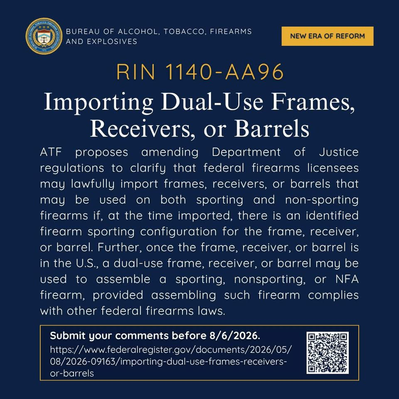
The Bureau of Alcohol, Tobacco, Firearms and Explosives (ATF) published a Notice of Proposed Rulemaking (NPRM) on May 8, 2026, titled “Importing Dual-Use Frames, Receivers, or Barrels” (RIN 1140-AA96). This proposal builds on ATF Ruling 2025-1 regarding dual-use barrels and extends similar logic to frames and receivers. It clarifies that Federal Firearms Licensees (FFLs) may import these components if they have an identified sporting configuration at the time of importation, regardless of prior use on non-sporting, military surplus, or National Firearms Act (NFA) firearms. Once imported, they can be used in a variety of assemblies, subject to other laws like 18 U.S.C. § 922(r).
This change promises to increase availability of parts, lower costs for American gun owners, and reduce arbitrary restrictions rooted in outdated policies. Comments are due by August 6, 2026. For Second Amendment advocates, this represents a pragmatic reform that prioritizes lawful commerce over excessive bureaucratic hurdles.
Historical Context of Firearm Import Regulations
The Gun Control Act of 1968 and Sporting Purposes Test
The foundation lies in the Gun Control Act (GCA) of 1968, particularly 18 U.S.C. § 925(d)(3), which generally prohibits importation of firearms not “generally recognized as particularly suitable for or readily adaptable to sporting purposes.” This extends to frames, receivers, and barrels that would form prohibited firearms if assembled.
Evolution of ATF Policy on Dual-Use Parts
Prior ATF guidance, including a 2005 open letter, took a restrictive view of “dual-use” barrels and parts. Importers faced limitations based on prior configurations or potential non-sporting uses. ATF Ruling 2025-1 marked an initial shift for barrels, recognizing that prior overseas use on military or NFA items should not permanently “taint” them if a sporting configuration exists at import.
The 2026 NPRM codifies and expands this, acknowledging the modular nature of modern firearms.
Breakdown of the Proposed Rule
Key Provisions
• Import Criteria: Focus shifts to whether an “identified sporting configuration” exists at importation, not prior history or dual potential.
• Post-Importation Use: Lawfully imported parts may be assembled into sporting, non-sporting, or NFA firearms, provided compliance with § 922(r), the NFA, and other laws.
• Regulatory Amendments: Changes to 27 C.F.R. §§ 478.39, 478.112, 478.113, 478.113a, and 478.114.
What Qualifies as “Dual-Use” and “Sporting Configuration”?
The rule addresses parts usable in both sporting (e.g., hunting, target shooting) and non-sporting configurations. “Identified sporting configuration” likely means the part can be assembled without modification into a sporting firearm, though comments may seek further clarity (especially for handguns).
Impact on Military Surplus and NFA Items
This opens importation of barrels and parts from surplus firearms previously restricted for decades, benefiting collectors and enthusiasts.
Benefits for Gun Owners, Industry, and Collectors
Increased Availability and Lower Costs
More imported parts mean greater supply, competition, and affordability for builds, repairs, and custom firearms.
Support for Modular and Modern Firearms
Modern designs blur lines between sporting and tactical. The rule adapts to this reality rather than fighting it.
Boost to Small Businesses and FFLs
Importers and manufacturers gain predictability, reducing compliance burdens and legal risks.
Second Amendment Implications
By easing access to common components without undermining core prohibitions on non-sporting complete firearms, the rule aligns with lawful ownership and self-defense rights.
Potential Concerns and Criticisms
Opponents may argue it indirectly facilitates non-sporting builds or circumvents import bans. However, the rule maintains § 922(r) and NFA compliance.
Implementation and Clarity Issues
Ambiguities around “identified sporting configuration” could lead to inconsistent enforcement. Advocates should submit comments for precision.
Enforcement Challenges
ATF must train personnel and update guidance to avoid overreach.
Comparison with Past ATF Policies
• 2005 Open Letter: More restrictive on dual-use barrels.
• Ruling 2025-1: Breakthrough for barrels.
• 2026 NPRM: Comprehensive extension to frames/receivers with post-import flexibility.
Legal and Constitutional Analysis
Alignment with Second Amendment Jurisprudence
Post-Bruen (2022), regulations must align with historical traditions. This reform reduces discretionary burdens on protected arms and accessories.
Administrative Procedure Act Considerations
The NPRM follows proper notice-and-comment procedures. Public input is crucial.
Potential for Litigation
While pro-2A overall, any final rule could face challenges from either side.
Economic and Market Impact Analysis
• Industry Growth: Expanded imports could add millions in economic activity.
• Consumer Savings: Lower part prices benefit hobbyists and professionals.
• Job Creation: In importation, manufacturing, and retail sectors.
State-Level Considerations (Focus on Indiana and Similar States)
Indiana’s strong 2A protections complement federal reforms. Advocates should monitor how state laws interact with imported parts. Similar dynamics apply in other pro-2A states.
International Trade and Foreign Policy Angles
The rule facilitates lawful commerce while respecting export controls and defense article distinctions.
Step-by-Step Guide for Stakeholders
1. Review the full NPRM and Ruling 2025-1.
2. Prepare comments (due Aug. 6, 2026) via regulations.gov.
3. For FFLs: Update import procedures and documentation.
4. Gun owners: Understand assembly rules remain in effect.
Public Comment Strategy for 2A Advocates
Emphasize benefits for lawful owners, technological adaptation, reduced bureaucracy, and economic gains. Request clear definitions and minimal burdens.
Related ATF Reform Initiatives
This NPRM is part of a broader “New Era of Reform,” including other proposals on trade zones, training rounds, etc.
Case Studies and Examples
• Military surplus barrels now more accessible.
• Modular AR-platform parts benefiting from clarity.
• Handgun frames/receivers in sporting configs.
Future Outlook and Recommendations
If finalized, monitor implementation. Advocates should push for further deregulation consistent with constitutional rights. Long-term, focus on congressional action for permanent statutory reforms.
Appendix: Key Resources and Links
• Federal Register NPRM.
• ATF Ruling 2025-1.
• Regulations.gov docket.
• ATF reform page.
Conclusion
The ATF’s dual-use import proposal is a welcome, common-sense reform that enhances access to firearm components for law-abiding Americans. It reflects evolving firearm technology and prioritizes practical governance over outdated restrictions. Second Amendment supporters in Indiana and nationwide should engage actively in the comment period to help shape a final rule that maximizes liberty while upholding public safety. This is progress worth building upon.