Background and Facts
In 2016, Harris County, Texas, Officer Roberto Felix Jr. pulled over Ashtian Barnes for unpaid toll violations. Barnes was ordered to exit the vehicle but instead started driving away. Officer Felix jumped onto the doorsill of the moving car, shouted commands, and fired two shots into the vehicle, killing Barnes. The entire incident from when the car started moving to when it stopped lasted about five seconds.
Barnes’ family sued, alleging the use of deadly force violated his Fourth Amendment rights against unreasonable seizures. Lower courts (District Court and Fifth Circuit) granted summary judgment in favor of the officer, applying the Fifth Circuit’s “moment of threat” rule. This rule limited the reasonableness analysis to only the precise moment when the officer perceived an immediate threat (here, when he was on the accelerating car).
Supreme Court Holding
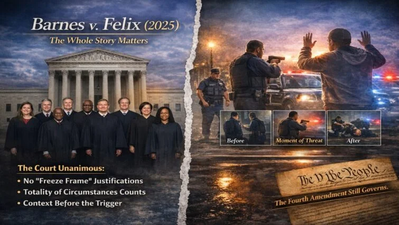
The Supreme Court, in an opinion by Justice Elena Kagan, vacated the Fifth Circuit’s decision and remanded the case. It rejected the “moment of threat” doctrine (used by the Fifth, Second, Fourth, and Eighth Circuits) as too narrow.
Key points:
• Fourth Amendment excessive force claims must be judged under the totality of the circumstances, drawing from Graham v. Connor (1989). This inquiry has no strict time limit.
• Courts can (and must) consider the broader context of the encounter, including events leading up to the use of force, the severity of the crime, the suspect’s actions (e.g., flight), and the officer’s conduct.
• The decision is narrow and reaffirms longstanding precedent rather than creating a new sweeping rule. It resolves a circuit split by invalidating overly restrictive time-based limits.
Justice Kavanaugh wrote a concurrence (joined by Thomas, Alito, and Barrett) emphasizing the inherent dangers of traffic stops for officers.
Implications
• For excessive force litigation: Plaintiffs in police shooting cases can more easily argue that an officer’s prior actions or the overall situation contributed to the need for force (sometimes called “officer-created jeopardy”). Lower courts must now take a broader view on remand.
• For law enforcement: It doesn’t eliminate qualified immunity or make shootings automatically unlawful, but it requires a more holistic reasonableness review. Training may need adjustments to avoid creating avoidable high-risk situations.
• Pro-2A/Rights perspective: This case reinforces constitutional protections against unreasonable government force while balancing officer safety. It’s often discussed in contexts of accountability during traffic stops, which can intersect with gun rights encounters (e.g., stops involving armed citizens).
The case was remanded for further proceedings applying the broader standard. For the full opinion, check the Supreme Court’s site (23-1239).