Carrying Firearms into Post Offices: History, Federal Law, and the DOJ’s Reading of 18 U.S.C. § 930(d)(3)
The question of whether an otherwise law-abiding citizen may carry a firearm into a United States post office has long been treated as settled against the individual. Federal criminal law and Postal Service regulations appeared to create a near-absolute ban. That understanding has been upended by recent judicial decisions applying New York State Rifle & Pistol Association v. Bruen and, most decisively, by an August 12, 2026, Office of Legal Counsel (OLC) opinion interpreting the key statutory exception. This article examines the historical record, the text and structure of the governing statute, the Postal Service regulation, and the Department of Justice’s current position, with particular focus on Section 930(d)(3) of Title 18 as it applies today.
Historical Background: No Founding-Era Ban
Post offices and the mail system are as old as the Republic. The Continental Congress established a postal system in 1775, and the Constitution expressly empowered Congress “To establish Post Offices and post Roads.” Early Congresses protected the mail and postal employees through severe criminal penalties for robbery and interference, including capital punishment in some cases. What they did not do was prohibit ordinary citizens from carrying arms into post offices.
For nearly two centuries after the Founding, no federal prohibition on firearms in post offices existed. Early post offices were frequently located in private homes, general stores, or other places of business provided by the postmaster. Even after the federal government began housing post offices in dedicated federal buildings in the early twentieth century, no weapons ban followed for decades. Air-mail pilots were required to carry pistols for a time, and postal clerks were armed in response to robberies in the early twentieth century. The first general federal property management regulations restricting firearms on federal property appeared only in the 1960s. A specific Postal Service regulation banning firearms, dangerous weapons, and explosives on postal property “except for official purposes” was adopted in 1972. The criminal statute now codified at 18 U.S.C. § 930 was enacted in 1988 as part of the Anti-Drug Abuse Act.
Courts applying the Bruen historical-tradition test have repeatedly noted this absence of early analogues. Judge Reed O’Connor of the Northern District of Texas, ruling in favor of the Firearms Policy Coalition and Second Amendment Foundation in 2025, observed that Congress and the Founders were aware of violence directed at the postal system yet addressed it through means other than disarming the public at post offices. The government conceded that the first specific ban on firearms on postal property dated only to 1972—nearly two hundred years after the Founding. Under Bruen, the lack of a relevantly similar historical tradition is fatal to a modern restriction that burdens the right to keep and bear arms for self-defense.
The Statutory Framework: 18 U.S.C. § 930
Section 930(a) makes it a federal misdemeanor for any person to “knowingly possess[] or cause[] to be present a firearm or other dangerous weapon in a Federal facility (other than a Federal court facility).” A “Federal facility” is defined as “a building or part thereof owned or leased by the Federal Government, where Federal employees are regularly present for the purpose of performing their official duties.” Post offices plainly fall within this definition. The Postal Service is an Executive Branch entity whose employees perform official duties in facilities the government owns or leases. Penalties for a simple violation are a fine, imprisonment for not more than one year, or both. A higher penalty applies if the firearm is possessed with intent that it be used in a crime.
Subsection (d) carves out three exceptions. The third is central:
(d) Subsection (a) shall not apply to—
…
(3) the lawful carrying of firearms or other dangerous weapons in a Federal facility incident to hunting or other lawful purposes.
This language has existed since the statute’s enactment in 1988. For decades, the Department of Justice and lower courts tended to read the exception narrowly, often treating “incident to hunting or other lawful purposes” as requiring a purpose closely tied to the federal facility itself (for example, carrying a hunting rifle into a national park where hunting is permitted). Some courts applied the ejusdem generis canon to limit “other lawful purposes” to activities similar to hunting.
The Postal Service’s own regulation, 39 C.F.R. § 232.1(l), is even broader on its face. It provides that “[n]otwithstanding the provisions of any other law, rule or regulation, no person while on postal property may carry firearms, other dangerous or deadly weapons, or explosives, either openly or concealed, or store the same on postal property, except for official purposes.” Violations are punishable by a fine or imprisonment of not more than 30 days. This regulation reaches not only the interior of post offices but also surrounding postal property, including parking lots in many interpretations.
The 2026 OLC Opinion: Section 930(d)(3) and Self-Defense
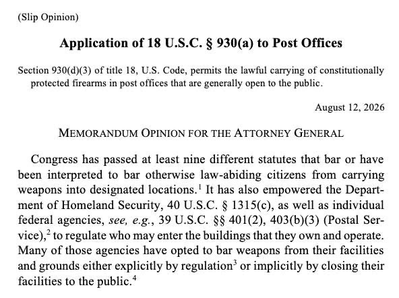
On August 12, 2026, the Office of Legal Counsel issued a formal memorandum opinion to the Attorney General titled “Application of 18 U.S.C. § 930(a) to Post Offices.” The opinion concludes that Section 930(d)(3) “permits the lawful carrying of constitutionally protected firearms in post offices that are generally open to the public.”
OLC’s reasoning proceeds in two steps. First, the carrying must itself be “lawful.” This incorporates both federal and state prohibitions. Persons prohibited under 18 U.S.C. § 922(g)—felons, those adjudicated mentally defective or committed to mental institutions, illegal aliens, and those convicted of misdemeanor domestic violence, among others—cannot claim the exception. State licensing requirements may also limit who qualifies, provided those requirements are themselves constitutional.
Second, the carrying must be “incident to hunting or other lawful purposes.” OLC rejects a narrow construction that would require the purpose of the carry to be specially related to the post office itself. Dictionary definitions of “incident” include occurring as a minor consequence or accompaniment. More importantly, the opinion treats self-defense as a paradigmatic lawful purpose. Drawing on Supreme Court precedent, including Heller, Bruen, and the more recent Wolford decision, OLC notes that the right to keep and bear arms is most frequently exercised for self-defense in the course of ordinary daily life. Post offices open to the public function as retail establishments where citizens conduct brief, routine transactions. Carrying a firearm for self-defense while entering such a place is therefore “incident to” a lawful purpose.
The opinion emphasizes that Congress itself chose the broad language “other lawful purposes” rather than a closed list. Hunting is listed as an example, but self-defense has long been paired with hunting as a core lawful purpose in both federal statutes and constitutional doctrine. Because an ordinary post office open to the public is not a “sensitive place” in the Heller/Bruen sense (courthouses, legislatures, and polling places present different historical traditions), the statutory exception applies.
Crucially, OLC concludes that the Executive Branch may not enforce Section 930(a) against law-abiding individuals carrying constitutionally protected firearms for self-defense in publicly accessible post offices. The Postal Service regulation, 39 C.F.R. § 232.1(l), cannot override the statutory exception; as applied to such carry, the regulation is unlawful. The opinion is carefully limited: it addresses only post offices generally open to the public and does not reach closed or restricted postal facilities (for example, those on military bases or behind airport security) or other categories of federal buildings.
Practical Application Today
Under the current DOJ position, a person who is not federally prohibited from possessing firearms, who may lawfully carry under the law of the relevant state, and who carries a constitutionally protected firearm (ordinary handguns and long guns) for self-defense into an ordinary public post office does not violate 18 U.S.C. § 930(a). Federal prosecutors are directed not to charge such conduct. The USPS regulation may not be enforced against it.
This does not mean every post office is automatically open to carry. Facilities located inside military installations, secure airport areas, or other restricted zones remain subject to separate statutes and regulations. “Dangerous weapons” that are independently prohibited (undetectable firearms, for example) fall outside the protection. State and local law continues to apply outside the federal facility itself. Storage of firearms in vehicles on postal property presents separate questions that the OLC opinion does not fully resolve in every factual setting.
The opinion also sits alongside earlier judicial developments. In 2025, Judge O’Connor declared both Section 930(a) and the USPS regulation unconstitutional as applied to ordinary post offices and surrounding postal property with respect to members of the challenging organizations. The Department of Justice later abandoned its appeal, leaving the injunction intact for those parties. The OLC opinion provides a nationwide interpretive framework grounded in the statute itself, independent of any particular injunction.
Broader Implications and Remaining Questions
The OLC’s reading of “other lawful purposes” is textually grounded and constitutionally informed. By recognizing self-defense as a paradigmatic lawful purpose and refusing to engraft extra-textual limitations onto the exception, the opinion restores the statute’s actual language. It also avoids the serious constitutional questions that would arise from a blanket ban on carrying arms into buildings the public has used since the Founding for routine civic and commercial activity.
Questions remain. The opinion deliberately declines to address other federal facilities. Whether similar reasoning would extend to Social Security offices, certain IRS facilities open to the public, or other non-sensitive federal buildings open for ordinary business is left for future analysis. The interaction between the statutory exception and agency regulations that purport to create absolute bans will continue to be tested. And individuals must still comply with state carry laws and federal prohibited-person rules.
For the ordinary citizen visiting a neighborhood post office, however, the legal landscape has shifted decisively. Section 930(d)(3) is not a narrow hunting carve-out. Properly read, it permits the lawful carrying of constitutionally protected firearms for self-defense in post offices generally open to the public. The Department of Justice has now formally adopted that reading. The longstanding assumption that post offices are Second Amendment-free zones no longer holds under federal criminal law.