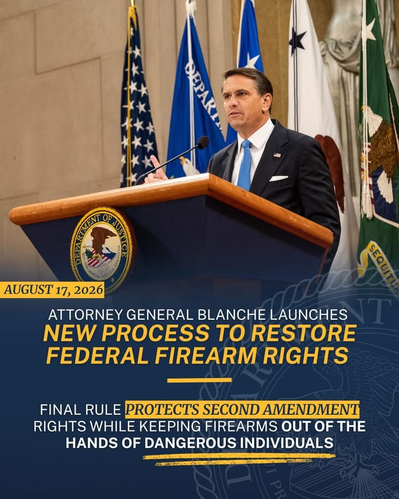
Todd Blanche’s Efforts to Restore Federal Firearm Rights
Attorney General Todd Blanche took decisive action on August 17, 2026, finalizing a long-awaited federal regulation that reopens a pathway for eligible Americans to regain their federal firearm rights. As one of his first major moves after Senate confirmation, Blanche restored a process under 18 U.S.C. § 925(c) that had been effectively unavailable for more than three decades. The rule implements a structured, individualized review system designed to protect the Second Amendment while keeping firearms out of the hands of those who pose genuine public-safety risks.
The Long Dormancy of Section 925(c)
Congress created a statutory mechanism decades ago allowing the Attorney General to grant relief from federal firearms disabilities on a case-by-case basis. For over thirty years, however, appropriations riders blocked the Bureau of Alcohol, Tobacco, Firearms and Explosives from investigating or acting on applications. The result was a near-total shutdown of the process. Millions of Americans who had completed their sentences, paid their debts to society, and demonstrated rehabilitated lives remained permanently barred from exercising a fundamental constitutional right. Federal law treated the Second Amendment as effectively extinguished for these individuals, with no practical avenue for restoration short of a presidential pardon.
A New, Rigorous Restoration Process
Blanche’s final rule revives the individualized review Congress authorized and shifts primary responsibility to the Attorney General. Restoration is neither automatic nor guaranteed. Applicants must demonstrate that the circumstances of their original prohibition, combined with their subsequent record, reputation, and conduct, show they are not likely to act in a manner dangerous to public safety and that granting relief would not be contrary to the public interest.
The Department of Justice will maintain strong presumptions against relief for those whose crimes or status present elevated risks. Absent extraordinary circumstances, violent felons, registered sex offenders, illegal aliens, and others who present an ongoing danger remain presumptively ineligible. Any relief granted removes only federal disabilities and does not override separate state-law restrictions.
The Justice Department has established a dedicated Federal Firearm Rights Restoration Program website at justice.gov/ffrr. Applications will open in stages after the rule’s publication in the Federal Register, beginning with limited cohorts and expanding over subsequent months. Applicants will submit supporting documentation, electronic fingerprints, character references, and, in later stages, a modest application fee.
Balancing Rights and Public Safety
Blanche emphasized the constitutional foundation of the initiative. “The Second Amendment is not a second-class right, and the federal government should not permanently deprive Americans of a constitutional right without regard to whether they pose a danger to public safety,” he stated. “This rule establishes a rigorous, commonsense process that protects the public while giving deserving Americans a real path to restoration.”
U.S. Pardon Attorney Edward Martin highlighted the scale of the effort, noting work under Blanche’s direction to create a pathway for the estimated tens of millions of Americans affected by federal firearms disabilities. The approach prioritizes both constitutional fidelity and careful screening, rejecting a one-size-fits-all lifetime ban in favor of evidence-based evaluation.
Broader Context of Second Amendment Restoration
This rule forms part of a broader Trump administration effort to reverse years of regulatory overreach and restore respect for the right to keep and bear arms. Earlier actions under Blanche’s leadership as Acting Attorney General included significant ATF regulatory reforms aimed at reducing unnecessary burdens on lawful gun owners and the firearms industry. The restoration process directly addresses a longstanding grievance of Second Amendment advocates: the permanent stripping of rights from non-violent individuals who have demonstrated they no longer present a threat.
Gun-rights organizations have welcomed the development as a meaningful step forward, while noting that continued advocacy will be necessary to refine the process and ensure fair, accessible implementation. Critics from gun-control groups have stressed the need for robust safeguards, a concern the rule’s strict presumptions and individualized scrutiny aim to address.
Looking Ahead
The final rule takes effect thirty days after Federal Register publication. Eligible individuals can begin preparing documentation and monitoring the justice.gov/ffrr site for application windows. For many law-abiding Americans who have rebuilt their lives after past mistakes, this represents the first realistic opportunity in a generation to reclaim a core constitutional right. Blanche’s action affirms that the Second Amendment deserves the same careful, rights-respecting treatment afforded other fundamental liberties—neither casually discarded nor recklessly restored.