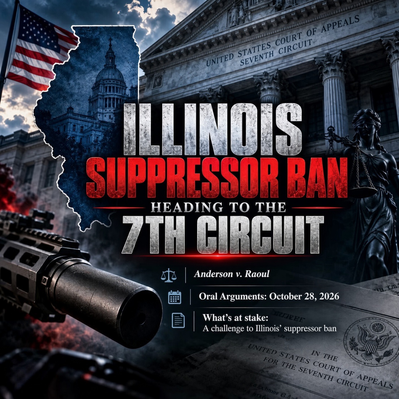
Anderson v. Raoul and the Fight Over Illinois Suppressor Ban in the Seventh Circuit
Introduction
Anderson v. Raoul is a consolidated Second Amendment challenge to Illinois’s longstanding ban on firearm suppressors (often called silencers). The case, now pending before the U.S. Court of Appeals for the Seventh Circuit as Nos. 25-2642 and 25-2663, asks whether a flat state prohibition on devices that reduce the report of a firearm violates the right to keep and bear arms as interpreted in New York State Rifle & Pistol Association v. Bruen (2022) and District of Columbia v. Heller (2008).
Illinois is one of a small minority of states that completely bars civilian ownership and possession of suppressors under 720 ILCS 5/24-1(a)(6). Plaintiffs argue that suppressors are protected “Arms” (or necessary facilitators of armed self-defense) and that no historical tradition supports an outright ban. The Southern District of Illinois disagreed at the threshold, holding that suppressors are not “arms” within the Second Amendment’s historically fixed meaning. The appeal tests that conclusion and intersects with a developing circuit split on the same question.
Background of the Case and Illinois Law
Illinois has prohibited devices “designed, used or intended for use in silencing the report of any firearm” for more than sixty years. The statute treats possession as a felony. Suppressors remain lawful under the National Firearms Act in most of the country; roughly forty-two states allow them after the usual NFA process. Illinois, along with California, New York, New Jersey, and a handful of others, maintains a total civilian ban.
In late 2022 and early 2023, two sets of Illinois plaintiffs filed suit. Larry Morse and Theodore Ray Buck Jr. brought Morse v. Raoul. Carlin Anderson and Dave Clark filed Anderson v. Raoul with support from the American Suppressor Association Foundation and Silencer Shop. Both actions alleged that the ban violates the Second and Fourteenth Amendments and sought declaratory and injunctive relief. The plaintiffs described intended uses that include hearing protection during training and hunting, reduced noise for neighbors, improved accuracy and follow-up shots in self-defense scenarios, and ordinary range and competition shooting. Anderson already owned a suppressor but kept it outside the state because of the ban; the others alleged they would acquire them but for the prohibition.
The district court consolidated the cases in June 2023. After the Protect Illinois Communities Act litigation temporarily stayed related proceedings, the state defendants moved for judgment on the pleadings under Rule 12(c). They argued that the claims fail at Bruen’s first step because suppressors are not “Arms” covered by the Second Amendment’s plain text.
The District Court Proceedings and Ruling
On September 5, 2025, Judge David W. Dugan of the Southern District of Illinois granted the state’s motion. The court accepted the plaintiffs’ factual allegations as true but concluded they had not plausibly alleged that suppressors qualify as “arms” under the Second Amendment’s historically fixed meaning.
Judge Dugan began with Heller’s definition, drawn from eighteenth-century sources: “weapons of offence, or armour of defence,” or “any thing that a man wears for his defence, or takes into his hands, or useth in wrath to cast at or strike another.” While Heller and Bruen make clear that the Second Amendment extends to modern instruments that constitute bearable arms, the court held that suppressors fall outside that category. They do not independently cast or strike; they are accessories that modify the sound of a firearm. The court emphasized the absence of any eighteenth- or nineteenth-century precursor that reduced the report of a firearm and was understood as an “arm.” Suppressors’ modern origin—Hiram Percy Maxim’s early-twentieth-century patents—placed them outside the historical understanding the Supreme Court has treated as fixed.
The court distinguished Caetano v. Massachusetts (2016), which protected stun guns as modern bearable arms in common use for self-defense. It also rejected the argument that anything useful to armed self-defense is therefore an “arm.” Even accepting that suppressors reduce hearing damage, recoil, and muzzle blast while aiding accuracy, the court found those benefits insufficient without a historical analogue or a showing that the devices themselves are weapons. Judgment was entered for the defendants on September 8, 2025. The Illinois ban remained in force.
Plaintiffs contend the ruling misapplies Bruen. They note that the Supreme Court has expressly rejected the idea that the Second Amendment protects only arms that existed in 1791, and that the government bears the burden once the plain text covers the conduct. They argue that suppressors facilitate the core right of self-defense and should be treated like other modern advancements that improve the effectiveness and safety of arms.
The Appeal to the Seventh Circuit
Both sets of plaintiffs appealed. The Seventh Circuit docketed the consolidated appeals in September 2025. Briefing is complete. Oral argument is scheduled for October 28, 2026. The state’s appellees’ brief maintains that the district court correctly applied Bruen’s first step: silencers are accessories, not weapons, and are not necessary to the ordinary use of firearms for self-defense. Alternatives such as ear protection exist, and only a fraction of the nation’s firearm owners possess suppressors. The state argues that if the Seventh Circuit were to reverse, the proper course would be remand for further proceedings on historical tradition rather than immediate judgment for the plaintiffs.
The plaintiffs’ opening and reply briefs emphasize that the Second Amendment’s plain text covers instruments that facilitate armed self-defense, that suppressors are in common lawful use elsewhere, and that Illinois has identified no historical tradition of banning devices that merely reduce noise. They also cite the Seventh Circuit’s own Bevis v. City of Naperville decision and subsequent developments, arguing that suppressors satisfy any relevant common-use or facilitative standard.
Key Legal Arguments
The central dispute is whether possession of a suppressor (or a firearm equipped with one) is conduct covered by the Second Amendment’s plain text. Under Bruen, if the answer is no, the analysis ends and the ban is constitutional. If the answer is yes, the government must demonstrate that the ban is consistent with the nation’s historical tradition of firearm regulation.
Plaintiffs argue that suppressors are “arms” or, at minimum, protected facilitators of the right. They point to functional benefits—hearing preservation, reduced recoil, better accuracy, faster follow-up shots, and the ability to communicate during defensive use—and note that millions of Americans lawfully own them in other states. They contend that treating modern safety and effectiveness improvements as outside the Amendment would freeze the right in an eighteenth-century technological snapshot that Heller and Bruen rejected.
The state responds that the text protects “Arms,” not every accessory that can be attached to one. Suppressors are not weapons themselves; a firearm functions without them. Historical dictionaries and usage do not treat sound-reducing attachments as arms. The state further argues that the Second Amendment does not constitutionalize every improvement that makes shooting more pleasant or convenient, and that the plaintiffs have not shown suppressors are necessary rather than merely helpful.
Related Developments and Circuit Split
The appeal arrives against a backdrop of conflicting appellate decisions. In June 2026, a unanimous Fifth Circuit panel in United States v. Comeaux held that silencers are Second Amendment “Arms.” The court reasoned that they reduce loudness and hearing risk, lower recoil, eliminate muzzle blast, increase accuracy, and enable faster follow-up shots—functions that make firearms safer and more effective for self-defense. The panel affirmed the NFA conviction under existing circuit precedent treating the registration regime as presumptively lawful, but its textual holding that suppressors are arms is significant. Plaintiffs in Anderson promptly notified the Seventh Circuit of Comeaux as supplemental authority.
By contrast, the Ninth Circuit has treated suppressors as optional accessories outside the plain text in cases such as United States v. DeBorba. Other courts have reached similar conclusions. The resulting split on the threshold “arms” question increases the likelihood that the Supreme Court will eventually address suppressor protection, particularly if the Seventh Circuit joins one side or the other.
Implications and Outlook
A ruling for the plaintiffs would be the first appellate decision striking down a state suppressor ban on Second Amendment grounds and would place significant pressure on the remaining total-ban states. It would also reinforce the broader argument that modern safety and effectiveness devices that facilitate lawful armed self-defense fall within the Amendment’s protection. An affirmance would leave Illinois’s ban intact, align the Seventh Circuit with courts that view suppressors as unprotected accessories, and deepen the circuit split.
Because the district court resolved the case solely on the plain-text step, a reversal would likely produce a remand for historical-tradition analysis rather than an immediate injunction. That second step would require Illinois to identify analogous historical regulations—something plaintiffs argue is difficult given the absence of any longstanding tradition of banning noise-reducing devices. The Seventh Circuit’s broader Second Amendment jurisprudence, including its recent decisions upholding certain sensitive-place and assault-weapon restrictions, will shape how the panel approaches both steps.
Conclusion
Anderson v. Raoul presents a clean, threshold question about the scope of the Second Amendment in the post-Bruen era: are suppressors “arms,” or at least instruments whose possession is protected because they facilitate the core right of self-defense? The district court answered no, relying on the lack of historical precursors and the devices’ accessory status. Plaintiffs contend that answer conflicts with the Supreme Court’s instruction that the Amendment extends to modern bearable arms and that the government bears the historical burden once the text is implicated.
With oral argument set for late October 2026 and a circuit split already in existence after Comeaux, the Seventh Circuit’s decision will carry weight far beyond Illinois. It will help determine whether states may maintain absolute bans on devices that millions of Americans use for hearing protection, accuracy, and safer training and self-defense, or whether such bans must survive the same historical scrutiny the Supreme Court now requires for other firearm regulations. The outcome will clarify one more boundary of the right to keep and bear arms and will likely influence both remaining state bans and the larger debate over what modern advancements the Second Amendment protects.