Elite Precision Customs v. ATF: The Fight Over Interstate Handgun Sales
Federal law has long treated handguns differently from rifles and shotguns when a buyer lives in another state. Elite Precision Customs v. ATF is the latest effort to dismantle that distinction under the Second Amendment. Filed in January 2025, the case asks whether Congress can force law-abiding adults to route an out-of-state handgun purchase through a second licensed dealer in their home state. A Texas district judge upheld the restriction in September 2025. On September 2, 2026, a Fifth Circuit panel heard oral argument. A decision has not yet issued.
The Federal Restrictions at Issue
The challenge targets provisions of the Gun Control Act of 1968, principally 18 U.S.C. §§ 922(a)(3), 922(a)(5), and 922(b)(3), along with the implementing regulation at 27 C.F.R. § 478.99(a). Together they are often called the “Sale Restrictions.”
A licensed dealer may sell a rifle or shotgun face-to-face to a resident of another state if the sale complies with the laws of both states. Handguns are different. A dealer who knows or has reason to believe the buyer lives elsewhere generally cannot deliver the pistol on the spot. The buyer must have the gun shipped to a federal firearms licensee in the buyer’s home state, complete a second transfer there, and pay the extra transfer fee. Unlicensed private transfers across state lines are separately restricted. Congress enacted the scheme after finding that interstate commerce made it too easy to evade state and local gun laws.
The practical result is extra cost, delay, and the inability to walk out of an out-of-state shop with a handgun in hand. Plaintiffs argue that is a ban on taking possession outside one’s state of residence, not a modest commercial condition.
The Plaintiffs and How the Ban Affects Them
The lead plaintiff is Elite Precision Customs LLC, a federally licensed manufacturer and dealer in Mansfield, Texas. When an out-of-state customer wants one of its custom handguns, the shop must ship the firearm to another licensee instead of completing the sale in the store. That adds expense and complexity.
Two individual members of Firearms Policy Coalition (FPC) joined the suit. Freddie Blish, a retired Marine lieutenant colonel living in Arizona, travels the country teaching defensive handgun courses. He visits dealers in other states and says he would buy from Elite Precision but for the restriction. Tim Herron, a New Mexico resident and USPSA Grand Master, competes and instructs nationwide. He already buys the occasional out-of-state handgun by having it shipped home, paying an extra $30–$40 and waiting to take possession. He too would buy directly from Elite Precision if the law allowed it. FPC sued on behalf of its members. Counsel includes Cooper & Kirk and FPC Law. Defendants are the ATF, the Attorney General, and the ATF Director.
Filing and District Court Proceedings
Plaintiffs filed the complaint on January 20, 2025, in the U.S. District Court for the Northern District of Texas, Fort Worth Division, case number 4:25-cv-00044, assigned to Judge Mark T. Pittman. They sought a declaration that the Sale Restrictions violate the Second Amendment and a permanent injunction. Because the facts were undisputed, the parties filed cross-motions: the government moved to dismiss; plaintiffs moved for summary judgment. Briefing concluded in late August 2025.
This was not the first challenge to the same statutes. In Mance v. Sessions, the Fifth Circuit upheld them in 2018 under the old means-end scrutiny framework. The Supreme Court later rejected that framework in New York State Rifle & Pistol Association v. Bruen (2022). Plaintiffs asked the district court to apply Bruen’s text-and-history test instead.
Judge Pittman’s Ruling
On September 30, 2025, Judge Pittman granted the government’s motion to dismiss and denied plaintiffs’ motion for summary judgment. Final judgment dismissing the case with prejudice followed on October 1, 2025.
The court held that the Sale Restrictions do not even implicate the Second Amendment’s plain text. Citing Heller’s statement that “laws imposing conditions and qualifications on the commercial sale of arms” are “presumptively lawful,” and the Fifth Circuit’s later decision in McRorey v. Garland upholding a ten-day background-check delay, Judge Pittman treated the interstate-handgun rules as a commercial condition rather than a ban on keeping or bearing arms. The extra shipping step and modest fee, he wrote, are not a de facto prohibition on possession. Because the conduct fell outside the Amendment’s text, the court never reached Bruen’s historical-tradition inquiry. FPC called the ruling “judicial abdication” and announced an immediate appeal.
The Appeal and Fifth Circuit Arguments
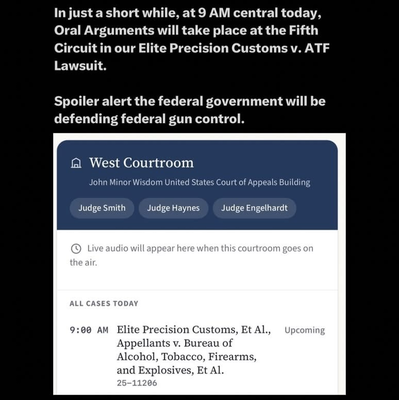
Plaintiffs noticed their appeal on October 28, 2025. The Fifth Circuit docketed the case as No. 25-11206. Appellants filed their opening brief on February 4, 2026. The government filed its brief on May 6, 2026. Plaintiffs replied on May 27, 2026. Oral argument was held September 2, 2026, before Circuit Judges Catharina Haynes, Jerry Smith, and Kurt Engelhardt.
At argument, plaintiffs’ counsel Peter Patterson told the panel the government had cited no founding-era or nineteenth-century law that barred a nonresident from acquiring a firearm outside his home state. He analogized the restriction to a rule forbidding a person from buying a book from an out-of-state bookstore and walking out with it. Department of Justice attorney Laura Myron defended the statutes as commercial regulations that do not ban any class of firearm or any class of lawful buyer. Their purpose, she said, is to stop residents from evading their own states’ sales rules. She also pointed to Mance’s description of the burden as “de minimis.” No opinion has been issued.
What Comes Next
The Fifth Circuit will decide whether Judge Pittman correctly stopped at Bruen step one or whether the government must now justify the 1968 handgun rule with historical analogues. A reversal would reopen the possibility of face-to-face interstate handgun sales by licensed dealers, subject to the laws of both states—the same framework that already applies to rifles and shotguns. An affirmance would leave the two-step transfer process intact. Either result could invite Supreme Court review, given the nationwide reach of the federal statute and the post-Bruen debate over what counts as a “condition on commercial sale” versus an infringement of the right to acquire arms.
For now, the law remains as Congress wrote it in 1968: an out-of-state customer can still buy a custom pistol from a Texas shop, but the gun must travel home through another licensee first. Elite Precision Customs v. ATF is the vehicle asking whether that extra step is constitutionally required.