Elite Precision Customs v. ATF: The Fight Over Interstate Handgun Sales
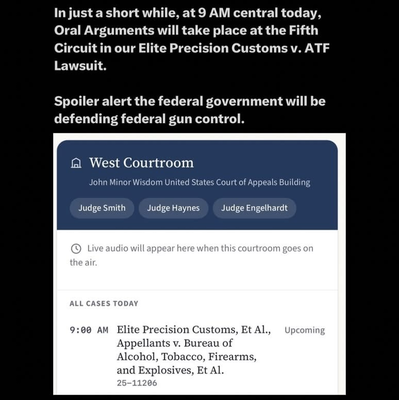
Federal law has long treated handguns differently from rifles and shotguns when a buyer lives in another state. Elite Precision Customs v. ATF is the latest effort to dismantle that distinction under the Second Amendment. Filed in January 2025, the case asks whether Congress can force law-abiding adults to route an out-of-state handgun purchase through a second licensed dealer in their home state. A Texas district judge upheld the restriction in September 2025. On September 2, 2026, a Fifth Circuit panel heard oral argument. A decision has not yet issued.
The Federal Restrictions at Issue
The challenge targets provisions of the Gun Control Act of 1968, principally 18 U.S.C. §§ 922(a)(3), 922(a)(5), and 922(b)(3), along with the implementing regulation at 27 C.F.R. § 478.99(a). Together they are often called the “Sale Restrictions.”
A licensed dealer may sell a rifle or shotgun face-to-face to a resident of another state if the sale complies with the laws of both states. Handguns are different. A dealer who knows or has reason to believe the buyer lives elsewhere generally cannot deliver the pistol on the spot. The buyer must have the gun shipped to a federal firearms licensee in the buyer’s home state, complete a second transfer there, and pay the extra transfer fee. Unlicensed private transfers across state lines are separately restricted. Congress enacted the scheme after finding that interstate commerce made it too easy to evade state and local gun laws.
The practical result is extra cost, delay, and the inability to walk out of an out-of-state shop with a handgun in hand. Plaintiffs argue that is a ban on taking possession outside one’s state of residence, not a modest commercial condition.
The Plaintiffs and How the Ban Affects Them
The lead plaintiff is Elite Precision Customs LLC, a federally licensed manufacturer and dealer in Mansfield, Texas. When an out-of-state customer wants one of its custom handguns, the shop must ship the firearm to another licensee instead of completing the sale in the store. That adds expense and complexity.
Two individual members of Firearms Policy Coalition (FPC) joined the suit. Freddie Blish, a retired Marine lieutenant colonel living in Arizona, travels the country teaching defensive handgun courses. He visits dealers in other states and says he would buy from Elite Precision but for the restriction. Tim Herron, a New Mexico resident and USPSA Grand Master, competes and instructs nationwide. He already buys the occasional out-of-state handgun by having it shipped home, paying an extra $30–$40 and waiting to take possession. He too would buy directly from Elite Precision if the law allowed it. FPC sued on behalf of its members. Counsel includes Cooper & Kirk and FPC Law. Defendants are the ATF, the Attorney General, and the ATF Director.
Filing and District Court Proceedings
Plaintiffs filed the complaint on January 20, 2025, in the U.S. District Court for the Northern District of Texas, Fort Worth Division, case number 4:25-cv-00044, assigned to Judge Mark T. Pittman. They sought a declaration that the Sale Restrictions violate the Second Amendment and a permanent injunction. Because the facts were undisputed, the parties filed cross-motions: the government moved to dismiss; plaintiffs moved for summary judgment. Briefing concluded in late August 2025.
This was not the first challenge to the same statutes. In Mance v. Sessions, the Fifth Circuit upheld them in 2018 under the old means-end scrutiny framework. The Supreme Court later rejected that framework in New York State Rifle & Pistol Association v. Bruen (2022). Plaintiffs asked the district court to apply Bruen’s text-and-history test instead.
Judge Pittman’s Ruling
On September 30, 2025, Judge Pittman granted the government’s motion to dismiss and denied plaintiffs’ motion for summary judgment. Final judgment dismissing the case with prejudice followed on October 1, 2025.
The court held that the Sale Restrictions do not even implicate the Second Amendment’s plain text. Citing Heller’s statement that “laws imposing conditions and qualifications on the commercial sale of arms” are “presumptively lawful,” and the Fifth Circuit’s later decision in McRorey v. Garland upholding a ten-day background-check delay, Judge Pittman treated the interstate-handgun rules as a commercial condition rather than a ban on keeping or bearing arms. The extra shipping step and modest fee, he wrote, are not a de facto prohibition on possession. Because the conduct fell outside the Amendment’s text, the court never reached Bruen’s historical-tradition inquiry. FPC called the ruling “judicial abdication” and announced an immediate appeal.
The Appeal and Fifth Circuit Arguments
Plaintiffs noticed their appeal on October 28, 2025. The Fifth Circuit docketed the case as No. 25-11206. Appellants filed their opening brief on February 4, 2026. The government filed its brief on May 6, 2026. Plaintiffs replied on May 27, 2026. Oral argument was held September 2, 2026, before Circuit Judges Catharina Haynes, Jerry Smith, and Kurt Engelhardt.
At argument, plaintiffs’ counsel Peter Patterson told the panel the government had cited no founding-era or nineteenth-century law that barred a nonresident from acquiring a firearm outside his home state. He analogized the restriction to a rule forbidding a person from buying a book from an out-of-state bookstore and walking out with it. Department of Justice attorney Laura Myron defended the statutes as commercial regulations that do not ban any class of firearm or any class of lawful buyer. Their purpose, she said, is to stop residents from evading their own states’ sales rules. She also pointed to Mance’s description of the burden as “de minimis.” No opinion has been issued.
What Comes Next
The Fifth Circuit will decide whether Judge Pittman correctly stopped at Bruen step one or whether the government must now justify the 1968 handgun rule with historical analogues. A reversal would reopen the possibility of face-to-face interstate handgun sales by licensed dealers, subject to the laws of both states—the same framework that already applies to rifles and shotguns. An affirmance would leave the two-step transfer process intact. Either result could invite Supreme Court review, given the nationwide reach of the federal statute and the post-Bruen debate over what counts as a “condition on commercial sale” versus an infringement of the right to acquire arms.
For now, the law remains as Congress wrote it in 1968: an out-of-state customer can still buy a custom pistol from a Texas shop, but the gun must travel home through another licensee first. Elite Precision Customs v. ATF is the vehicle asking whether that extra step is constitutionally required.
The Supreme Court Confronts AR-15 Bans: Viramontes, Grant, and the Road to a 2027 Decision
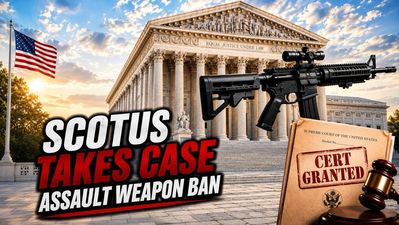
On the last day of its 2025–2026 term, the Supreme Court of the United States did something it had declined to do for years. It agreed to decide whether the Second and Fourteenth Amendments protect the right to possess AR-15-platform rifles and similar semiautomatic firearms. The vehicle is a pair of consolidated cases: Viramontes v. Cook County, No. 25-238, from the Seventh Circuit, and Grant v. Higgins, No. 25-566, from the Second Circuit. The question presented is spare and deliberate: “Whether the Second and Fourteenth Amendments guarantee the right to possess AR-15 platform and similar semiautomatic rifles.”
That question has hovered over American firearms law since District of Columbia v. Heller in 2008. Heller held that the Second Amendment protects an individual right to keep and bear arms and that the government may not ban an entire class of arms “in common use” for lawful purposes. It also said that “dangerous and unusual” weapons fall outside that protection. Handguns, the Court held, are in common use. Machineguns, it suggested, are not. What the Court never squarely answered is where the most popular rifle in the country sits on that line.
For more than a decade, states and localities filled the silence with “assault weapon” statutes. Cook County, Illinois, and the State of Connecticut are two of the jurisdictions that did so. Their laws ban, by name and by feature, the AR-15 and a long list of similar rifles. Lower federal courts, applying Heller and later New York State Rifle & Pistol Association v. Bruen, repeatedly upheld those bans. On June 30, 2026, the Supreme Court granted review and consolidated the two petitions for one hour of argument. The cases are now on the October Term 2026 docket. A decision is expected by the end of that term—June 2027.
The most immediate development is the petitioners’ merits brief, filed August 28, 2026. That filing, together with an early amicus brief the day before, marks the start of the merits stage. Respondents’ briefs are due October 21, 2026. Reply briefing follows in November. Argument will come later in the term. What the Court says in 2027 will not merely dispose of two local bans. It will tell every legislature and every court of appeals whether America’s most common civilian rifle is a constitutional “arm” or a category of weapon that may be outlawed because officials prefer something else.
The Cook County Ordinance and the People Who Challenged It
Cook County’s ban did not begin as a statewide project. It began as a local ordinance, adopted in 2006 and later expanded, that prohibits the possession, sale, and transfer of what the county labels assault weapons. The code names more than one hundred specific rifles, including AR-15 and AK-47 platforms. It also reaches any semiautomatic rifle that can accept a magazine holding more than ten rounds and that has at least one listed physical feature—a folding or telescoping stock, a pistol grip, a barrel shroud, a flash suppressor, or a similar characteristic. A first offense can bring up to six months in jail and a minimum fine of $5,000.
The ordinance is not a relic. It was the local precursor to Illinois’s later statewide Protect Illinois Communities Act, which copied much of the same list and feature test. Residents of Cook County who want a rifle that is legal in most of the United States cannot buy one, keep one, or take lawful title to one without violating county law.
Cutberto Viramontes is one of those residents. He wants an AR-15-style rifle for self-defense. Christopher Khaya wants an IMI Galil, another semiautomatic rifle on the banned list. They did not sue alone. They joined the Firearms Policy Coalition and the Second Amendment Foundation and filed in the Northern District of Illinois in August 2021. The suit sought declaratory and injunctive relief and, importantly for later mootness analysis, nominal damages. After the district court granted summary judgment to the county in March 2024, the Seventh Circuit affirmed in a short order on June 2, 2025. The Supreme Court then granted certiorari.
The procedural history matters because the Seventh Circuit did not write on a blank slate. In 2023, in Bevis v. City of Naperville, a panel of that court upheld Illinois and local assault-weapon bans at the preliminary-injunction stage. The majority reasoned that AR-15s are “indistinguishable” from M16s, more useful in military service than for civilian self-defense, and therefore outside the Second Amendment’s definition of “arms.” When Viramontes arrived on a fuller record, the court said the plaintiffs had not developed facts sufficient to escape Bevis. The ban stood. That is the judgment now before the Supreme Court.
Connecticut’s Statute and Grant v. Higgins
Connecticut’s law is a state felony statute rather than a county ordinance, but the design is familiar. After the Sandy Hook murders, the legislature banned a set of semiautomatic centerfire rifles by name and by feature. The current version reaches rifles that accept a detachable magazine and have at least one listed characteristic: a folding stock, a pistol grip, a forward pistol grip, a flash suppressor, or a fixed magazine holding more than ten rounds, among others. Possession of a covered rifle acquired after April 3, 2013, is a crime.
Eddie Grant Jr., Jennifer Hamilton, Michael Stiefel, the Connecticut Citizens Defense League, and the Second Amendment Foundation challenged that statute. The district court denied a preliminary injunction. On August 22, 2025, the Second Circuit affirmed. Unlike the Seventh Circuit, the Second Circuit assumed without deciding that the rifles were “arms.” It then applied a relaxed historical inquiry, citing the “unprecedented societal concern” of mass shootings, recast Heller’s phrase “dangerous and unusual” as “unusually dangerous,” and upheld the ban because the state still allowed other firearms that the legislature deemed less dangerous for self-defense.
The Grant petition asked whether the Second and Fourteenth Amendments guarantee the right to possess semiautomatic rifles “in common use for lawful purposes, including the most popular rifle in the country, the AR-15.” When the Supreme Court granted both petitions on June 30, 2026, it limited review to the question presented in Viramontes and consolidated the cases. Future filings appear on the Viramontes docket. One hour of argument will cover both.
Taking two cases rather than one was a structural choice. In 2020, after the Court granted review in New York State Rifle & Pistol Association v. City of New York, the city and state rewrote the challenged transport rule. The Court dismissed the case as moot. Justice Kavanaugh concurred but warned that lower courts were not faithfully applying Heller and McDonald. Two years later came Bruen. Mootness is far less available here. Cook County is unlikely to legalize AR-15s to escape a ruling. Connecticut is unlikely to repeal a post-Sandy Hook statute for the same reason. The Viramontes complaint also pleaded nominal damages, a claim that survives repeal of the ordinance itself. Two independent bans in two circuits make it much harder for a single legislature to pull the case out from under the Court.
Heller, Bruen, and the Fight Over Method
Any honest account of these cases has to start with method, because method is what the governments and the challengers are really fighting about.
Heller held that the Second Amendment’s operative clause—“the right of the people to keep and bear Arms, shall not be infringed”—protects an individual right unconnected to militia service. The prefatory militia clause announces a purpose; it does not confine the right. The Court then asked which arms the right covers. It looked to the historical tradition of banning only “dangerous and unusual” weapons and protecting arms “in common use at the time” for lawful purposes such as self-defense. Handguns qualified. The District of Columbia’s handgun ban did not.
McDonald v. City of Chicago applied that holding to the states through the Fourteenth Amendment. Bruen rejected means-end balancing. If the Second Amendment’s plain text covers an individual’s conduct, the government must justify its regulation by demonstrating that it is consistent with the Nation’s historical tradition of firearm regulation. Bruen was a carry case, not a ban-on-a-class-of-arms case. Heller remains the Court’s last word on which weapons may be banned outright.
Petitioners say that distinction is decisive. A ban on a type of firearm is governed by Heller’s common-use test. Courts do not get to invent a new historical analogical exercise that treats popularity as irrelevant and “military usefulness” as disqualifying. Respondents say common ownership is not enough. Some argue that “common use” belongs inside the threshold textual inquiry and that “arms” already incorporates Heller’s limitations. Others argue that common use requires proof of actual use in self-defense, not mere sales figures, and that a weapon useful for “offensive combat” is not the sort of arm the Amendment protects. The National Association of Attorneys General’s summary of the grant captured that split cleanly: Cook County wants common use treated as a textual limit; Connecticut wants an analysis of “actual use and functionality for self-defense—not its popularity in the abstract.”
That methodological fight explains why the Court took the cases now. After Bruen, every court of appeals to reach a so-called assault-weapon ban on the merits has upheld it. The First, Second, Fourth, and Seventh Circuits have done so on varying theories. There is no classic circuit split in outcome. There is a deepening split in reasoning, and a growing pile of petitions asking the Court to say whether Heller still means what it said. The grant on June 30 ended that period of denial.
The August 28 Brief: What Petitioners Asked the Court to Hold
On August 28, 2026, Cooper & Kirk filed the opening merits brief for all petitioners. David H. Thompson is counsel of record. Peter A. Patterson, William V. Bergstrom, and J. Joel Alicea appear with him. Connecticut counsel Craig C. Fishbein appears for the Grant plaintiffs. The same day, the parties filed the joint appendix. A day earlier, attorney G. Antaeus B. Edelsohn filed an amicus brief pressing the militia-arm argument. Those three filings are the first complete merits-stage papers the Court has seen in an AR-15 ban case.
The brief’s structure tracks Heller. First, the plain text. Semiautomatic rifles are arms. The Second Amendment’s text covers “Arms,” not “handguns only” and not “arms that a legislature finds suitable for home defense.” The Seventh Circuit’s holding that Cook County’s ban does not even implicate the text is, petitioners argue, irreconcilable with Heller. If a firearm is not an “arm” because a county board says it is too effective, then the Amendment’s operative language has been rewritten.
Second, history and common use. AR-15-platform rifles have been sold to American civilians since the 1960s. They are legal in the large majority of states. They are, by every serious count, the most popular rifles in the country. Petitioners and supporting groups have long analogized their numbers to ordinary consumer goods—SAF’s Adam Kraut observed after the grant that it is hard to argue that a rifle type that may outnumber Ford F-150s fails a common-use test. The brief treats that popularity as legally sufficient under Heller. A weapon that is unusual may be banned. A weapon that is common may not be banned because officials dislike its appearance or its rate of semiautomatic fire.
Third, the governments have the militia clause backward. Cook County and Connecticut have argued that AR-15s are not protected because they are useful for offensive combat rather than personal defense. Petitioners answer that the Amendment’s prefatory clause identifies a well-regulated militia as necessary to the security of a free state. An arm does not lose protection because it is suitable for that purpose. If anything, militia suitability cuts in favor of protection. The Edelsohn amicus pressed that originalist point at length, while drawing a line at fully automatic machineguns that the petitioners do not need the Court to erase in order to win. That line will be debated in commentary; it is not required by the question presented.
Fourth, the lower courts’ alternative formulations—“unusually dangerous,” “indistinguishable from the M16,” “unprecedented societal concern”—are not the test Heller announced. Handguns are used in the overwhelming majority of firearm homicides. Heller still protected them as a class. Long guns of all types account for a much smaller share of homicides. Treating the most common civilian rifle as uniquely ban-able because of rare, horrific crimes inverts the Court’s own hierarchy. Petitioners also note that justices across the Court’s ideological range have already described these rifles in ordinary-consumer terms. Justice Kagan, writing for a unanimous Court in Smith & Wesson Brands, Inc. v. Estados Unidos Mexicanos in 2025, called the AR-15 “widely legal and bought by many ordinary consumers.” Justice Sotomayor, dissenting in Garland v. Cargill, called them “commonly available, semiautomatic rifles.” Those descriptions are not holdings, but they undercut the claim that the rifles are exotic military instruments unknown to the civilian market.
The brief does not ask the Court to invent a new right. It asks the Court to apply the right Heller already recognized to the rifle Heller never had occasion to name.
What Comes Next on the Calendar
The Clerk granted an agreed briefing extension on July 15, 2026. Petitioners’ brief and the joint appendix were due August 28. Respondents’ merits briefs are due October 21. The reply is due November 20. That schedule was designed, counsel told the Clerk, to permit argument in the December or January sitting and to accommodate trial and other obligations. One hour is allotted. No argument date has been announced.
Observers who count grants on the October Term 2026 docket have placed these cases well into the sequence of argued matters. Chief Justice Roberts has typically scheduled about nine arguments per monthly sitting. On that pattern, argument in early December 2026 is a reasonable projection. Opinions in high-stakes cases argued that late in the calendar year often arrive in June. A decision in the final week of June 2027 would fit the Court’s ordinary end-of-term practice. Those dates are estimates, not orders. The Court can accelerate or delay. What is fixed is the term: October Term 2026, with a decision expected in 2027.
Amicus practice will be heavy. Gun-rights organizations, state attorneys general, historians, and social-science filers will all appear. Watchers have asked whether the Solicitor General will file in support of petitioners and whether experienced Supreme Court counsel such as Paul Clement and Erin Murphy will file an amicus that the justices read with particular care. There is no federal analogue to these bans, so the United States has no statute of its own to defend. The administration’s recent Second Amendment posture makes a supporting brief plausible. None of that is on file yet. The only merits brief that exists as of late August 2026 is the petitioners’.
Why Two Circuits and a National Map Matter
Fourteen states and the District of Columbia have enacted comparable laws. Some ban rifles by name. Some use feature tests that turn a legal rifle into a felony the moment a pistol grip or adjustable stock is attached. Some combine both. Illinois built a statewide ban on the Cook County model. California, New York, Maryland, New Jersey, Massachusetts, and others have their own versions. Challenges to those laws are pending or stayed in multiple circuits. The Ninth Circuit already delayed argument in a long-running challenge to California’s assault-weapons ban so it can await Viramontes and Grant. A Virginia district court was asked to stay related proceedings for the same reason. Whatever the Supreme Court writes will not stay confined to Chicago and Hartford.
A holding that AR-15-platform rifles are arms in common use would not automatically invalidate every magazine limit, every feature restriction, or every licensing rule. The question presented is possession of the rifles themselves. Courts would still have to apply Bruen to regulations that fall short of a ban. But the central theory used to sustain these statutes—that the rifles are not “arms” at all, or that they may be banned because they resemble service rifles—would be gone. Legislatures that built their codes on that theory would have to start over.
A holding that the bans are consistent with history would, by contrast, give states a clear green light. It would also invite a new generation of lists: more named models, more features, more arguments that the next popular rifle is “too military.” That is why the methodology paragraph in the eventual opinion may matter as much as the disposition. Commentators already worry that a unanimous judgment purchased with softening language would be worse for future cases than a narrower majority that keeps Heller’s common-use rule intact. That is prediction, not law. The Court has not spoken.
The Human and Civic Stakes
It is easy to discuss these cases as abstractions—docket numbers, feature tests, analogical history. The plaintiffs are not abstractions. They are people who live in jurisdictions where a rifle that is ordinary in Indiana, Texas, Florida, or most of rural America is contraband. They want the same tool for home defense, competition, and lawful recreation that their fellow citizens already own in the tens of millions. The organizations that joined them exist to make that claim in court when individual owners cannot bear the cost alone.
Governments on the other side point to mass shootings in which some of these rifles were used. Those crimes are real. The legal question is not whether they are tragic. The legal question is whether the Constitution permits a state or county to ban an entire class of commonly owned arms because a subset of criminals misuse them. Heller answered that question for handguns. Viramontes and Grant ask whether the answer is different for rifles.
There is also a federalism and notice problem. A rifle legal in most of the country becomes a jail sentence a few miles across a county line. Travelers, heirs, and people who move for work discover that a firearm they purchased lawfully is suddenly an “assault weapon.” Feature tests are especially unstable. A stock, a grip, or a muzzle device can change the legal status of an otherwise identical gun. If the Supreme Court holds that the underlying rifle is protected, many of those tripwires lose their justification.
What to Watch Between Now and Judgment Day
Several markers will tell observers how the case is developing. First, the respondents’ October briefs: do they double down on the claim that these rifles are not “arms,” or do they retreat to a narrower historical-analogue argument that assumes the text is satisfied? Second, the Solicitor General: silence, a brief supporting neither side, or an affirmative brief for the Second Amendment. Third, the argument date and the composition of the bench that hears it. Fourth, whether any jurisdiction attempts a last-minute amendment to manufacture mootness—an effort the nominal-damages claim and the dual-case structure are designed to defeat.
Fifth, collateral litigation. Illinois’s statewide ban, California’s statute, magazine cases, and 18-to-20-year-old purchase cases are all moving on nearby tracks. The Court denied several young-adult petitions around the same time it granted these rifle cases. Those splits will linger until the Court is ready. A 2027 opinion on AR-15s will not resolve every Second Amendment dispute. It will resolve the one that lower courts have used to treat the country’s most common rifle as if Heller never spoke.
Conclusion
Viramontes v. Cook County and Grant v. Higgins are not technical follow-ons to Bruen. They are the Court’s first direct engagement with the question Heller left on the table: may the government ban the AR-15? The petitioners’ August 28, 2026 brief gives the justices a complete merits argument built on text, common use, and the militia purpose the Amendment itself announces. The governments will answer in October. Argument will follow. By June 2027, there should be an opinion.
Until that opinion issues, the law remains what the Seventh and Second Circuits said it was: these bans stand. After that opinion issues, either they will not, or the Supreme Court will have told the country that the most popular rifle in America may be treated as contraband. That is the choice the Court granted certiorari to make. The briefing has begun. The 2027 decision will finish it.
Kansas Congressman Tracey Mann’s Letter to ATF Director Robert Cekada: Demanding Guidance After Silencer Shop Foundation v. ATF
On August 27, 2026, Representative Tracey Mann of Kansas’s First Congressional District sent a pointed letter to Bureau of Alcohol, Tobacco, Firearms and Explosives Director Robert Cekada. The subject was not a new statute, a proposed rule, or another round of appropriations riders. It was the practical aftermath of a federal court decision that has already begun to rewrite how suppressors and other previously taxed National Firearms Act items move in commerce. Two weeks after the injunction in Silencer Shop Foundation v. ATF took effect, the agency still had not published official guidance. Dealers, manufacturers, and owners were left to interpret a party-specific injunction while ATF eForms continued to operate as if little had changed. Mann’s letter asked the Director to end that vacuum.
The request is straightforward on its face and consequential in its implications. A district court has held that core registration and transfer provisions of the National Firearms Act can no longer rest on Congress’s taxing power now that the making and transfer taxes on suppressors, short-barreled rifles, short-barreled shotguns, and certain “any other weapons” have been reduced to zero. The ATF has not told the regulated community, in plain language, what that holding means for Form 4s, pending files, remaining statutory duties, or dealer procedures. Mann’s letter puts a date on the demand: a response no later than September 17, 2026.
The Ruling That Created the Vacuum
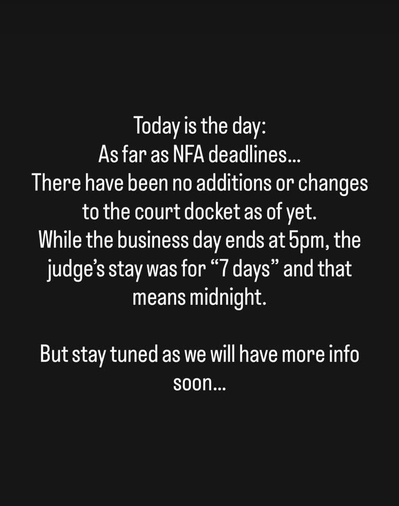
On August 5, 2026, Judge James Wesley Hendrix of the U.S. District Court for the Northern District of Texas, San Angelo Division, entered final judgment in the consolidated cases of Silencer Shop Foundation v. ATF, No. 6:25-cv-056, and Jensen v. ATF. The court held that specified NFA registration, application, and related provisions exceed Congress’s enumerated powers as applied to “untaxed firearms”—the categories for which the One Big Beautiful Bill Act zeroed the $200 making and transfer taxes effective January 1, 2026. A seven-day stay expired at the end of August 12. As of August 13, the permanent injunction was in force.
The injunction is real and narrow at the same time. It bars ATF, the Department of Justice, Acting Attorney General Todd Blanche, Director Cekada, and those acting in concert with them from enforcing listed statutory and regulatory provisions against the named plaintiffs and, where applicable, their members, agencies, political subdivisions, and customers. Covered parties include Silencer Shop Foundation, Gun Owners of America, Gun Owners Foundation, the Firearms Regulatory Accountability Coalition, manufacturers and retailers such as SilencerCo, Palmetto State Armory, and B&T USA, individual plaintiff Brady Wetz, and a coalition of states that includes Kansas. The order does not repeal the National Firearms Act. It does not automatically cover every American. It does not wipe away the Gun Control Act, prohibited-person rules, or state laws that still treat suppressors as NFA items. Those distinctions are precisely why official guidance matters.
In the weeks after the stay expired, Silencer Shop and some other covered sellers began transferring suppressors on a Form 4473 and a NICS check in states that do not impose their own registration overlay. That is a historic change: the first lawful unregistered suppressor transfers since 1934, according to the plaintiffs. Many other dealers have declined to follow, citing the absence of ATF written instructions, uncertainty about who counts as a protected customer, and fear that an appeal or a later clarification could leave them exposed. ATF’s public posture has been minimal. A spokesperson has said the bureau is “processing forms and will continue to process forms consistent with applicable law, regulations, and agency policy.” That sentence does not answer the questions Mann listed.
Why a Kansas Congressman Wrote the Letter
Tracey Mann represents the sprawling “Big First” District of western and central Kansas. He is a fifth-generation Kansan, raised on a family farm south of Quinter, a Kansas State University agricultural economics graduate, a former lieutenant governor, and a commercial real estate broker who still owns farmland. He has a consistent record of supporting hunting, shooting sports, and Second Amendment legislation, including measures aimed at ATF licensing overreach and the now-rescinded pistol-brace rule. Kansas is one of the state plaintiffs in Silencer Shop Foundation. The case is not an abstraction for his constituents. It is a live question for Kansas dealers, manufacturers, and owners who want to know whether they can treat a suppressor like any other Title I firearm or whether they must still run the old NFA gauntlet.
Mann’s letter opens by acknowledging Cekada’s tenure and the administration’s stated commitment to constitutional gun rights. It then turns immediately to the problem. Judicial action has created uncertainty. Legal owners, manufacturers, and dealers need direction on existing and pending applications. If the court has barred enforcement of certain registration requirements, the bureau should say which requirements remain and which procedures are no longer required. The letter urges the ATF to deal directly with Congress and with the industry rather than leave regulated parties to invent their own compliance theories. That last point is not rhetorical. When an agency declines to speak, the market fragments. Some shops transfer. Some refuse. Some demand extra paperwork that may no longer be legally required. Uncertainty itself becomes a form of regulation.
The Six Questions Mann Put on the Record
Mann asked for clarification on six specific points.
First: what steps the ATF has already taken to implement the ruling. Implementation is not a slogan. It means internal directives to NFA examiners, instructions to industry operations investigators, changes to eForms logic, and communications to U.S. Attorneys’ offices that might otherwise treat an unregistered suppressor transfer as a felony.
Second: how the ruling affects Form 4 approval processes. Form 4 is the transfer application that, for decades, sat at the center of suppressor commerce. If covered transfers no longer require an approved Form 4, the bureau should say so. If some transfers still do—because the buyer is not a protected party, because the item remains taxed, or because a state statute independently requires registration—the bureau should draw that line in writing.
Third: which federal NFA registration requirements remain in effect. The injunction lists particular subsections of 26 U.S.C. §§ 5841, 5842, and 5861 and particular regulatory paragraphs in 27 C.F.R. Part 479. Other NFA provisions, including some interstate-transport rules and the treatment of machineguns and destructive devices, were not swept away. Owners and dealers cannot be expected to parse a judgment and a code book without an agency map.
Fourth: how the ATF will handle existing and pending applications. Hundreds of thousands of Form 4s and Form 1s were in the pipeline when the tax went to zero and again when the injunction took effect. Applicants paid fees, submitted photographs and fingerprints, and waited. They need to know whether those files will be approved under the old process, withdrawn, converted, or simply left to expire in a system that no longer matches the law as applied to protected parties.
Fifth: what procedures owners, manufacturers, and dealers should follow going forward. This is the operational heart of the letter. Should a Kansas FFL run a 4473 and NICS and complete the sale the same day for a GOA member buying a suppressor? Should the same dealer still file a Form 4 for a customer who is not in a protected class? What marking, recordkeeping, and interstate-shipment rules still apply? Industry lawyers have published interpretations. Those interpretations are not ATF policy.
Sixth: a date on which the ATF intends to publish official, finalized guidance. Mann did not ask for an open-ended promise. He asked for a calendar. The September 17 response deadline is the mechanism that turns a request into a congressional demand.
The Industry Split and the Cost of Silence
The practical landscape since mid-August has been uneven by design. Silencer Shop has treated covered customers in “free states” as ordinary firearm purchasers. Other covered manufacturers have been more cautious, especially on short-barreled rifles and shotguns, even though the tax-zeroing statute and the court’s enumerated-powers analysis reach those items as well. Dealers outside the plaintiff class have almost uniformly stayed on the Form 4 track. That split is not a sign of healthy federalism. It is a sign that the enforcing agency has not told the market what the court told the agency.
Gun Owners of America framed Mann’s letter in exactly those terms: the injunction had been in effect for more than two weeks, yet headquarters was still, in the group’s view, discouraging unregistered suppressor sales by withholding guidance. That charge may overstate intent. It does not overstate the effect. When ATF remains silent, risk-averse licensees default to the process they know. The process they know is the process the court said cannot be enforced against protected parties. Silence therefore preserves the old regime for everyone who is not willing to bet a federal firearms license on a district-court order.
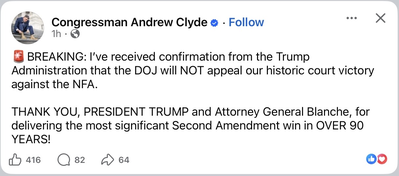
There is a second, related reason for delay. The Department of Justice missed the short window to seek an extension of the stay. Whether it will appeal the merits to the Fifth Circuit remains an open question in public reporting. If DOJ appeals and seeks a stay pending appeal, the guidance problem becomes even sharper: the injunction is in force now, but the government may later ask a higher court to freeze it. If DOJ declines to appeal, the constitutional holding sits on the books as the government’s loss. In that scenario, applying the holding only to named plaintiffs would be a political and legal choice, not a necessity imposed by the judgment’s text. Members of Congress have already urged the Department to treat the decision as a nationwide operating position and to begin APA rulemaking to conform the regulations. Mann’s letter does not itself demand nationwide application. It demands that ATF say, in writing, what it is doing while that larger debate continues.
Cekada, the Bureau, and the Expectation of Clarity
Robert Cekada was confirmed as ATF Director in the spring of 2026 after years as a career official and deputy director. He has publicly emphasized faster NFA processing, rollback of certain Biden-era rules, and a less adversarial posture toward the industry. Suppressors have been part of that story: processing times dropped sharply even as volume exploded after the tax went to zero. The Silencer Shop judgment tests a different skill—translating a court order into field instructions without waiting for the last possible appeal deadline. An agency that can approve a Form 4 in days should be able to tell examiners and licensees which Form 4s are still required.
Clarity here is not a courtesy to activists. It is a due-process interest for people who can be prosecuted for getting the paperwork wrong. The NFA’s criminal provisions still exist. Interstate movement of an unregistered NFA firearm remains a separate statutory problem the injunction did not fully erase. State laws in a significant minority of jurisdictions still require NFA-style processes even if federal registration is enjoined as to some buyers. A dealer in Kansas, a plaintiff state, still has to know whether a particular customer is covered, whether the item is an untaxed category, and whether a later buyer in a non-plaintiff state can lawfully receive it. Those are not questions a one-line spokesperson quote can answer.
What a Responsive Agency Letter Would Contain
A serious reply from Cekada would do more than recite that ATF follows the law. It would identify the protected classes as the bureau understands them, including future members and customers of the associational and commercial plaintiffs. It would state whether examiners have been instructed to approve, deny, or hold pending Form 4s filed by covered parties. It would say whether eForms will be modified so that a covered transfer is not forced through a registration workflow. It would address markings: the injunction reaches certain making and transfer provisions, but serial-number and manufacturer-marking duties under other statutes may still apply. It would address Form 1 homemade suppressors, which raise a different set of facts from dealer transfers. And it would give the date Mann requested—the date on which public guidance will appear on atf.gov rather than in industry rumor.
Anything less leaves the regulated public in the position Mann described: determining for themselves how a federal court order affects their livelihoods, with felony exposure on one side and a constitutional holding on the other.
Oversight, Deadlines, and the Next Thirty Days
Congressional letters do not bind an agency the way a court order does. They do create a record. Mann has given ATF a three-week clock. If the bureau answers with specifics, dealers can write standard operating procedures that match the government’s own description of the injunction. If the bureau answers with generalities, the letter becomes evidence in later oversight hearings that the agency chose opacity after a court had already spoken. Other members have already pressed related NFA questions this year—tax-stamp implementation after the One Big Beautiful Bill, Tiahrt Amendment compliance, processing backlogs. Silencer Shop is now the dominant operational question in that portfolio.
The underlying legal fight is not over. Parallel cases, including Brown v. ATF and Roberts v. ATF, may expand or complicate the protected classes. An appeal, if filed, would move the dispute to the Fifth Circuit and eventually, perhaps, to the Supreme Court. Rulemaking could lock in a broader or narrower policy than the judgment alone requires. None of those future events excuses the present failure to tell today’s licensees what today’s injunction means.
Representative Mann’s letter is, in that sense, a demand for the minimum competent act of administration. A court has enjoined enforcement of particular NFA provisions against particular people and companies. The bureau that used to process those provisions must say what it will do instead. Kansas owners, and owners in every other plaintiff state, should not have to guess. September 17 is the date Mann put on that obligation. The quality of Cekada’s answer will show whether ATF intends to administer the post-judgment world or merely wait for someone else to define it.
Tenth Circuit Strikes Down New Mexico’s Seven-Day Firearm Waiting Period: A Landmark Second Amendment Victory
In a significant application of the Supreme Court’s text-and-history framework from New York State Rifle & Pistol Association v. Bruen, a divided panel of the U.S. Court of Appeals for the Tenth Circuit held that New Mexico’s seven-day waiting period for most firearm purchases likely violates the Second Amendment. The August 19, 2025 decision in Ortega v. Lujan Grisham (also styled Ortega v. Grisham) reversed a district court denial of preliminary injunctive relief and ordered the lower court to enter an injunction. The ruling represents the first time the Tenth Circuit has struck down a firearms statute on Second Amendment grounds and sends a clear signal that categorical “cooling-off” periods cannot be imposed on law-abiding citizens simply because the government fears they might misuse a constitutional right.
Background of New Mexico’s Waiting Period Act
New Mexico enacted its Waiting Period Act in 2024 amid high rates of gun violence. Signed by Governor Michelle Lujan Grisham, the law required firearms sellers to wait seven calendar days before transferring a firearm to most buyers. The waiting period applied even after a buyer passed the required federal National Instant Criminal Background Check System (NICS) check. Limited exceptions existed for concealed-carry permit holders, law enforcement, and certain immediate family transfers. If a background check remained incomplete after seven days, the law effectively extended the delay further—up to 20 days in some circumstances—before transfer was permitted.
The stated purposes were to reduce impulsive acts of gun violence and suicide and to close what lawmakers viewed as a loophole in federal law that allows transfer after three business days if NICS has not returned a definitive result. Plaintiffs Samuel Ortega, a retired law enforcement officer, and Rebecca Scott, represented by the National Rifle Association and Mountain States Legal Foundation, filed suit the day the law took effect. They argued the mandatory delay unconstitutionally burdened their right to acquire firearms for self-defense, including in situations of immediate need.
A federal district court in New Mexico denied a preliminary injunction in July 2024. The lower court reasoned that the Second Amendment’s plain text did not necessarily protect the right to acquire arms, that the law was a presumptively lawful commercial regulation, and that historical analogues supported it. Plaintiffs appealed.
The Tenth Circuit’s Majority Opinion
Writing for the 2-1 majority, Judge Timothy Tymkovich (joined by Judge Allison H. Eid) conducted a straightforward Bruen analysis. The court first held that the right to keep and bear arms necessarily includes the right to acquire them. “Common sense dictates that the right to bear arms requires a right to acquire arms, just as the right to free press necessarily includes the right to acquire a printing press,” the opinion stated. A categorical delay that prevents lawful possession—even temporarily—burdens conduct protected by the Second Amendment’s plain text.
The majority rejected the argument that the waiting period was merely a “condition or qualification on the commercial sale of arms” entitled to a presumption of constitutionality under District of Columbia v. Heller. Unlike background checks, age restrictions, or licensing regimes that condition eligibility on objective criteria, New Mexico’s law imposed a universal, time-based barrier on nearly all purchasers regardless of their qualifications or circumstances. The sale itself could be completed; the waiting period simply delayed possession. That artificial delay, the court held, is not a traditional commercial condition.
Turning to historical tradition, the panel found no relevant analogue for a blanket cooling-off period. The earliest American waiting-period laws appeared in the 1920s and were generally tied to the time needed to complete background investigations rather than to impose an arbitrary reflection period. Analogies offered by the state—laws restricting the intoxicated, certain licensing schemes, or historical group-based prohibitions—were either individualized, targeted at specific risks, or rested on now-repudiated discriminatory rationales. The Second Amendment, the court emphasized, does not tolerate “universal and indiscriminate burdens” on the right to acquire firearms.
Importantly, the majority underscored a broader principle: “As a general matter, the government cannot delay the exercise of a right because it believes that citizens might misuse it without sufficient time to reflect beforehand.” Drawing comparisons to other enumerated rights, the court noted that a mandatory one-week cooling-off period before publishing news or practicing religion would be constitutionally intolerable. The same logic applies to the Second Amendment.
The panel concluded that plaintiffs were likely to succeed on the merits, that the other preliminary-injunction factors favored relief, and that an injunction was warranted. The case was reversed and remanded with instructions to enter injunctive relief consistent with the opinion.
The Dissent
Judge Scott Matheson dissented. He argued that the majority’s approach conflicted with the Tenth Circuit’s recent decision in Rocky Mountain Gun Owners v. Polis, which upheld Colorado’s age-21 restriction on firearm purchases as a presumptively lawful commercial regulation. Under that framework, Matheson contended, New Mexico’s waiting period established a condition or qualification on commercial sales that did not serve “abusive ends.” He would have affirmed the district court’s denial of preliminary relief.
Subsequent Proceedings and Current Status
New Mexico sought en banc rehearing. On December 22, 2025, the full Tenth Circuit denied the petition. Judges Richard Federico and Nancy Moritz dissented from the denial, warning of public-safety consequences and potential tension with circuit precedent. With en banc review denied, the panel decision stood. The district court later entered a preliminary injunction, and the litigation continued on the merits.
As of mid-2026, the seven-day waiting period remains blocked. The ruling is binding within the Tenth Circuit (Colorado, Kansas, New Mexico, Oklahoma, Utah, and Wyoming) and has already influenced parallel challenges, including litigation over Colorado’s shorter waiting period.
Broader Implications for Second Amendment Jurisprudence
Ortega is notable for several reasons. First, it squarely holds that the right to keep and bear arms encompasses the right to acquire them in a timely manner. Temporary deprivations are still deprivations. Second, it rejects the notion that modern “public safety” rationales—however well-intentioned—can substitute for historical tradition under Bruen. Third, it clarifies the limited scope of Heller’s “presumptively lawful” commercial regulations: not every restriction that happens to apply to a sale qualifies.
The decision also highlights the practical realities faced by law-abiding citizens. Victims of domestic violence, individuals facing credible threats, or those simply seeking to exercise a core constitutional right should not be forced to wait an arbitrary week while the state second-guesses their judgment. Background checks already screen for prohibited persons. Adding a categorical delay after clearance serves primarily as a hurdle rather than a tailored safety measure.
Critics of the ruling argue that waiting periods reduce impulsive suicides and certain crimes, pointing to studies from other jurisdictions. The Tenth Circuit majority did not dispute the state’s policy goals; it held that those goals cannot override the constitutional text and history. Under Bruen and United States v. Rahimi, the government must demonstrate consistency with the nation’s historical tradition of firearm regulation. New Mexico failed that test.
Looking Ahead
The Ortega decision strengthens the post-Bruen landscape by treating the Second Amendment as a real right rather than a second-class interest subject to balancing. It will likely be cited in challenges to similar waiting periods in other states and circuits. Whether the Supreme Court ultimately reviews the issue remains to be seen, but the Tenth Circuit has drawn a clear line: the government may not impose blanket delays on the exercise of a fundamental right simply because it distrusts the people in whom that right is vested.
For gun owners in New Mexico and across the Tenth Circuit, the ruling restores a measure of the immediate access the Second Amendment has always contemplated. Law-abiding citizens who pass background checks should be able to take possession of their firearms without an artificial cooling-off period dictated by legislative preference. That principle, rooted in text, history, and common sense is precisely what the Tenth Circuit vindicated.
Possible Paths Forward for the ATF and DOJ After Judge Hendrix’s August 5, 2026 NFA Ruling
On August 5, 2026, U.S. District Judge James Wesley Hendrix of the Northern District of Texas issued a significant decision in the consolidated cases Silencer Shop Foundation v. ATF and Jensen v. ATF. The court held that key registration, application, approval, and related regulatory provisions of the National Firearms Act (NFA) of 1934 exceed Congress’s enumerated powers as applied to suppressors (silencers), short-barreled rifles (SBRs), short-barreled shotguns (SBSs), and certain “any other weapons” (AOWs).
Congress had reduced the making and transfer taxes on these categories to $0 through the One Big Beautiful Bill Act (effective January 1, 2026). Judge Hendrix reasoned that the NFA’s challenged provisions were enacted under the Taxing Clause and lost their constitutional foundation once they no longer generated revenue. The court rejected post-hoc reliance on the Commerce Clause or Necessary and Proper Clause, finding that Congress had not invoked those powers for the relevant rules. Second Amendment claims were dismissed without prejudice as abandoned.
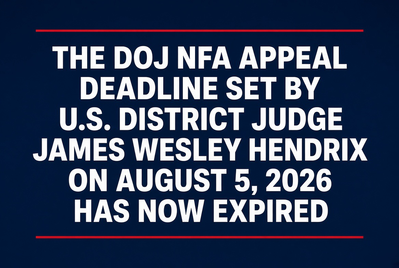
The court entered a permanent injunction barring the ATF, Department of Justice, and related officials from enforcing the specified provisions against the plaintiffs and, where applicable, their agencies, political subdivisions, members, and customers (current and future). The injunction is party-specific rather than nationwide. A seven-day stay allowed the government time to seek appellate relief; that stay expired around August 12–13 without an emergency stay being obtained, and the injunction took effect. As of late August 2026, the government still retained a standard window (generally 60 days from judgment) to file a notice of appeal.
As of August 26, 2026, several concrete options remain available to the ATF and DOJ.
Filing a Notice of Appeal to the Fifth Circuit
The most direct remaining procedural option is a timely notice of appeal to the U.S. Court of Appeals for the Fifth Circuit. The ordinary deadline runs approximately 60 days from entry of judgment (roughly early October). An appeal would allow the government to challenge the district court’s enumerated-powers analysis, the scope of the injunction, and related legal conclusions.
If an appeal is filed, the government could simultaneously or subsequently seek a stay of the injunction pending appeal from the district court or the Fifth Circuit. Success on a stay motion is not automatic and would require showing likelihood of success on the merits, irreparable harm, and the balance of equities. Without a stay, the party-specific injunction would continue to operate during the appeal. Appellate review could take many months, with possible further review by the Supreme Court if a circuit conflict or important question of federal law develops.
Declining to Appeal and Managing Compliance
The government may choose not to appeal, allowing the permanent injunction to stand as a final judgment against the covered parties. In that scenario, the ATF and DOJ would need to implement compliance measures for transactions involving plaintiffs, their members, and qualifying customers. This could include processing or declining Form 1 and Form 4 applications accordingly, adjusting internal enforcement guidance, and addressing how commercial plaintiffs’ downstream customers are treated.
Gun Control Act requirements (such as Form 4473 and NICS checks) remain fully in force. The absence of formal ATF implementation guidance as of mid-to-late August created practical uncertainty for federal firearms licensees, which the agencies could resolve through notices, open letters, or revised procedures even without an appeal.
Administrative Rulemaking or Policy Adjustments
Independent of litigation posture, the ATF retains authority under the Administrative Procedure Act to initiate notice-and-comment rulemaking amending or rescinding regulations tied to the enjoined NFA provisions as they apply to the zero-tax categories. Rulemaking could formalize non-enforcement for broader categories of transactions, clarify recordkeeping for dealers, or address inventory and disposition procedures for items previously tracked under NFA forms.
Policy memoranda or internal directives could also direct field offices and examiners on how to handle applications from covered parties while the injunction remains in effect. Such steps would not expand the injunction’s formal legal scope but could reduce enforcement disparities and provide clearer industry guidance.
Seeking Legislative or Broader Regulatory Clarification
Because the district court emphasized that only Congress can restore a constitutional basis (for example, by reimposing a meaningful tax or explicitly invoking another enumerated power), the administration could request legislative action. Congress could amend the NFA, restructure the tax scheme, or clarify statutory authority. Parallel NFA challenges pending in other districts and circuits create additional pressure points that could influence legislative or administrative priorities.
The government could also defend or adjust its position in related litigation, potentially seeking consistent nationwide standards if other courts reach differing conclusions.
Practical Enforcement and Risk Management Considerations
Even while options remain open, the ATF must avoid enforcing the enjoined provisions against protected parties. Failure to respect the injunction risks contempt or further judicial relief. At the same time, the agency continues to administer unaffected NFA categories (most notably machine guns and destructive devices, which retained their tax) and all GCA obligations.
State laws that independently regulate suppressors, short-barreled firearms, or registration remain unaffected by the federal ruling. Dealers and individuals must still navigate those state requirements.
As of August 26, 2026, the window for a standard appeal had not yet closed, no formal nationwide guidance had fully resolved operational questions, and the party-specific injunction remained operative. The ATF and DOJ therefore retain meaningful choices: pursue appellate review and a possible stay, accept the judgment and focus on compliance and rulemaking, or pursue a combination of administrative and legislative avenues. Each path carries different implications for enforcement uniformity, industry compliance burdens, and the longer-term status of NFA registration requirements for the zero-tax categories. The coming weeks will clarify which course the government elects.
The doctrine of entrapment by estoppel stands as a narrow but important due process safeguard in American criminal law. It prevents the government from prosecuting an individual who reasonably relied on affirmative statements or assurances from authorized government officials that certain conduct was legal. Unlike traditional entrapment, which focuses on whether government agents induced a predisposed defendant to commit a crime, entrapment by estoppel centers on fundamental fairness: the state may not actively mislead a citizen and then punish the citizen for acting on that misleading advice.
This principle has particular resonance in the highly technical and heavily regulated field of firearms law, especially under the National Firearms Act (NFA) of 1934, codified at 26 U.S.C. §§ 5801–5872. The NFA imposes registration, taxation, and transfer requirements on certain categories of firearms and devices, including short-barreled rifles and shotguns, silencers (suppressors), machineguns, destructive devices, and “any other weapons.” Violations of core prohibitions—most notably the receipt or possession of an unregistered NFA firearm under 26 U.S.C. § 5861(d)—carry severe penalties of up to ten years in prison and substantial fines under 26 U.S.C. § 5871.
In an era of shifting administrative interpretations, court injunctions, and evolving regulatory guidance from the Bureau of Alcohol, Tobacco, Firearms and Explosives (ATF), the defense of entrapment by estoppel offers a potential shield for individuals who act in good-faith reliance on official statements about the legality of possessing or transferring NFA items. Understanding the doctrine’s contours, elements, and limits is essential for anyone navigating the complex intersection of federal firearms regulation and constitutional due process.
What Is Entrapment by Estoppel?
Entrapment by estoppel is a due process-based affirmative defense rooted in the Fifth Amendment’s guarantee that no person shall be deprived of liberty without due process of law. It applies when a government official or authorized agent affirmatively represents that specific conduct is lawful, the defendant reasonably relies on that representation, and the government later seeks to prosecute the defendant for engaging in that same conduct.
The defense does not require proof that the defendant lacked predisposition to commit the offense, nor does it depend on aggressive inducement by undercover agents. Instead, it rests on the principle that “traditional notions of fairness inherent in our system of criminal justice” prohibit the government from securing a conviction after it has affirmatively misled the defendant. Courts have repeatedly emphasized that the defense is narrow. Vague statements, contradictory advice, or informal opinions from unauthorized persons will not suffice. The official must have actual or apparent authority to interpret the law in question, and the defendant’s reliance must be both actual and objectively reasonable under the circumstances.
This doctrine is distinct from ordinary mistake of law, which is generally not a defense, and from public authority defenses that require the defendant to have been granted actual permission to engage in the conduct by someone with lawful power to authorize it.
Historical Development and Supreme Court Foundations
The Supreme Court laid the groundwork for the modern doctrine in a series of mid-twentieth-century decisions. In Raley v. Ohio, 360 U.S. 423 (1959), defendants were prosecuted for refusing to answer questions before a state legislative commission after the chairman had assured them they could invoke their privilege against self-incrimination. The Court held that convicting them under those circumstances constituted an “indefensible sort of entrapment by the State” that violated due process.
Six years later, in Cox v. Louisiana, 379 U.S. 559 (1965), the Court reversed a conviction for demonstrating “near” a courthouse where the highest local police officials, in the presence of the mayor and sheriff, had effectively told the demonstrators that their chosen location was permissible. Again, the Court found that due process barred the prosecution.
The third foundational case, United States v. Pennsylvania Industrial Chemical Corp., 411 U.S. 655 (1973) (often called PICCO), involved a corporation prosecuted for discharging industrial pollutants into a navigable river in violation of the Rivers and Harbors Act. The defendant had relied on longstanding Corps of Engineers regulations that appeared to permit such discharges if they did not impede navigation. The Supreme Court held that the defendant should have been allowed to present evidence of this reliance, because the government may not prosecute when its own responsible agency has affirmatively misled the regulated party about the scope of the law.
Lower courts have synthesized these holdings into a coherent affirmative defense. While formulations vary slightly by circuit, the core requirement remains the same: the government may not actively assure a citizen that conduct is legal and then punish the citizen for following that assurance when reliance was reasonable.
Elements of the Defense
Most federal circuits require the defendant to prove, by a preponderance of the evidence, several key elements. A representative formulation, drawn from Ninth Circuit pattern instructions and widely influential case law such as United States v. Batterjee, 361 F.3d 1210 (9th Cir. 2004), includes the following:
First, an authorized government official or agent empowered to render the claimed advice must have been involved. The official must possess actual or apparent authority to interpret or apply the relevant law.
Second, the official must have been made aware of all relevant historical facts surrounding the defendant’s situation.
Third, the official must have affirmatively told the defendant that the proscribed conduct was permissible. Silence, omissions, or ambiguous statements are generally insufficient.
Fourth, the defendant must have actually relied on the false information.
Fifth, the reliance must have been reasonable in light of the identity of the official, the point of law involved, the substance of the statement, and all surrounding circumstances. A person “sincerely desirous of obeying the law” would have accepted the advice as true and would not have been put on notice to make further inquiries.
Other circuits use four-element or simpler tests, but the common thread is affirmative official misrepresentation coupled with reasonable reliance. The defense is unavailable when the advice comes from private parties lacking governmental authority, or when the defendant’s own knowledge or the circumstances made reliance unreasonable.
Application in Firearms Cases
Firearms prosecutions have produced some of the most significant applications of the doctrine. Because federal firearms laws are complex, technical, and frequently administered through forms, licensing systems, and dealer interactions, opportunities for official misstatement arise with some regularity.
In United States v. Tallmadge, 829 F.2d 767 (9th Cir. 1987), and later in Batterjee, the Ninth Circuit held that federally licensed firearms dealers can, in certain circumstances, function as authorized agents of the federal government for purposes of gathering and dispensing information about the legality of a purchase. When a dealer, fully informed of the buyer’s relevant history, affirmatively represents that a transaction is lawful, and the buyer reasonably relies on that representation, the defense may be available against subsequent prosecution under statutes such as 18 U.S.C. § 922(g).
Other circuits have been more restrictive, holding that licensed dealers are private parties rather than federal officials or agents for estoppel purposes. The Fifth Circuit, for example, has joined the majority view that dealer statements or forms, standing alone, do not estop the government. In those jurisdictions, the source of the misrepresentation must be traced more directly to federal officials or official government documents, such as outdated ATF forms that fail to reflect changes in the law.
Reliance on National Instant Criminal Background Check System (NICS) approvals or on the completion of ATF Form 4473 has also been litigated. Courts have generally required more than a simple “proceed” response from NICS; the defendant must still show affirmative misleading advice from an authorized source and reasonable reliance. False statements by the defendant on the form itself will usually defeat the defense.
Relevance to the National Firearms Act
The NFA presents a particularly fertile ground for consideration of the doctrine. Under 26 U.S.C. § 5841, the Secretary maintains the National Firearms Registration and Transfer Record. Section 5861(d) makes it unlawful to receive or possess a firearm that is not registered to the possessor in that record. Related provisions prohibit receiving a firearm transferred or made in violation of the chapter (§ 5861(b) and (c)), transferring or making a firearm in violation of the chapter (§ 5861(e) and (f)), and transporting an unregistered firearm in interstate commerce (§ 5861(j)).
Because the NFA is a tax-and-registration statute rather than a pure prohibition, its administration has always involved detailed forms (Form 1 for making, Form 4 for transfer), tax stamps, and ATF approval processes. When Congress later reduced the making and transfer taxes on certain categories of NFA items to zero, legal challenges followed arguing that the remaining registration and approval requirements exceeded Congress’s enumerated powers. District court injunctions entered in those cases have barred enforcement of specific statutory and regulatory provisions against covered plaintiffs, their members, and customers with respect to certain untaxed firearms (primarily suppressors, short-barreled rifles, and short-barreled shotguns).
In this environment, a defendant charged under § 5861 for possessing an item that a federal court has enjoined the government from requiring to be registered could potentially invoke entrapment by estoppel. A formal judicial order directed at the ATF and Department of Justice constitutes a powerful form of official governmental statement. Reasonable reliance on a permanent injunction that declares specific registration and transfer requirements unenforceable against a defined class of persons could support the defense, provided the defendant falls within the protected class and the other elements are met.
Similarly, if ATF personnel or other authorized officials issue public guidance or individual advice confirming that a particular transaction or possession is lawful under the current state of the law (including the effect of an injunction), a defendant who acts in accordance with that advice may later assert the defense if the government reverses course. The key is the affirmative character of the official statement and the reasonableness of reliance given the technical nature of NFA regulation.
The defense is less likely to succeed where the defendant relies solely on statements by private dealers, informal online commentary, or ambiguous administrative silence. Courts have stressed that the official must be empowered to render the advice and must have been informed of the relevant facts. General public pronouncements that do not address the defendant’s specific circumstances may also fall short.
Limitations and Practical Considerations
Entrapment by estoppel remains a difficult defense to establish. The burden rests on the defendant. Many judges and prosecutors are unfamiliar with it, and courts treat it as an exceptional remedy rather than a routine one. Reliance must be reasonable; a sophisticated party with access to legal counsel or with reason to know the law may find the defense unavailable. Statements by state officials generally cannot estop a federal prosecution. The advice must concern the legality of the conduct under the statute being enforced.
In the NFA context, practical hurdles include proving that the defendant was covered by any applicable injunction, that the official statement was sufficiently clear and affirmative, and that the defendant actually relied on it rather than on independent desire to possess the item. Possession of an item that remains fully regulated (such as a post-1986 machinegun) will not be shielded by advice pertaining only to other categories.
Nevertheless, the doctrine serves an important function. It encourages government officials to give accurate advice and protects citizens who make good-faith efforts to comply with complex regulatory schemes. In a regulatory environment as intricate as the NFA—where the difference between lawful and felonious conduct can turn on a single form, a tax stamp, or the precise wording of a court order—due process demands that the government not punish those it has itself led astray.
Conclusion
Entrapment by estoppel is a due process doctrine of limited but vital application. Grounded in Supreme Court decisions from Raley, Cox, and PICCO, it bars the government from prosecuting individuals who reasonably rely on affirmative official assurances that their conduct is legal. In the firearms arena, and particularly under the National Firearms Act’s registration and possession provisions in 26 U.S.C. §§ 5841 and 5861, the defense can become relevant whenever authorized federal officials, or binding judicial decrees directed at federal agencies, create a reasonable expectation of legality.
As NFA litigation continues to evolve and as administrative practice adapts to judicial rulings, careful attention to official statements and the reasonableness of reliance will remain critical. The doctrine does not rewrite the statute or confer immunity based on private opinions. It does, however, enforce a basic requirement of fairness: the government may not speak with one voice to the citizen and another to the prosecutor. In a legal system that demands strict compliance with technical firearms regulations, that principle of fairness is indispensable.
Disclaimer
We are not lawyers, and nothing on this site or in any of our content establishes an attorney-client relationship. The information provided is for general educational and informational purposes only and should not be considered legal advice. Always consult a qualified attorney licensed in your jurisdiction for advice regarding your specific situation.
Here Is A Good Video Explaining Entrapment By Estoppel From An Actual Attorney
BREAKING NEWS! MASSIVE HIDDEN PERMANENT NFA WIN JUST REVEALED!
Ninth Circuit Rejects California and Giffords Challenge to ATF Frame-and-Receiver Rule for Lack of Standing
On August 21, 2026, a three-judge panel of the U.S. Court of Appeals for the Ninth Circuit vacated a district court order in State of California v. U.S. Bureau of Alcohol, Tobacco, Firearms & Explosives, No. 24-2701. The panel held that the State of California and the Giffords Law Center to Prevent Gun Violence lacked Article III standing to challenge a specific aspect of the Bureau of Alcohol, Tobacco, Firearms and Explosives’ 2022 Final Rule on frames and receivers. The decision remanded the case with instructions to dismiss without prejudice.
Background on the ATF Final Rule and Example 4
The Gun Control Act of 1968 regulates the manufacture, importation, and dealing of firearms. It defines a “firearm” to include any weapon that will or is designed to or may readily be converted to expel a projectile by the action of an explosive, as well as the frame or receiver of any such weapon. Congress left key terms such as “frame,” “receiver,” and “readily” undefined, leaving their interpretation to ATF through regulation.
In 2022, ATF issued a Final Rule that updated the definitions of “frame” and “receiver.” The rule extended coverage to certain partially complete, disassembled, or nonfunctional frames and receivers that are designed to or may readily be completed, assembled, restored, or otherwise converted to function as a frame or receiver. The change responded to the rise of privately made firearms, often called “ghost guns,” assembled from parts kits that previously fell outside federal serialization, background-check, and recordkeeping requirements.
The Final Rule included nonexclusive examples. Example 2 stated that a partially complete billet or blank with one or more template holes drilled or indexed in the correct location qualifies as a frame or receiver because a person with common hand tools may readily complete it. Example 4, the provision at the heart of this litigation, drew a different line: “A billet or blank of an AR-15 variant receiver without critical interior areas having been indexed, machined, or formed that is not sold, distributed, or possessed with instructions, jigs, templates, equipment, or tools such that it may readily be completed is not a receiver.”
ATF applied this distinction in subsequent classification determinations, treating certain unfinished AR-type receiver blanks sold alone as outside the definition of a regulated receiver.
The Lawsuit and District Court Ruling
California and Giffords, later joined by individual plaintiffs, sued ATF and related federal officials in the Northern District of California. They did not seek to invalidate the entire Final Rule. Instead, they argued that Example 4 and related agency determinations unlawfully narrowed the rule’s reach. They claimed the provision conflicted with the Gun Control Act and was arbitrary and capricious under the APA because it left an easily navigable loophole and failed to consider important aspects of the ghost-gun problem.
In February 2024, District Judge Edward M. Chen held that the plaintiffs had standing. He granted summary judgment to the plaintiffs on the arbitrary-and-capricious claim, declared Example 4 unlawful, vacated it along with related open letters and classification determinations, and remanded the matter to ATF. The government appealed. Proceedings were stayed pending the Supreme Court’s decision in Bondi v. VanDerStok, which upheld the broader Final Rule. After that decision, the Ninth Circuit denied a government request to remand and proceeded to decide the appeal. Oral argument occurred on March 12, 2026.
The Ninth Circuit’s Standing Analysis
Circuit Judge Consuelo M. Callahan, writing for a unanimous panel that included Judges Holly A. Thomas and Anthony D. Johnstone, began and ended with standing. Article III requires a concrete, particularized, and actual or imminent injury that is fairly traceable to the challenged action and redressable by a favorable decision. When the alleged harm arises only indirectly from the government’s regulation (or non-regulation) of third parties, standing is substantially more difficult to establish. Plaintiffs must show a predictable chain of events linking the government action to their injury rather than relying on speculation about how independent actors will behave.
California claimed that Example 4 forced it to increase expenditures to accelerate state legislation regulating ghost-gun parts and to train law-enforcement personnel on ghost guns. Giffords argued that the insufficient federal regulation frustrated its core mission of reducing gun violence and required it to divert resources to combat the proliferation of ghost guns.
The panel found both theories deficient on causation. Neither plaintiff was directly regulated by Example 4. Their injuries, if any, depended on the predicted reactions of manufacturers, sellers, and criminals. California’s evidence largely addressed ghost guns in general and expenditures made between 2016 and 2022—before the Final Rule took effect. It did not isolate the specific unfinished receivers covered by Example 4 from products already regulated under the broader rule. Post-rule data from Los Angeles County, California’s largest jurisdiction, showed the share of recovered privately made firearms declining from about 9 percent in July 2021 to a range of roughly 5 to 8 percent in 2022 and early 2023. That trend undercut rather than supported the claim that Example 4 caused an increase in the relevant harms.
Giffords’ evidence suffered from the same flaws. Nearly all of its documented activities and expenditures predated the Final Rule, and the organization failed to isolate the effects of Example 4 from the broader category of privately made firearms. The panel declined to endorse standing theories that rest on speculation about third-party behavior or that allow plaintiffs to manufacture standing by choosing to spend money in response to a policy they dislike.
Because the plaintiffs failed to establish the required causal link, the court vacated the district court’s order and directed dismissal without prejudice for lack of standing. It did not reach the merits of the APA claims.
What the Decision Does and Does Not Resolve
The ruling is narrow. It does not hold that the 2022 Final Rule is constitutional or that Congress could not regulate unfinished receivers more aggressively. It does not create any new right to purchase 80-percent receivers or similar products. It simply holds that these particular plaintiffs failed to show an injury fairly traceable to Example 4. Because the dismissal is without prejudice, different plaintiffs or stronger evidence could potentially support a future challenge.
State regulation remains unaffected. California already imposes its own requirements on firearm precursor parts and may continue to do so. The decision preserves the federal classification line drawn in Example 4; it does not erase California law.
The timing of the decision is noteworthy. Only days earlier, a federal district court in Texas held the broader frame-and-receiver rule unconstitutional as applied to certain parties, finding it unconstitutionally vague and inconsistent with the historical tradition of private firearm making. Those two rulings address different legal questions, yet both highlight ongoing uncertainty about the precise point at which raw material or an unfinished component becomes a regulated firearm under federal law.
Broader Implications for Standing and Regulatory Challenges
The Ninth Circuit’s emphasis on causation and its refusal to accept generalized downstream costs or resource-diversion theories align with recent Supreme Court decisions that have tightened standing doctrine, particularly when plaintiffs challenge the government’s regulation of third parties. Courts are not to serve as an alternative legislative forum for states or advocacy organizations dissatisfied with the scope of federal policy. The decision reinforces that plaintiffs must produce specific, non-speculative evidence tying the challenged agency action to their claimed harm.
For Second Amendment advocates and industry participants, the practical effect is that the Example 4 line remains operative for the time being. Manufacturers and sellers of unfinished AR-15-style receiver blanks that lack critical machining and are not sold with completion tools or jigs continue to operate under the classification that those items are not receivers under the Gun Control Act. Litigation over the broader Final Rule continues in other forums, and future challenges to Example 4 itself remain possible if standing can be properly established.
The case illustrates the continuing tension between federal efforts to regulate privately made firearms, state efforts to fill perceived regulatory gaps, and the constitutional limits on who may invoke the federal courts to force agencies to expand their rules. By dismissing the challenge on standing grounds, the Ninth Circuit avoided a broader merits ruling while reaffirming a core separation-of-powers principle: federal courts decide concrete cases and controversies, not abstract policy disagreements.
In this very long article we will use an AR style pistol in our explanation. The AR pistol / brace example is simply the most common real-world scenario people are asking about right now, because millions of braced AR pistols exist and the brace-to-stock swap is an obvious, low-effort way to create an SBR. It is not a legal limitation of the injunction itself. Configuring a pistol (of any platform, not limited to AR) that you already own by adding a shoulder stock, thereby creating an SBR (barrel under 16 inches).
This applies to the act of “making” an SBR (or, in varying degrees depending on the specific plaintiff group, certain other categories).
• Taking a rifle you already own and installing a barrel under 16 inches (or otherwise reducing it to SBR dimensions).
• Assembling an SBR configuration from a receiver (or other components) that you already lawfully possess.
If you are not a GOA (Gun Owners of America) member (or other plaintiff member from the injunction’s plaintiffs) but just a citizen of Indiana this information doesn’t apply. So what are you waiting for? Join the GOA today.
We are not lawyers and do not offer legal advice. This article does not constitute or establish a lawyer/client relationship. One should consult with qualified legal representation for advice!
GOA Members in Indiana Can Now Replace an AR Pistol Brace with a Shoulder Stock: Understanding the Landmark Shift in “Making” an SBR Without a Form 1
In the rapidly evolving landscape of federal firearms regulation, a seismic change has taken place that directly benefits Gun Owners of America (GOA) members residing in Indiana. As of mid-August 2026, following the permanent injunction entered by U.S. District Judge James Wesley Hendrix in the Northern District of Texas in the consolidated cases of Silencer Shop Foundation v. ATF (and related Jensen v. ATF), covered individuals—including current members of plaintiff organizations such as GOA—may lawfully reconfigure certain firearms they already own in ways that previously required extensive prior approval under the National Firearms Act (NFA).
One of the most practical and widely discussed applications of this relief involves an AR-platform pistol equipped with a stabilizing brace. A GOA member in Indiana who already possesses such a firearm can now remove the brace and install a conventional shoulder stock, thereby creating a short-barreled rifle (SBR), without first submitting and receiving approval on an ATF Form 1. This is a profound departure from decades of prior practice. At the same time, critical residual requirements remain in force, most notably the statutory obligation to apply proper NFA identification markings to the firearm. Equally important is the clear legal distinction between “making” an SBR from a firearm one already owns and “buying” a pre-built SBR from a Federal Firearms Licensee (FFL). These two pathways are not interchangeable, and the injunction’s protection is narrower with respect to commercial transfers.
This article examines the background of the NFA’s treatment of short-barreled rifles, the constitutional and statutory developments that produced the current injunction, the precise scope of relief available to GOA members in Indiana, the continuing marking obligations, the differences between making and purchasing, practical considerations for Hoosier gun owners, and the broader implications for Second Amendment practice. The discussion is intentionally detailed because the legal terrain remains nuanced, state law continues to matter, and responsible ownership demands precision rather than assumption.
Historical Context: The NFA, Short-Barreled Rifles, and the Brace Era
The National Firearms Act of 1934, as amended, has long regulated certain categories of firearms, including short-barreled rifles. Under 26 U.S.C. § 5845(a), an SBR is defined, in relevant part, as a rifle having a barrel or barrels of less than 16 inches in length, or any weapon made from a rifle if such weapon as modified has an overall length of less than 26 inches or a barrel or barrels of less than 16 inches in length. Possession, making, and transfer of such firearms have historically been conditioned on registration in the National Firearms Registration and Transfer Record, prior application and approval, payment of a making or transfer tax (historically $200), fingerprinting, photographs, and related administrative hurdles.
AR-platform pistols with stabilizing braces occupied a complicated space for years. Early ATF classification letters treated many braces as pistol accessories that did not convert the firearm into an SBR when used as designed. That understanding was upended by the 2023 Final Rule (2021R-08F), which sought to reclassify large numbers of braced pistols as SBRs based on a multi-factor test. Federal courts subsequently vacated that rule, and by 2025–2026 the brace rule itself was no longer being enforced. Braced AR pistols therefore returned, in the main, to non-NFA status so long as they remained configured and used as pistols.
The critical distinction, however, has always been between a brace and a true shoulder stock. Installing a conventional stock designed for shouldering on a pistol with a barrel under 16 inches has long been understood to “make” an SBR. Prior to the recent injunction, that act of making required an approved Form 1 before the stock could be attached. Failure to obtain prior approval constituted a serious federal felony.
The Zero Tax and the Constitutional Challenge
A pivotal legislative change occurred when Congress, through provisions in the One Big Beautiful Bill Act signed in 2025, reduced the making and transfer tax on suppressors, short-barreled rifles, short-barreled shotguns, and certain other NFA items to zero dollars, effective January 1, 2026. The original NFA had been upheld largely as an exercise of Congress’s taxing power. With the tax reduced to zero for these categories, plaintiffs—including the Silencer Shop Foundation, Gun Owners of America, Gun Owners Foundation, and others—challenged the continued enforcement of the registration, application, and related criminal provisions as applied to the now-untaxed items.
On August 5, 2026, Judge Hendrix entered final judgment and a permanent injunction. After a short stay expired, the injunction took effect around August 13, 2026. The court reasoned that once the tax foundation was removed, the regulatory apparatus of prior approval and registration for the affected categories could no longer be sustained under the taxing power, and alternative justifications under the Commerce Clause were insufficient to support the specific challenged provisions against the covered parties. The injunction is party-specific: it protects the named plaintiffs and, importantly, the current and future members of organizational plaintiffs such as GOA, as well as certain customers of commercial plaintiffs in applicable contexts.
Scope of Relief for GOA Members: Making an SBR from an Owned AR Pistol
For a current GOA member in good standing, the practical consequence is significant. If that member already owns an AR pistol (with a barrel under 16 inches) that was lawfully acquired and configured as a pistol—whether with a brace or otherwise—the member may now remove the brace (or bare buffer tube) and install a shoulder stock without first filing a Form 1, waiting for ATF approval, submitting fingerprints and photographs for that purpose, or obtaining a tax stamp. The making, registration, and certain possession provisions of the NFA that would otherwise have been triggered by that reconfiguration are enjoined as against covered persons.
This relief is limited to “making” activity by covered individuals with respect to firearms they already possess. It does not automatically convert every braced pistol in America into a freely convertible SBR, nor does it eliminate all federal firearms law. State law continues to apply independently. Fortunately for Indiana residents, the state imposes no additional prohibition on short-barreled rifles. Indiana treats SBRs as legal provided federal requirements (to the extent still applicable) are satisfied. There is no state-level ban, no extra state registration scheme for NFA items beyond the federal framework, and strong state preemption that limits local interference. Hunting regulations even contemplate the use of short-barreled rifles when properly possessed under federal law. Thus, for example, a GOA member in Sullivan County, Knox County, or elsewhere in Indiana operates in a relatively permissive state environment.
The injunction’s protection is membership-based. Coverage flows through affiliation with a plaintiff organization. Maintaining active GOA membership is therefore not a trivial formality; it is the mechanism that places the individual within the protected class for purposes of the making activity. Individuals who are not members of covered organizations remain subject to the traditional Form 1 process for making an SBR.
NFA Markings Remain Required: What Must Be Engraved
It is essential to emphasize that the absence of a Form 1 requirement does not eliminate all NFA obligations. In particular, the identification and marking requirements of 26 U.S.C. § 5842(a) continue to apply. That statute provides that each manufacturer, importer, and anyone making a firearm shall identify each firearm (other than a destructive device) by a serial number that may not be readily removed, obliterated, or altered, the name of the manufacturer, importer, or maker, and such other identification as the Secretary may by regulations prescribe.
Implementing regulations (including 27 C.F.R. § 479.102 and related provisions under the Gun Control Act marking rules) require that the markings be legible, conspicuous, and applied to a minimum depth of .003 inch, with the serial number in a print size no smaller than 1/16 inch. For a person who is “making” the SBR by reconfiguring an existing firearm, the required information typically includes:
• The maker’s name (the individual’s legal name or the name of a trust or legal entity if the making is done through such an entity);
• The city and state where the making occurred; and
• A unique serial number if the receiver does not already bear one that will serve for the NFA firearm, or continued use of the existing manufacturer’s serial number where appropriate and non-duplicative.
In practice, most AR lower receivers already carry a manufacturer’s serial number. The additional required maker information (name, city, and state of the individual or entity performing the making) must still be engraved, stamped, or otherwise permanently applied, usually on the receiver. Professional laser engraving services commonly handle this work for a modest fee. The markings must be applied in a manner that resists ready removal or alteration.
Attorneys involved in the litigation have been clear: the injunction did not erase the marking duty under § 5842(a). Some related marking and possession-of-unmarked-firearm provisions were enjoined only as to certain plaintiffs in the Jensen side of the consolidated litigation; for GOA members relying on the broader associational coverage, the core maker identification obligation remains. Failure to mark properly leaves the firearm out of compliance even if the Form 1 process itself is enjoined. Responsible owners therefore treat engraving as a non-negotiable step that should occur contemporaneously with or immediately upon the reconfiguration.
“Making” Is Not the Same as “Buying”: The Critical Distinction Between Form 1 and Form 4 Pathways
One of the most important clarifications for gun owners is that the relief for “making” an SBR does not equate to unrestricted commercial acquisition of pre-built SBRs. The two activities are legally distinct and are treated differently under the injunction and under remaining statutes.
“Making” refers to the act of creating or converting a firearm into an NFA-regulated configuration by the individual (or entity) who will possess it. Classic examples include attaching a shoulder stock to an existing AR pistol the owner already possesses, installing a short-barreled upper on a lower the owner already owns, or assembling components into an SBR configuration from a receiver the owner already holds. Under the pre-injunction regime, this required an approved ATF Form 1 (Application to Make and Register a Firearm) before the making occurred. The injunction now bars enforcement of that prior-approval and registration scheme against covered GOA members for the affected categories.
“Buying,” by contrast, refers to the transfer of an already-completed SBR from a licensed dealer (or other transferor) to a non-licensee. Such transfers have historically required an ATF Form 4 (Application for Tax Paid Transfer and Registration of Firearm). Critically, even after the NFA tax was reduced to zero and even after the injunction, a separate provision of the Gun Control Act—18 U.S.C. § 922(b)(4)—continues to prohibit a licensee from selling or delivering a short-barreled rifle or short-barreled shotgun to any person other than another licensee, except as specifically authorized by the Attorney General. In practice, that authorization has been effectuated through the Form 4 process. The injunction removed certain NFA registration and approval requirements but did not itself supply the Attorney General authorization required by the Gun Control Act provision. Consequently, commercial transfers of finished SBRs from FFLs to non-licensees still generally proceed through a Form 4 (or equivalent mechanism if ATF later provides one).
The practical difference is stark. A GOA member in Indiana who already owns an AR pistol can, under the injunction, convert it by installing a stock without a Form 1. That same member cannot simply walk into an FFL, purchase a factory-configured SBR off the shelf, and take it home the same day without the transfer paperwork that § 922(b)(4) continues to require. Some commercial plaintiffs and their customers have additional coverage in specific transactional contexts, but the baseline rule for ordinary retail SBR purchases remains the Form 4 pathway. Palmetto State Armory and certain other entities have issued guidance distinguishing qualifying firearms they previously sold (and GOA membership) from unrelated firearms or component-only purchases; individual circumstances still require careful verification.
This distinction protects the integrity of the commercial dealer system while still delivering meaningful relief to individuals who already possess the base firearm and wish to reconfigure it. It also underscores why membership in a covered organization such as GOA is valuable: it unlocks the making pathway that would otherwise remain closed.
Practical Steps and Considerations for Indiana GOA Members
For a GOA member in Indiana contemplating the conversion of an owned AR pistol, several practical points merit attention. First, confirm current, active membership status. Second, ensure the firearm is already lawfully possessed as a pistol and that state and local law present no independent barrier (Indiana presents none for SBRs). Third, perform the physical reconfiguration only after understanding that the marking obligation attaches upon making. Arrange for professional engraving of the required maker information. Fourth, document the process reasonably—photographs of the firearm before and after, records of membership, and any engraving receipt—without creating unnecessary paper trails beyond what prudence requires. Fifth, recognize that interstate transportation of an SBR continues to implicate separate federal authorization requirements under the NFA and related statutes; the injunction does not automatically eliminate those for travel across state lines. Sixth, remain attentive to the possibility of further appellate developments, although the Trump administration has indicated it will not appeal the core ruling.
Owners should also understand that constructive possession doctrines and the prohibition on assembling an unregistered NFA firearm before approval historically created traps for the unwary. Under the injunction, covered making activity is protected, but careless statements, incomplete markings, or attempts to transfer the newly configured firearm outside lawful channels can still create exposure. Consultation with a knowledgeable firearms attorney familiar with the specific terms of the Hendrix injunction remains the gold standard for high-stakes decisions.
Broader Implications for Second Amendment Practice and Indiana Advocacy
The ability of GOA members to convert owned AR pistols into SBRs without Form 1 approval represents more than a technical adjustment. It is a concrete restoration of the right to configure one’s own property without prior bureaucratic permission for a category of arms that Congress has chosen no longer to tax. Indiana’s already favorable legal climate amplifies the practical benefit. Hoosiers who maintain GOA membership gain a meaningful advantage over non-members in the same state.
At the same time, the persistence of marking requirements and the continued Form 4 pathway for commercial purchases illustrate that the NFA has not been repealed wholesale. Machine guns and destructive devices remain fully regulated with their original tax and registration scheme intact. The injunction is carefully tailored. Responsible advocacy therefore celebrates the victory while accurately describing its boundaries.
For second amendment advocates, the development reinforces the value of organizational membership, the importance of following litigation closely, and the need to educate fellow gun owners about the precise contours of new legal protections. Replacing a brace with a stock is no longer an act that automatically exposes a covered GOA member to Form 1 criminal liability. It is, however, an act that still demands proper identification markings and careful attention to the distinction between self-making and commercial acquisition.
In sum, GOA members in Indiana stand on firmer ground than at any time in recent decades when it comes to reconfiguring an already-owned AR pistol into a short-barreled rifle configuration. The Form 1 barrier for that specific making activity has been enjoined. The markings required by 26 U.S.C. § 5842(a)—serial number integrity, the maker’s name, and the city and state of making, applied to the prescribed depth and size—remain mandatory. And “making” from a firearm one already possesses is legally and practically distinct from purchasing a finished SBR from an FFL, which continues to implicate Gun Control Act transfer restrictions.
This is progress measured in the currency of restored individual autonomy over one’s own property, tempered by the continuing obligations that the statute and the injunction leave in place. Gun owners who understand both the opportunity and the remaining duties will be best positioned to exercise their rights lawfully and effectively. As always, this discussion is informational and not a substitute for personalized legal advice from counsel admitted in the relevant jurisdiction and familiar with the current status of the Silencer Shop Foundation injunction.
Is Membership In The GOA The Only Organization You Can Be Covered By Under the “Hendrix Injunction”?
No, GOA is not the only organization that can provide coverage.
Under the permanent injunction in Silencer Shop Foundation v. ATF (consolidated with Jensen v. ATF), relief for covered “making” of an SBR (including converting a pistol you already own by adding a shoulder stock) extends to current and future members of the associational plaintiffs, as well as customers of certain commercial plaintiffs in qualifying transactions.
Primary Associational Plaintiffs Whose Members Are Covered
Besides Gun Owners of America (GOA), the main membership organizations whose members receive coverage include:
• Gun Owners Foundation (GOF) — Closely affiliated with GOA. It is a named associational plaintiff, and its members are covered on the same basis as GOA members for the enjoined making, registration, and related provisions.
• Firearms Regulatory Accountability Coalition (FRAC) — A named associational plaintiff (industry-focused but with membership coverage). Members of FRAC are within the protected class for the relevant making activities.
From the consolidated Jensen side of the litigation and contemporaneous reporting on the scope of the injunction, additional associational plaintiffs whose members are covered include:
• Texas State Rifle Association (TSRA)
• FPC Action Foundation
• Citizens Committee for the Right to Keep and Bear Arms (CCRKBA)
These groups’ current and future members fall under the injunction’s protection for the challenged NFA provisions as applied to untaxed items such as SBRs.
Important Clarifications for an Indiana Resident
• Indiana is a state plaintiff, but that status primarily protects the state’s own agencies and political subdivisions. It does not automatically cover every Indiana resident as an individual. Individual protection for making an SBR still requires personal coverage through membership in one of the associational plaintiffs (or qualifying customer status in a covered commercial transaction).
• Membership must generally be current/active. Coverage is described as extending to both current and future members of the listed organizations.
• For pure individual “making” (reconfiguring a firearm or receiver you already own), association membership is the cleanest and most commonly discussed route. Commercial plaintiff customer status (e.g., certain transactions involving Silencer Shop, Palmetto State Armory, SilencerCo, B&T USA, or Hot Shots Custom) can provide coverage in specific transactional contexts, but it is more limited for home conversion of an already-owned pistol.
• The injunction remains party-specific. Being a member of other major groups (such as NRA, Second Amendment Foundation, or Firearms Policy Coalition in their general capacity) does not automatically confer the same protection unless that membership runs through one of the specifically covered entities (e.g., CCRKBA or FPC Action Foundation where applicable).
Practical Takeaway
An Indiana resident can obtain the relevant protection by maintaining active membership in GOA, Gun Owners Foundation, FRAC, or one of the other listed associational plaintiffs (TSRA, FPC Action Foundation, or CCRKBA). Many people join more than one for belt-and-suspenders coverage.
Because the exact contours of membership verification and the interplay between the lead case and the consolidated Jensen case continue to be clarified by counsel involved in the litigation, the most reliable approach is to confirm current membership status directly with the organization and, for high-stakes decisions, consult an attorney familiar with the Hendrix injunction. State law in Indiana remains favorable (SBRs are legal), so the federal coverage is the primary variable.
Federal Judge Strikes Down Key Aspects of ATF Ghost Gun Rule on Second Amendment and Vagueness Grounds
In a significant development for firearm regulation and Second Amendment jurisprudence, U.S. District Judge Reed O’Connor of the Northern District of Texas issued an opinion and order on August 17, 2026, holding that critical provisions of the Bureau of Alcohol, Tobacco, Firearms and Explosives (ATF) 2022 “Frame or Receiver” Final Rule are unconstitutional. The ruling came in the long-running VanDerStok v. Garland litigation (now involving Defense Distributed and the Second Amendment Foundation as the remaining plaintiffs). Judge O’Connor determined that the rule violates the Second Amendment and is void for vagueness under the Fifth Amendment’s Due Process Clause. He granted permanent injunctive relief limited to the plaintiffs, their members, and specific products.
The decision does not wipe the rule off the books nationwide. It is party-specific and product-specific in key respects. Still, it represents a notable post-Bruen application of historical tradition analysis to modern regulatory efforts aimed at unfinished frames, receivers, and weapons parts kits commonly labeled “ghost guns.”
Background on the ATF Frame or Receiver Rule
In April 2022, the ATF finalized its rule titled “Definition of ‘Frame or Receiver’ and Identification of Firearms.” The regulation expanded the longstanding understanding of what constitutes a “firearm” and a “frame or receiver” under the Gun Control Act of 1968 (GCA). It covered partially complete, disassembled, or nonfunctional frames and receivers, as well as certain weapons parts kits that “may readily be completed, assembled, restored, or otherwise converted” into functional firearms or frames/receivers.
The rule allowed ATF to consider extrinsic factors such as accompanying jigs, templates, tools, instructions, and marketing materials when making classification decisions. Manufacturers and sellers of covered items were required to mark them with serial numbers, obtain federal firearms licenses where appropriate, conduct background checks, and maintain records—the same requirements that apply to completed firearms.
ATF and the Department of Justice justified the rule by pointing to a sharp rise in recoveries of privately made firearms (PMFs) at crime scenes. Officials argued that easy-to-assemble kits sold online without serialization or background checks undermined tracing efforts and allowed prohibited persons to acquire functional firearms. Sales of such kits had grown substantially in the years leading up to the rule.
Gun rights organizations and manufacturers challenged the rule almost immediately. They argued that unfinished frames and receivers had not historically been treated as firearms, that the rule exceeded ATF’s statutory authority under the GCA, and that it improperly restricted the longstanding American tradition of individuals manufacturing firearms for personal use.
The Supreme Court Decision in Bondi v. VanDerStok
The case reached the Supreme Court. In March 2025, the Court issued its decision in Bondi v. VanDerStok (previously styled Garland v. VanDerStok). Writing for a 7-2 majority, Justice Neil Gorsuch held that the GCA’s text is broad enough to permit ATF to regulate some weapon parts kits and unfinished frames or receivers. The Court concluded that the rule was not facially inconsistent with the statute. It reversed the Fifth Circuit’s earlier affirmance of a district court vacatur and remanded for further proceedings.
Justices Clarence Thomas and Samuel Alito dissented. The majority emphasized that facial challenges require showing that a regulation is invalid in all its applications. It left open the possibility of as-applied challenges to particular products and did not definitively resolve every constitutional question.
After the Supreme Court ruling, the remaining plaintiffs—primarily Defense Distributed and the Second Amendment Foundation—continued litigating residual claims in the Northern District of Texas before Judge O’Connor. Those claims included Administrative Procedure Act challenges as well as constitutional claims under the Second and Fifth Amendments.
Judge O’Connor’s August 2026 Ruling
On August 17, 2026, Judge O’Connor issued a memorandum opinion and order granting summary judgment to the plaintiffs on their Second Amendment and void-for-vagueness claims. He granted summary judgment to the government on the remaining APA claims.
On the APA counts, the court found that ATF had adequately explained its change in position by citing technological developments, crime data involving privately made firearms, and the grandfathering of certain prior classifications. The Supreme Court’s decision had effectively confirmed that Congress delegated interpretive authority over the terms “firearm” and “frame or receiver.”
The constitutional analysis went differently. Applying the two-step framework from New York State Rifle & Pistol Association v. Bruen (2022), Judge O’Connor first concluded that the Second Amendment’s plain text covers the right to make and repair personal firearms. The right to keep and bear arms logically includes the ability to manufacture them for lawful personal use, a practice with deep roots in American history.
At the historical tradition step, the government pointed to colonial-era laws concerning barrel proofing and gunpowder storage. The court found these analogies inadequate. Those historical regulations primarily addressed product safety for the user and general fire hazards, not the modern goals of serialization, tracing, and preventing prohibited persons from acquiring unfinished components. The opinion emphasized that historical tradition from the colonial period through the 19th century strongly supports unregulated self-manufacture of arms by private individuals.
Separately, the court held that the rule is unconstitutionally vague. The key term “readily” is defined by reference to a non-exclusive list of eight factors (including time, ease, expertise, and equipment required). The regulation also permits consideration of associated jigs, templates, instructions, and marketing materials. According to the court, this framework fails to give ordinary people fair notice of what is prohibited and invites arbitrary or discriminatory enforcement. The phrase “clearly identifiable as an unfinished component part of a weapon” likewise provides no workable, predictable standard.
Scope of the Permanent Injunction: Who Is Protected and From Which Provisions
Judge O’Connor ruled that 27 C.F.R. § 478.11 and § 478.12(c) are unconstitutional under the Second Amendment and void for vagueness under the Fifth Amendment. These are the core definitional provisions of the Final Rule that expanded the meaning of “firearm” to include certain weapons parts kits and broadened “frame or receiver” to cover partially complete, disassembled, or nonfunctional frames or receivers (including parts kits) that are designed to or may readily be completed, assembled, restored, or otherwise converted to function as a frame or receiver.
The permanent injunction prohibits the Bureau of Alcohol, Tobacco, Firearms and Explosives, the Department of Justice, and related officials from enforcing those two specific regulatory provisions against the following parties:
• Defense Distributed
• The Second Amendment Foundation (SAF)
• Any of SAF’s current or future members
The injunction is further limited to specific Defense Distributed products at issue in the case: M1911 80% frames, the G80 Build Kit, the unfinished receiver, and the grip module associated with those products.
This means the protected parties cannot be subjected to the serialization, licensing, background-check, or record-keeping requirements that flow from the challenged definitions as applied to those particular items. The relief is party-specific and product-specific. It does not extend to the general public, to non-members of SAF, or to other manufacturers’ products. All other provisions of the Gun Control Act and ATF regulations remain fully applicable, and the government retains authority to enforce the Frame or Receiver Rule against non-protected parties and products.
Implications and Open Questions
The ruling does not automatically free all unfinished frames, receivers, or kits from regulation across the country. Enforcement against non-parties and other products can continue under the rule as it stands, subject to future challenges. Federal firearms licensees and individuals outside the protected classes must still navigate the existing regulatory landscape carefully. Background check, serialization, and licensing requirements under the GCA remain in force for items that qualify as firearms under the statute as interpreted by the Supreme Court.
The decision is almost certain to be appealed. The government retains the ability to seek a stay pending appeal and to challenge both the constitutional holdings and the scope of the injunction. Given the Supreme Court’s prior statutory holding and the current composition of the Court, the ultimate outcome remains uncertain. Parallel or follow-on litigation by other parties is also likely.
Broader context matters. The August 2026 ruling arrives amid other significant developments in federal firearms law, including recent litigation over National Firearms Act registration requirements after Congress zeroed out certain transfer and making taxes. Courts continue to grapple with the application of Bruen’s historical tradition test to contemporary technologies and regulatory schemes that did not exist at the Founding.
For gun owners, manufacturers, and advocates, the decision underscores the ongoing vitality of as-applied constitutional challenges even after a facial statutory loss at the Supreme Court. It also highlights the practical importance of membership in organizations that can secure party-specific relief. For regulators and law enforcement, it illustrates the difficulty of crafting rules that both address modern tracing and crime concerns and satisfy rigorous historical and notice requirements.
Looking Ahead
The ATF Frame or Receiver Rule was designed to close what the agency viewed as a significant loophole enabling the proliferation of untraceable firearms. The Supreme Court upheld ATF’s basic statutory authority to regulate certain kits and unfinished components. Judge O’Connor’s subsequent ruling, however, found that the particular manner in which the agency exercised that authority—especially the open-ended “readily” standard and the consideration of extrinsic materials—ran afoul of both the Second Amendment’s historical tradition and basic due process principles of fair notice.
Whether this limited injunction expands, is stayed, or is reversed on appeal will shape the next chapter of the ghost gun debate. In the meantime, the decision reinforces a core principle of recent Second Amendment case law: regulations must be measured against the Nation’s historical tradition of firearm regulation, and modern rules that lack close historical analogues face an uphill battle, particularly when they restrict core aspects of the right to keep and bear arms such as personal manufacture.
The litigation over unfinished frames, receivers, and parts kits is far from over. Judge O’Connor’s August 17, 2026 opinion ensures that the conversation will continue in the appellate courts and, quite possibly, back before the Supreme Court.
Todd Blanche’s Efforts to Restore Federal Firearm Rights
Attorney General Todd Blanche took decisive action on August 17, 2026, finalizing a long-awaited federal regulation that reopens a pathway for eligible Americans to regain their federal firearm rights. As one of his first major moves after Senate confirmation, Blanche restored a process under 18 U.S.C. § 925(c) that had been effectively unavailable for more than three decades. The rule implements a structured, individualized review system designed to protect the Second Amendment while keeping firearms out of the hands of those who pose genuine public-safety risks.
The Long Dormancy of Section 925(c)
Congress created a statutory mechanism decades ago allowing the Attorney General to grant relief from federal firearms disabilities on a case-by-case basis. For over thirty years, however, appropriations riders blocked the Bureau of Alcohol, Tobacco, Firearms and Explosives from investigating or acting on applications. The result was a near-total shutdown of the process. Millions of Americans who had completed their sentences, paid their debts to society, and demonstrated rehabilitated lives remained permanently barred from exercising a fundamental constitutional right. Federal law treated the Second Amendment as effectively extinguished for these individuals, with no practical avenue for restoration short of a presidential pardon.
A New, Rigorous Restoration Process
Blanche’s final rule revives the individualized review Congress authorized and shifts primary responsibility to the Attorney General. Restoration is neither automatic nor guaranteed. Applicants must demonstrate that the circumstances of their original prohibition, combined with their subsequent record, reputation, and conduct, show they are not likely to act in a manner dangerous to public safety and that granting relief would not be contrary to the public interest.
The Department of Justice will maintain strong presumptions against relief for those whose crimes or status present elevated risks. Absent extraordinary circumstances, violent felons, registered sex offenders, illegal aliens, and others who present an ongoing danger remain presumptively ineligible. Any relief granted removes only federal disabilities and does not override separate state-law restrictions.
The Justice Department has established a dedicated Federal Firearm Rights Restoration Program website at justice.gov/ffrr. Applications will open in stages after the rule’s publication in the Federal Register, beginning with limited cohorts and expanding over subsequent months. Applicants will submit supporting documentation, electronic fingerprints, character references, and, in later stages, a modest application fee.
Balancing Rights and Public Safety
Blanche emphasized the constitutional foundation of the initiative. “The Second Amendment is not a second-class right, and the federal government should not permanently deprive Americans of a constitutional right without regard to whether they pose a danger to public safety,” he stated. “This rule establishes a rigorous, commonsense process that protects the public while giving deserving Americans a real path to restoration.”
U.S. Pardon Attorney Edward Martin highlighted the scale of the effort, noting work under Blanche’s direction to create a pathway for the estimated tens of millions of Americans affected by federal firearms disabilities. The approach prioritizes both constitutional fidelity and careful screening, rejecting a one-size-fits-all lifetime ban in favor of evidence-based evaluation.
Broader Context of Second Amendment Restoration
This rule forms part of a broader Trump administration effort to reverse years of regulatory overreach and restore respect for the right to keep and bear arms. Earlier actions under Blanche’s leadership as Acting Attorney General included significant ATF regulatory reforms aimed at reducing unnecessary burdens on lawful gun owners and the firearms industry. The restoration process directly addresses a longstanding grievance of Second Amendment advocates: the permanent stripping of rights from non-violent individuals who have demonstrated they no longer present a threat.
Gun-rights organizations have welcomed the development as a meaningful step forward, while noting that continued advocacy will be necessary to refine the process and ensure fair, accessible implementation. Critics from gun-control groups have stressed the need for robust safeguards, a concern the rule’s strict presumptions and individualized scrutiny aim to address.
Looking Ahead
The final rule takes effect thirty days after Federal Register publication. Eligible individuals can begin preparing documentation and monitoring the justice.gov/ffrr site for application windows. For many law-abiding Americans who have rebuilt their lives after past mistakes, this represents the first realistic opportunity in a generation to reclaim a core constitutional right. Blanche’s action affirms that the Second Amendment deserves the same careful, rights-respecting treatment afforded other fundamental liberties—neither casually discarded nor recklessly restored.
Indiana Suppressor Purchases Today With Form 4473 Only
Indiana now allows same-day suppressor purchases via standard Form 4473 and NICS background checks for covered transactions following a federal court ruling.
As of mid-August 2026, the injunction in Silencer Shop Foundation v. ATF (Northern District of Texas) is in effect after the DOJ did not seek a stay. The ruling holds that once Congress set the NFA transfer/making tax to $0 for suppressors (and certain other items) effective January 1, 2026, the accompanying registration and Form 4 requirements lack constitutional foundation under the taxing power for the covered parties and customers.
Indiana is one of the 27 “free states” with no state-level NFA registration mandate layered on top of federal law. Suppressors remain fully legal for ownership, possession, and hunting under Indiana law, with no additional state permits or paperwork required beyond federal rules.
Important Limitations
This is not a blanket nationwide deregulation of the NFA. Coverage is party- and transaction-specific—primarily purchases originating from Silencer Shop (or inventory from Silencer Shop routed through Powered By Silencer Shop dealers) for customers in free states. Independent FFLs without that connection generally continue requiring traditional Form 4 processing. SBRs, SBSs, machine guns, and destructive devices are treated differently. The situation remains subject to potential appeals, further litigation, or clarification. Always verify current status directly with the dealer and consider consulting a qualified attorney. This is not legal advice.
How Purchases Work in Covered Cases
Buyers select a suppressor (often online through Silencer Shop or at a participating dealer), complete a standard ATF Form 4473, pass a NICS check, and take possession the same day in many cases—no fingerprints, photos, Form 4 submission, tax stamp (already $0), or ATF wait for covered items.
As of August 16, 2026, same-day suppressor transfers via Form 4473 + NICS (no Form 4) apply only to covered transactions under the Silencer Shop Foundation v. ATF injunction (in effect since August 13 after the stay expired).
Indiana is one of the 27 free states with no independent state-level NFA registration requirement. Coverage is limited primarily to suppressors (and certain AOWs) originating from Silencer Shop or stocked by Powered By Silencer Shop dealers. Independent FFLs without that connection, or those choosing caution due to lack of formal ATF guidance on inventory/recordkeeping, generally continue using the traditional Form 4 process.
Adoption is uneven. Silencer Shop has noted that dealers can opt into 4473 transfers for covered inventory, and they are working on better ways to identify participating dealers. Many shops are still evaluating compliance risks.
Known Indiana Dealers Associated with Silencer Shop / Powered By Network
This List Will Grow
These appear in Silencer Shop dealer locator results or publicly partner for suppressor sales/transfers. Contact them directly to confirm whether they are currently performing same-day 4473 transfers on covered (Silencer Shop-origin) inventory:
• Armory 219 — Valparaiso (103-3 Morthland Dr) and Merrillville (4343 E Lincoln Hwy). Class 3/SOT dealer that stocks suppressors and appears in Silencer Shop listings.
• South County Guns — Schererville (2129-2133 / 2133 US Hwy 41). Listed in Silencer Shop dealer results; full-service Northwest Indiana retailer.
• Four Guns — Lafayette (3 N Earl Ave). Explicit Silencer Shop dealer locator listing with suppressor inventory.
• M & J Firearms — Fortville (24 South Main St). Longstanding Silencer Shop partner for suppressor purchases and transfers serving the Indianapolis-area market.
• Silencer Central — Licensed in Indiana (Westfield-area presence noted). Addresses the post-ruling process and supports in-person transfers where NICS clears (online/to-door still follows residual processes in some cases).
Silencer Shop reports dozens of Powered By dealers across Indiana, concentrated near Indianapolis, Fort Wayne, Evansville, South Bend, and Bloomington. Use their official dealer locator for the most current map and to select a transfer location when ordering.
Practical advice: Call ahead. Ask specifically whether they are transferring covered Silencer Shop inventory on a standard 4473 + NICS today, what proof of coverage (if any) they require, and current stock. Policies can change quickly while the industry and ATF sort implementation details. This is not a universal over-the-counter market yet.
This remains a fluid legal situation subject to potential appeal or further clarification. It is not legal advice—verify directly with the dealer and consider consulting qualified counsel for your specific circumstances.
Carrying Firearms into Post Offices: History, Federal Law, and the DOJ’s Reading of 18 U.S.C. § 930(d)(3)
The question of whether an otherwise law-abiding citizen may carry a firearm into a United States post office has long been treated as settled against the individual. Federal criminal law and Postal Service regulations appeared to create a near-absolute ban. That understanding has been upended by recent judicial decisions applying New York State Rifle & Pistol Association v. Bruen and, most decisively, by an August 12, 2026, Office of Legal Counsel (OLC) opinion interpreting the key statutory exception. This article examines the historical record, the text and structure of the governing statute, the Postal Service regulation, and the Department of Justice’s current position, with particular focus on Section 930(d)(3) of Title 18 as it applies today.
Historical Background: No Founding-Era Ban
Post offices and the mail system are as old as the Republic. The Continental Congress established a postal system in 1775, and the Constitution expressly empowered Congress “To establish Post Offices and post Roads.” Early Congresses protected the mail and postal employees through severe criminal penalties for robbery and interference, including capital punishment in some cases. What they did not do was prohibit ordinary citizens from carrying arms into post offices.
For nearly two centuries after the Founding, no federal prohibition on firearms in post offices existed. Early post offices were frequently located in private homes, general stores, or other places of business provided by the postmaster. Even after the federal government began housing post offices in dedicated federal buildings in the early twentieth century, no weapons ban followed for decades. Air-mail pilots were required to carry pistols for a time, and postal clerks were armed in response to robberies in the early twentieth century. The first general federal property management regulations restricting firearms on federal property appeared only in the 1960s. A specific Postal Service regulation banning firearms, dangerous weapons, and explosives on postal property “except for official purposes” was adopted in 1972. The criminal statute now codified at 18 U.S.C. § 930 was enacted in 1988 as part of the Anti-Drug Abuse Act.
Courts applying the Bruen historical-tradition test have repeatedly noted this absence of early analogues. Judge Reed O’Connor of the Northern District of Texas, ruling in favor of the Firearms Policy Coalition and Second Amendment Foundation in 2025, observed that Congress and the Founders were aware of violence directed at the postal system yet addressed it through means other than disarming the public at post offices. The government conceded that the first specific ban on firearms on postal property dated only to 1972—nearly two hundred years after the Founding. Under Bruen, the lack of a relevantly similar historical tradition is fatal to a modern restriction that burdens the right to keep and bear arms for self-defense.
The Statutory Framework: 18 U.S.C. § 930
Section 930(a) makes it a federal misdemeanor for any person to “knowingly possess[] or cause[] to be present a firearm or other dangerous weapon in a Federal facility (other than a Federal court facility).” A “Federal facility” is defined as “a building or part thereof owned or leased by the Federal Government, where Federal employees are regularly present for the purpose of performing their official duties.” Post offices plainly fall within this definition. The Postal Service is an Executive Branch entity whose employees perform official duties in facilities the government owns or leases. Penalties for a simple violation are a fine, imprisonment for not more than one year, or both. A higher penalty applies if the firearm is possessed with intent that it be used in a crime.
Subsection (d) carves out three exceptions. The third is central:
(d) Subsection (a) shall not apply to—
…
(3) the lawful carrying of firearms or other dangerous weapons in a Federal facility incident to hunting or other lawful purposes.
This language has existed since the statute’s enactment in 1988. For decades, the Department of Justice and lower courts tended to read the exception narrowly, often treating “incident to hunting or other lawful purposes” as requiring a purpose closely tied to the federal facility itself (for example, carrying a hunting rifle into a national park where hunting is permitted). Some courts applied the ejusdem generis canon to limit “other lawful purposes” to activities similar to hunting.
The Postal Service’s own regulation, 39 C.F.R. § 232.1(l), is even broader on its face. It provides that “[n]otwithstanding the provisions of any other law, rule or regulation, no person while on postal property may carry firearms, other dangerous or deadly weapons, or explosives, either openly or concealed, or store the same on postal property, except for official purposes.” Violations are punishable by a fine or imprisonment of not more than 30 days. This regulation reaches not only the interior of post offices but also surrounding postal property, including parking lots in many interpretations.
The 2026 OLC Opinion: Section 930(d)(3) and Self-Defense
On August 12, 2026, the Office of Legal Counsel issued a formal memorandum opinion to the Attorney General titled “Application of 18 U.S.C. § 930(a) to Post Offices.” The opinion concludes that Section 930(d)(3) “permits the lawful carrying of constitutionally protected firearms in post offices that are generally open to the public.”
OLC’s reasoning proceeds in two steps. First, the carrying must itself be “lawful.” This incorporates both federal and state prohibitions. Persons prohibited under 18 U.S.C. § 922(g)—felons, those adjudicated mentally defective or committed to mental institutions, illegal aliens, and those convicted of misdemeanor domestic violence, among others—cannot claim the exception. State licensing requirements may also limit who qualifies, provided those requirements are themselves constitutional.
Second, the carrying must be “incident to hunting or other lawful purposes.” OLC rejects a narrow construction that would require the purpose of the carry to be specially related to the post office itself. Dictionary definitions of “incident” include occurring as a minor consequence or accompaniment. More importantly, the opinion treats self-defense as a paradigmatic lawful purpose. Drawing on Supreme Court precedent, including Heller, Bruen, and the more recent Wolford decision, OLC notes that the right to keep and bear arms is most frequently exercised for self-defense in the course of ordinary daily life. Post offices open to the public function as retail establishments where citizens conduct brief, routine transactions. Carrying a firearm for self-defense while entering such a place is therefore “incident to” a lawful purpose.
The opinion emphasizes that Congress itself chose the broad language “other lawful purposes” rather than a closed list. Hunting is listed as an example, but self-defense has long been paired with hunting as a core lawful purpose in both federal statutes and constitutional doctrine. Because an ordinary post office open to the public is not a “sensitive place” in the Heller/Bruen sense (courthouses, legislatures, and polling places present different historical traditions), the statutory exception applies.
Crucially, OLC concludes that the Executive Branch may not enforce Section 930(a) against law-abiding individuals carrying constitutionally protected firearms for self-defense in publicly accessible post offices. The Postal Service regulation, 39 C.F.R. § 232.1(l), cannot override the statutory exception; as applied to such carry, the regulation is unlawful. The opinion is carefully limited: it addresses only post offices generally open to the public and does not reach closed or restricted postal facilities (for example, those on military bases or behind airport security) or other categories of federal buildings.
Practical Application Today
Under the current DOJ position, a person who is not federally prohibited from possessing firearms, who may lawfully carry under the law of the relevant state, and who carries a constitutionally protected firearm (ordinary handguns and long guns) for self-defense into an ordinary public post office does not violate 18 U.S.C. § 930(a). Federal prosecutors are directed not to charge such conduct. The USPS regulation may not be enforced against it.
This does not mean every post office is automatically open to carry. Facilities located inside military installations, secure airport areas, or other restricted zones remain subject to separate statutes and regulations. “Dangerous weapons” that are independently prohibited (undetectable firearms, for example) fall outside the protection. State and local law continues to apply outside the federal facility itself. Storage of firearms in vehicles on postal property presents separate questions that the OLC opinion does not fully resolve in every factual setting.
The opinion also sits alongside earlier judicial developments. In 2025, Judge O’Connor declared both Section 930(a) and the USPS regulation unconstitutional as applied to ordinary post offices and surrounding postal property with respect to members of the challenging organizations. The Department of Justice later abandoned its appeal, leaving the injunction intact for those parties. The OLC opinion provides a nationwide interpretive framework grounded in the statute itself, independent of any particular injunction.
Broader Implications and Remaining Questions
The OLC’s reading of “other lawful purposes” is textually grounded and constitutionally informed. By recognizing self-defense as a paradigmatic lawful purpose and refusing to engraft extra-textual limitations onto the exception, the opinion restores the statute’s actual language. It also avoids the serious constitutional questions that would arise from a blanket ban on carrying arms into buildings the public has used since the Founding for routine civic and commercial activity.
Questions remain. The opinion deliberately declines to address other federal facilities. Whether similar reasoning would extend to Social Security offices, certain IRS facilities open to the public, or other non-sensitive federal buildings open for ordinary business is left for future analysis. The interaction between the statutory exception and agency regulations that purport to create absolute bans will continue to be tested. And individuals must still comply with state carry laws and federal prohibited-person rules.
For the ordinary citizen visiting a neighborhood post office, however, the legal landscape has shifted decisively. Section 930(d)(3) is not a narrow hunting carve-out. Properly read, it permits the lawful carrying of constitutionally protected firearms for self-defense in post offices generally open to the public. The Department of Justice has now formally adopted that reading. The longstanding assumption that post offices are Second Amendment-free zones no longer holds under federal criminal law.
The 7-day stay of Judge Hendrix’s final judgment expired on August 12, 2026
The permanent injunction against enforcement of the challenged NFA registration/application provisions (as applied to the now-untaxed items—suppressors, short-barreled rifles, short-barreled shotguns, and certain AOWs) against the covered plaintiffs, their members/customers (current and future), and the plaintiff states is no longer stayed by the district court.
How Much Longer The DOJ Has To Fight It
Under Federal Rule of Appellate Procedure 4(a)(1)(B), because the United States (and its agencies/officers) is a party, the government generally has 60 days from entry of the judgment (August 5, 2026) to file a notice of appeal. That puts the ordinary deadline around early October 2026 (roughly October 4–5, depending on exact counting rules).
• An appeal does not automatically stay the injunction. The DOJ would need to move for a stay pending appeal (first typically in the district court under FRAP 8, or directly in the Fifth Circuit). As of reports from August 12, no such appellate stay or notice of appeal had been publicly confirmed in the immediate aftermath of the district court’s stay expiring.
• Even if a stay is granted pending appeal, the appeal process itself (briefing, possible oral argument, panel decision) typically takes many months. A further petition for rehearing or certiorari to the Supreme Court could extend the timeline substantially longer.
Means Available To The DOJ
1. Appeal to the U.S. Court of Appeals for the Fifth Circuit — This is the primary and expected next step. The Fifth Circuit has a relatively favorable track record on Second Amendment and related gun cases in recent years. The government can simultaneously seek a stay of the injunction while the appeal is pending.
2. Seek a stay pending appeal — Without a stay, the injunction takes effect for the covered parties (it is party-specific, not a universal/nationwide injunction, consistent with recent Supreme Court limits on universal injunctions). Coverage is limited to the named plaintiffs, organizational members (current/future), customers of commercial plaintiffs, and the 15 plaintiff states (including Indiana, Texas, etc.).
3. Further review — If the Fifth Circuit affirms, the DOJ could petition for rehearing en banc or seek Supreme Court review via certiorari. Parallel NFA challenges (e.g., in Missouri) could also create opportunities for circuit splits that increase the chance of high-court involvement.
4. Policy/administrative options — Separate from litigation, the administration could choose not to appeal (as some lawmakers have urged), decline to defend the provisions, or pursue rulemaking/guidance to broaden non-enforcement. Congress could also act legislatively. Internal DOJ debate on whether to appeal has been reported.
Key limitations of the ruling: It rests on the loss of the taxing-power foundation after Congress zeroed the making/transfer taxes (via the 2025 legislation effective January 1, 2026). The court did not reach the Second Amendment claims (dismissed without prejudice as abandoned). Machine guns and destructive devices (which retained the $200 tax) are unaffected. State laws, Gun Control Act provisions, and other federal restrictions remain in place. The injunction is not nationwide.
As of the evening of August 12, 2026, the practical effect for covered parties depends on whether the DOJ has sought (and obtained) any further stay. Developments can move quickly; check official dockets (Northern District of Texas No. 6:25-cv-00056 and any Fifth Circuit appeal) or primary sources for the latest filings.
Our Recommendation Today
Based on the information published above we recommend waiting for further guidance and direction from the governing bodies and without activity listed in the “Means Available To The DOJ” section above until November 1, 2026. As always we are not attorneys and do not give legal advice. Continue watching the news and check back here often for updates as they become available.
If the DOJ Doesn’t Challenge the NFA Ruling by Midnight August 12
On August 5, 2026, U.S. District Judge James Wesley Hendrix of the Northern District of Texas ruled that key National Firearms Act registration and application requirements for suppressors, short-barreled rifles, short-barreled shotguns, and any other weapons are unconstitutional. The court held that once Congress zeroed out the $200 making and transfer taxes on these items in the One Big Beautiful Bill Act, the regulatory scheme lost its sole constitutional foundation under the taxing power.
The judge issued a permanent injunction but stayed its effect for seven days to give the Department of Justice time to seek appellate relief. That stay expires around midnight August 12, 2026.
Immediate Effect of an Expired Stay
If the DOJ neither appeals nor obtains an extension of the stay, the injunction takes effect. ATF and DOJ would be barred from enforcing the challenged NFA provisions—registration, Form 1 and Form 4 applications, fingerprinting, and related requirements—against the named plaintiffs, their current and future members, and their customers. Covered commercial plaintiffs include Silencer Shop and other dealers involved in the consolidated cases.
In practical terms, those covered parties could begin transferring or making the affected items without the traditional NFA process. Some plaintiffs have already indicated plans to conduct transfers shortly after the stay lifts if no government action intervenes.
Limited Scope of the Injunction
The ruling is not a nationwide, universal injunction. Relief is limited to the specific parties and their members or customers. It does not automatically free every American or every FFL from NFA requirements. Private transfers and privately manufactured items generally remain outside the injunction’s reach. State-level restrictions on short-barreled firearms and suppressors also continue to apply where they exist.
Broader Practical and Political Consequences
Even with party-limited relief, enforcement becomes complicated. ATF cannot easily distinguish covered members or customers from everyone else without access to membership lists. This uncertainty could produce a de facto wider effect as dealers and owners adjust behavior. Parallel challenges continue in other districts, including Missouri and Kentucky, keeping pressure on the regulatory scheme.
Republican lawmakers have urged the DOJ to decline any appeal, apply the constitutional holding nationwide as operating policy, and begin rulemaking to rescind the challenged regulations permanently. Accepting the ruling would align the executive branch with Congress’s decision to eliminate the tax that underpinned the registration system.
What Comes Next?
If the stay simply expires without further court action, the immediate legal change is real but narrow. The larger question becomes whether the administration treats the district court’s reasoning as governing policy for all untaxed NFA items. That decision will determine whether this ruling remains a limited victory for specific plaintiffs or the first step toward ending the longstanding registration regime for suppressors and short-barreled firearms.