Introduction
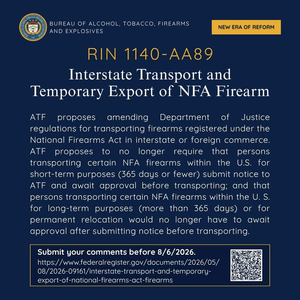
The Bureau of Alcohol, Tobacco, Firearms and Explosives (ATF) has issued a Notice of Proposed Rulemaking (NPRM) that promises meaningful relief for owners of National Firearms Act (NFA) items. Titled “Interstate Transport and Temporary Export of National Firearms Act Firearms” (RIN 1140-AA89), the proposal, published in the Federal Register on May 8, 2026, aims to modernize outdated administrative requirements under 27 CFR § 478.28 and 18 U.S.C. § 922(a)(4).
For decades, owners of machine guns, short-barreled rifles (SBRs), short-barreled shotguns (SBSs), and destructive devices have faced a cumbersome prior-approval process via ATF Form 5320.20 (Form 20) for interstate movement. This rule, part of a broader “New Era” reform package, seeks to eliminate unnecessary paperwork for short-term travel while maintaining core public safety and legality checks. Pro-Second Amendment advocates view this as a welcome acknowledgment that law-abiding citizens should not be treated as suspects for simply exercising their rights across state lines.
Current Requirements: The Form 20 Burden
Under existing regulations, individuals (non-FFLs or government entities) must submit ATF Form 5320.20 in advance for interstate transport or temporary export of affected NFA firearms. The form requires detailed information about the firearm(s), destinations, dates, and purpose. Owners must wait for ATF approval before moving the item, even for temporary trips like vacations, competitions, or hunting.
This process stems from the Gun Control Act of 1968, which prohibits transport of these items in interstate or foreign commerce without specific authorization from the Attorney General, deemed consistent with public safety and necessity. ATF uses the form to verify NFRTR registration and compliance with state and local laws at the destination. Silencers (suppressors) are exempt from this requirement, as are certain other NFA items like AOWs in many contexts.
In practice, the system has created significant delays and frustration. ATF data cited in analyses shows tens of thousands of Form 20 submissions processed over recent years, with denials often stemming from technical errors rather than substantive safety issues. For many owners, planning travel around ATF processing times has been a persistent hassle, especially for enthusiasts traveling to shooting events or ranges in neighboring states.
Key Provisions of the Proposed Rule
The proposal introduces categorical authorizations that differentiate based on trip duration:
• Short-Term Transport (365 days or fewer): No advance notice or ATF approval required. Owners may transport their lawfully registered NFA firearm interstate if it has a lawful purpose, remains legal at the destination, and they carry proof of registration (paper or electronic). This covers most common scenarios like range trips, competitions, or vacations.
• Long-Term or Permanent Relocation (more than 365 days): Submit notice via Form 5320.20 (or equivalent) at least 14 days in advance, but no waiting for approval is needed. Transport is authorized after the notice period unless ATF specifically objects.
• Temporary Export: The existing prior-approval process via Form 20 remains largely intact for foreign travel, reflecting international controls and re-importation requirements.
Additional clarifications include explicit authorization for pass-through travel through restrictive jurisdictions (provided compliance with 18 U.S.C. § 926A safe storage) and rules for common carriers, who would receive copies of registration documentation.
The rule explicitly states it does not alter underlying legality: Firearms must remain compliant with all federal, state, and local laws at every point. ATF emphasizes this change removes administrative burdens without compromising enforcement priorities.
Benefits for NFA Owners and Second Amendment Rights
This proposal represents a pragmatic reduction in regulatory friction. NFA ownership already involves strict registration, taxation, and compliance—often called the “NFA tax stamp” process. Eliminating pre-approval for short trips recognizes that the vast majority of owners are responsible citizens, not threats. ATF’s own low denial rate for substantive reasons underscores that the current system primarily generates paperwork rather than preventing crime.
For Indiana 2A Advocates and similar groups, this aligns with broader efforts to restore balance to firearms regulation. It eases burdens on collectors, competitors, and self-defense practitioners who might cross state lines. In a federal system with varying state laws, simplifying movement for lawful items strengthens the practical exercise of Second Amendment rights. Permanent moves still require notice, preserving ATF’s oversight where longer-term changes in possession occur.
Critics of overregulation will appreciate the acknowledgment that individualized approvals for routine travel are inefficient in the digital age, especially with NFRTR access for verification.
Potential Concerns and Implementation
While largely positive, some questions remain. States with strict NFA restrictions must still be respected— the proposal does not preempt local laws. Owners must ensure destinations permit the items. Enforcement details, such as what constitutes “lawful purpose” or adequate proof of registration during stops, will need clear guidance.
The comment period runs until August 6, 2026. Stakeholders should submit input via regulations.gov to refine the final rule. Concerns about potential abuse or inadequate verification could be addressed through stronger record-keeping recommendations or enhanced eForms integration.
FFLs receive explicit business-related exemptions, which is appropriate for commercial activities. Temporary export rules staying stricter makes sense due to international treaties and border security.
Conclusion
The ATF’s proposed rule on Interstate Transport and Temporary Export of NFA Firearms is a sensible reform that prioritizes burden reduction for compliant owners while upholding statutory requirements. By removing prior approval for short-term interstate travel and streamlining long-term notices, ATF moves away from treating every NFA owner as needing pre-clearance for ordinary activities.
This fits into a larger pattern of regulatory modernization under current leadership. For the firearms community, it means greater freedom to enjoy lawfully owned property without unnecessary federal hurdles. As comments are reviewed and the rule finalized, ongoing vigilance from 2A advocates will ensure it delivers on its promise without unintended consequences.
Law-abiding Americans deserve regulations that target criminals, not paperwork traps for the compliant. This proposal is a step in that direction— one that respects the Constitution’s protections while allowing effective law enforcement. NFA owners should review the full NPRM, provide constructive feedback, and prepare for easier travel once implemented.