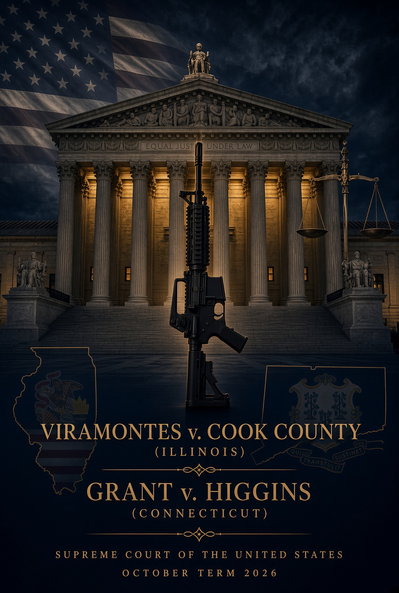
A Flood of Amicus Briefs Lands at the Supreme Court: Viramontes and Grant Draw a Massive Coalition on September 4, 2026
On Friday, September 4, 2026, the Supreme Court docket for the consolidated Second Amendment cases Viramontes v. Cook County (No. 25-238) and Grant v. Higgins (No. 25-566) filled with one of the heaviest single-day waves of amicus curiae briefing in recent gun-rights litigation. The Court had already set the cases for argument on Wednesday, December 2, 2026. The question presented is whether the Second and Fourteenth Amendments guarantee the right to possess AR-15-platform and similar semiautomatic rifles.
By the close of the day, more than a dozen distinct amicus briefs—several of them multi-party filings that themselves represent dozens of organizations, members of Congress, states, and industry actors—had been submitted in support of the petitioners. The volume is unusual even by the standards of major Second Amendment merits cases. What follows is a structured accounting of the briefs dated September 4 and the parties who signed them.
The Federal Government and the States
The most institutionally significant filing of the day was the Brief for the United States as Amicus Curiae in Support of Petitioners, submitted by Solicitor General D. John Sauer. The Trump administration urged the Court to hold that bans on commonly owned semiautomatic rifles violate the Second Amendment because governments may not prohibit arms that law-abiding Americans keep for lawful purposes.
Alongside the United States, a coalition of states filed the Brief of Tennessee, Kansas, and 25 Other States as Amici Curiae in Support of Petitioners. That filing placed more than two dozen state governments on the same side of the case as the challengers, signaling that the dispute is not merely a conflict between private plaintiffs and two blue jurisdictions.
Congress and National Advocacy Organizations
Representative Andrew Clyde (GA-09), joined by the American Center for Law & Justice and more than 60 House Republicans, filed the Amicus Brief of Members of Congress and the American Center for Law & Justice. The brief argued that treating military utility as a reason to ban a rifle in common civilian use would read the Second Amendment’s prefatory clause out of the Constitution and contradict Heller.
The National Rifle Association of America, the American Suppressor Association, and the Independence Institute filed a joint brief emphasizing historical tradition and the common-use test. A separate NRA Civil Rights Defense Fund brief also appeared on the docket the same day.
Gun Owners of America, Inc. led a large multi-organization brief that also listed Gun Owners Foundation, Gun Owners of California, the Tennessee Firearms Association and Foundation, the Virginia Citizens Defense League and Foundation, the Coalition of New Jersey Firearm Owners, Grass Roots North Carolina, the Heller Foundation, America’s Future, Citizens United and its Foundation, DownsizeDC.org and its Foundation, the U.S. Constitutional Rights Legal Defense Fund, the Conservative Legal Defense and Education Fund, and industry participants B&T USA, Century Arms, CANiK, and Fostech.
Industry, Sportsmen, and State Associations
The National Shooting Sports Foundation filed its own brief, arguing that the common-use inquiry leaves the choice of arms to the American people rather than to Cook County or Connecticut. Palmetto State Armory, LLC and the Firearms Regulatory Accountability Coalition, Inc. submitted a joint industry brief.
Hunting and conservation groups appeared as well: the U.S. Sportsmen’s Alliance Foundation and Safari Club International filed together.
A multi-state firearms-association brief listed the American Firearms Association, Illinois Firearms Association, Connecticut Firearms Association, New York State Firearms Association, Pennsylvania Firearms Association, Minnesota Gun Rights, Michigan Firearms Association, and Wisconsin Firearms Coalition. Additional association filings included Rocky Mountain Gun Owners; the New York State Rifle & Pistol Association and co-amici; and a New Jersey cluster consisting of the Association of New Jersey Rifle & Pistol Clubs, Gun Owners’ Action League, and New Jersey Firearms Owners Syndicate.
Think Tanks, Scholars, and Issue Coalitions
The Buckeye Institute filed independently. The Cato Institute also submitted a brief.
Professor William English and the Center for Human Liberty filed a brief grounded in survey and ownership data. Dr. Angus McClellan and Organizations Upholding the Second Amendment’s 1791 Meaning offered a Founding-era textual and historical argument.
Advancing American Freedom filed a coalition brief that also named American Values, the Idaho Freedom Foundation, the Independent Institute, the International Conference of Evangelical Chaplain Endorsers, JCCWatch.org, the Louisiana Family Forum, Men and Women for a Representative Democracy in America, Stand Up Michigan, Women for Democracy in America, former American Conservative Union vice chairman Charlie Gerow, former Missouri House Speaker Tim Jones, Melissa Ortiz of Capability Consulting, and retired Judge William Wagner.
A group of U.S. Senators—Ted Cruz, Jim Justice, Mike Lee, Cynthia Lummis, and Jim Risch—joined state legislators on still another brief.
Why the Volume Matters
Counting only the September 4 submissions, the Court received well over a dozen separately docketed amicus briefs. Several of those briefs are themselves coalitions. When the listed co-amici are totaled, the day’s filings represent scores of organizations, more than 60 members of the House, a large bloc of states, the Department of Justice, major industry trade groups, manufacturers, and scholars.
That concentration on a single calendar day is the story. Petitioners’ merits brief had already been filed. Respondents’ briefs are still to come. What arrived on September 4 was a coordinated demonstration that the AR-15 question has drawn the federal government, a majority of the states that chose to speak, Congress, the firearms industry, and the principal national 2A organizations onto one side of the ledger.
The briefs converge on a common theme even when they emphasize different authorities: AR-15-platform rifles are in common use for lawful purposes; categorical possession bans of that class of arms lack a historical analogue that satisfies Bruen; and lower-court attempts to recast “common use” or to treat militia-related features as disqualifying cannot be squared with Heller. Whether the Court ultimately agrees will be decided after December argument. The September 4 docket makes clear how many institutional actors intend to be heard before that day arrives.